Tuesday, 30 April 2013

Where in the World is Calgary Birder? - Clue #1

I'm heading off on an exciting trip this summer: a family vacation with lots of opportunities to see many new birds, as well as other cool wildlife.  Rather than just telling you where I'm headed, I figured it might be fun to post a few clues in the form of photos of birds that could/should turn up on this trip.

The first one should narrow down the hemisphere and continent, assuming that Alberta readers realize that this is not the bird they likely first think it is!  Feel free to post your ID's and destination guesses in the comments.


All of the images used in this series of posts are from the Internet Bird Collection, links will be posted to the original image and species pages when the big reveal is made.


Monday, 22 April 2013

Waterways of Calgary

Today's post was to have been a detailed exploration of the new Ralph Klein Park, on the south-east edge of Calgary.  My plan to spend a morning exploring this manufactured wetland was pleasantly thwarted by a call to help out with the early morning birding course at Inglewood Bird Sanctuary.  After a chilly, windy walk along the Bow River at Inglewood, I stopped by Elliston Park, Calgary's second largest body of water. Finally, with a little time to spare before meeting up with the family for a trip to the model train show, I stopped briefly at the new wetland.

The following little photo essay takes you through my morning jaunt through river, lake, and wetland.  Click on any image to view as a slideshow....
Spot the pipits!  Flocks of American Pipits, Anthus rubescens, migrate through Calgary every spring.  They are often found on gravel bars along the river and are extraordinarily well camouflaged, as these two birds show. 
In contrast to 2012, it is still cold and snowy in Calgary and many winter residents are abundant.  This Bohemian Waxwing, Bombycilla garrulus, was part of a flock that briefly flew down to the river for a drink.  This one flashed the rusty orange under its tail that helps tell it apart from its Cedar Waxwing summer cousins.
The next stop was Elliston Park where Lesser Scaup, Aythya affinis, were the most abundant species.  Here one female at centre and five males.
The males have only one thing on their minds at this time of year...
...and she is fed up with all the attention...
...but unfortunately there's no escape, even in the air - that's six males trying to box her in!
There were songbirds present at Elliston as well, including this stunning Red Crossbill, Loxia curvirostra.
The last stop I made was Ralph Klein Park, where I snapped this heavily-cropped, long-range shot of a Red-breasted Merganser, Mergus serrator, (bottom left) a regular but rare migrant through the Calgary area.  By the way, that's a pink-legged Herring Gull showing off above the two Common Goldeneyes, likely trying to mind their own business.
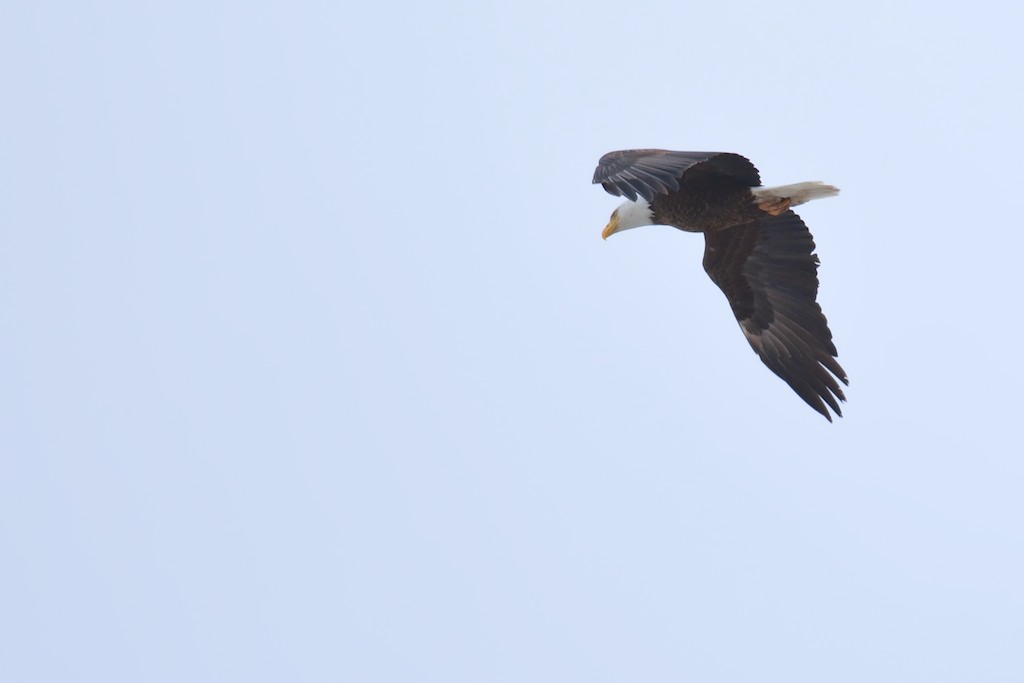
The Red-breasted Merganser didn't stick around for long as this Bald Eagle, Haliaeetus leucocephalus, flew in, flushing dozens of waterfowl and hundreds of gulls into a tower of circling noise.
Two more new birds for the year, feeding in another part of the park, were Black-necked Stilt, Himantopus mexicanus, and Greater Yellowlegs, Tringa melanoleuca.  A lovely way to end the morning's birding.

Update: Our intrepid leader for the morning, Dan Arndt of Birds Calgary, posted his images from the Inglewood outing here.  He's been playing around with a loaner Swarovski scope and digiscoping setup

Thursday, 18 April 2013

Exciting Changes to the Blog!

I've changed the look of this blog, returning it to closer to its original format for entirely selfish reasons that may nevertheless be of use to local birders....

1) On the right side of the window you'll see "BirdTrax", an amazing little application that pulls all of the sightings for a given time and region from eBird and throws them up in a handy little window.  I've set it up to do a 50km circle around Calgary for the last 14 days, although I may tweak these settings depending on how it performs (feedback appreciated as always).  If you click on the "+" sign it will link out to the eBird checklist.  Similarly under the checklists tab you can directly access individual checklists by person and location. This application doesn't currently work with Internet Explorer (but why are you using Internet Explorer?)

Still with me? ...here is a picture of a bird to maintain your interest ;)


2) Underneath the Birdtrax window is a blog list with the most recent entries to all the Alberta bird blogs that I know about, including the Albertabird listserv.  This should provide me, err, I mean, my readers with more convenient access to these key blogs, especially with Google Reader going the way of the Dodo (Passenger Pigeon, Eskimo Curlew, Ivory-billed Woodpecker, Carolina Parakeet, Labrador Duck, crap that's depressing...)

3) I've widened the blog to accommodate the BirdTrax window alongside extra-large photos.  Most people are using relatively high-resolution monitors now but let me know if you find this really irritating.

4) I'm finally going to use my Twitter account.  You can follow me @CalgaryBirder 

Congratulations on making it to the bottom of this grippingly exciting post!  Here is another picture of a bird...

Tuesday, 16 April 2013

Swans in the Air(waves)

Yesterday I posted photos from my weekend Frank/Namaka Lake excursion, including both Alberta species of swan (Trumpeter and Tundra).  The same day, I heard Brian Keating of the Calgary Zoo talking about swans on the radio!  It's a great little piece discussing the history of swans in Alberta, current threats to their population, and their ecology.  You can listen to the piece on the CBC website here: http://www.cbc.ca/homestretch/columnists/wildlife/2013/04/15/swans/
Tundra Swans, Cygnus columbianus, in a slough near Frank Lake


Monday, 15 April 2013

The Last Duck

On Saturday morning, I headed out of town hoping to get some sunshine birding before the forecast storm.  At first I beat the weather, then ran straight into it, but managed to find thirteen new species for the year, including a lifer!  I'll let the pictures tell the tale....
My first stop was the blind at Frank Lake, east of High River.  There were many American Coots, Fulica americana, calling to each other in the reeds.  This is one of a few that came into clear view.
A Horned Grebe, Podiceps auritus, was diving for food in front of the blind, along with many ducks including Common Goldeneye, Lesser Scaup, Mallard, Canvasback, and more. 
As I walked away from Frank Lake, this family of Trumpeter Swans, Cygnus buccinator, were also continuing their northward journey.
Heading north and east from Frank Lake the prairie is dotted with little marshes and sloughs.  Some were still frozen but, with no discernible pattern, others were completely open and each one had its own little birding treasures such as these Northern Pintail, Anas acuta, surely the most dapper of ducks.
It was in these prairie potholes that I completed my set of swans for the day with this pair of Tundra Swans, Cygnus columbianus.
Just north of Blackie I drove into a wall of fog and snow as the forecast storm arrived - welcome to April, Calgarians!  Pushing on to my next destination, Namaka Lake, this young Snowy Owl, Bubo scandiacus, sat forlorn in the middle of a field opposite the lake.  I'm used to seeing these owls on poles but this bird sat for the whole time I was there - I hope it is not "out of gas" on its return journey north.
The main body of Namaka Lake was completely frozen over but the south wetland was open and filled with ducks. Standing on the shore were these four Wigeon and the second from the right is a male Eurasian Wigeon, Anas penelope, the last of Alberta's 33 regularly occuring species of waterfowl for me to find!  As you can see in this image, the bird was aggressively chasing the two male American Wigeon, away from the female at right.  What's odd about this is that the female appears to be an American Wigeon as well.
When these same four birds flew off for a few laps of the lake, the female continued, to paraphrase Tammy Wynette, to "Stand By Your Interspecific Hybridizing Man".  Of course it could just be that I'm wrong about the ID on the female but after some reading it really seems like an American to me - more on Wigeon ID in a pdf article from the ABA magazine if you're so inclined.
All in all a lovely day out on the prairie, in spite of the weather.  I'm looking forward to my next wetland outing on the 21st, this time to Ralph Klein Park.

Wednesday, 27 March 2013

Taxidermy and Taxonomy at the Canadian Museum of Nature

I've been invited to contribute to the Bird Canada multi-author blog and will be writing on the 27th of each month.  My first post is up and you can read it by clicking on the image below.
Click it!  (You know you want to!)
By the way, I'll have a little more on my Ontario trip in the next little while - I'm still searching for that American Black Duck!

Monday, 18 March 2013

Weekend at Bluetail's


This past weekend Calgary Birder, Mrs. Calgary Birder and our two nestlings flew to Vancouver.  We were taking their 98 year old great-grandmother to attend her big sister's 100th birthday party!  It was a wonderful celebration and we all enjoyed the time visiting with family.  
As many as twenty Steller's Jays, Cyanocitta stelleri, at a time in our host's front yard - but these aren't the blue tails I was looking for...
Of course, I wasn't going to pass up the chance to chase the Vancouver area's current "mega" - a Red-flanked Bluetail, showing in a park in New Westminster since being discovered by Colin McKenzie on January 13th.  For the non-birding followers of this blog (or birders who have been living under a rock for the past two months) this little Eurasian flycatcher, which should be spending the winter in Indochina, is the second ever mainland North American record of this species.

I slipped out of a dark house in North Vancouver shortly before dawn and headed for Queen's Park in New Westminster.  The only birds I saw on the half hour drive were members of a huge flock of Northwestern Crows leaving their roost in Burnaby but even in the predawn light the park was jumping with activity.  American Robins and Dark-eyed Juncos were busy feeding on the ground along with, to my delight, several Varied Thrushes - a life bird before the sun had risen.

Varied Thrush, Ixoreus naevius.  Not bad views for a shy resident of the damp, dark understory.   The patterning on the feathers gives a textured quality to the plumage.
I spent about thirty minutes exploring the area around the playground, enjoying the melodic but frantic trills and buzzes of Pacific Wrens high above, before seeing a little brownish bird flicking its tail in a low shrub.  It flew a short distance, landed on a tree stump and flicked its tail again.  I brought my binoculars up and, in the dim lit of the understory, made out a faint eye-ring and what looked like reddish sides.  Almost certainly the bird but far from definitive views.  I wandered a little further north in the park and eventually relocated the bird, getting a good look and a passable identification photo.
Red-flanked Bluetail, Tarsiger cyanurus, a long way from home.
Uncropped, 420mm lens!
By this time there were a couple of other birders in the area and we chatted for a little while, enjoying the cedar trees which maybe reminded the little wanderer of the Northern Russian forests where it should be heading to breed at this time of year.  With limited views of the Bluetail and a deadline to be back in North Vancouver, I decided to head back through Vancouver and try to find a Brambling reported in the Fairview neighbourhood.  Thanks to a great set of directions from Dave Ingram over at Island Nature, I had no problem finding the right alley and backyard where another birder was quietly peering through the brambles.  

"Brambling was here until 10 minutes ago"  

Oh.  

"Apparently it's often only seen before 9 or 10 in the morning"

Uh-oh.

I stuck around in the rain for as long as possible - about forty-five minutes - but no sign of the Brambling.  What we did enjoy was a great selection of west coast songbirds: Song Sparrow, Pine Siskin, Golden-crowned Sparrow, Fox Sparrow, House Finch, Black-capped Chickadee, House Sparrow, and both the Slate-coloured and Oregon subspecies of Dark-eyed Junco.  To wrap things up, here are a few shots of those birds....
"Sooty" Fox Sparrow, Passerella iliaca unalaschcensis
"Oregon" Dark-eyed Junco, Junco hyemalis
Song Sparrow, Melospiza melodia