Showing posts with label Sparrows. Show all posts

Tuesday, 15 May 2012

Gulf Island Passerines

This is the second in a series of posts on my recent Gulf Islands sailing trip.  You can find Part 1 here.

The Gulf Islands are dotted with parks and protected areas, both marine and terrestrial.  The flagship park is the Gulf Islands National Park Reserve which was established in 2003 and covers 36 square kilometres of land scattered around the islands.  There are also eight provincial parks, including Montague Harbour where we spent one night on the trip.  Of course all of these protected areas, with thick forests and dense shrubbery, provide rich habitat for bird life.
Spotted Towhee, Pipilo maculatus, love tangled overgrown shrubbery so they love the Pacific Northwest.  They call "Drink TEA" and occasionally pop up to more visible perches to sing, look around, or be photographed.
Russell Island is a small island off Saltspring entirely held under the Gulf Islands National Park.  We woke up in this anchorage to hear Pacific Wrens singing across the water and found this Orange-crowned Warbler, Oreothlypis celata, during a hike around the trails.
Golden-crowned Sparrows, Zonotrichia atricapilla, are common on the coast but this was a new species for me when I spotted this one mixed in with a flock of White-crowned Sparrows.
Here's one of the aforementioned White-crowned Sparrows, Zonotrichia leucophrys, a few weeks before they show up in Calgary.
I know this is not a passerine, but I wanted to include this Rufous Hummingbird, Selasphorous rufus, as it was another bird that succeeded in drawing the interest and admiration of my crowd of non-birding teenagers.
Those are few of the smaller birds that we saw on our trip but the hummingbird was not the bird that most wowed the crowd, as we'll see next week....

Sunday, 13 May 2012

Sparrows of South Calgary with Friends of Fish Creek

For this week's birding course our group met in the extreme south of the city.  Here the suburbs are quickly consuming the prairie along the Bow River and the landscape is rapidly changing.  A state-of-the-art water treatment plant has just been completed next to the new freeway bridge.  Two housing developments are being expanded, one on each side of the river, and a new golf course abuts the provincial park boundary.  We explored a strip of land that is being preserved against the river, where there are some decent sized islands providing refuges of habitat for various species.  Here's a map of our route:


View Pine Creek FFCPP Birding in a larger map

We enjoyed observing Ospreys and Bald Eagles nesting and feeding along the river but the highlight was probably the sparrows.  There were four species observed by the group and we had great practice identifying them by sight and sound.  I've included a photo of each along with an embedded sound file from the Xeno-Canto public archive.
The Clay-coloured Sparrow is often tricky to see and is easily identified by its call - a series of insect-like buzzes.  The unstreaked breast, grey nape, and buffy feathers behind and below the eye are good field marks visible in this photo.


There were lots of Savannah Sparrows, which are more visible than the other species often singing from the tops of fence posts or grass stalks.  Their song, a mixture of chirps and buzzing sounds tells us to "take, take it EAAAZZZY"!
 

This Song Sparrow popped into view close to the Clay-coloured pictured above.  Why isn't this another Savannah Sparrow? The lack of the yellow spot above the eye, the longer tail and the larger bill are all reasonable field marks but again what is distinctive is its voice.  These birds start with 2-4 distinct tones and then sings a lazy trill of notes.
  
The Vesper Sparrow was our last sparrow of the morning.  I heard one singing far off in the distance and eventually another member of the group picked out a bird several hundred metres away on top of a rock.  After setting up the scope we were able to confirm Vesper Sparrow with a similarly fuzzy image to the one above (which was actually taken near Strathmore on last year's May species count).  The song of the Vesper Sparrow often starts with one or two pairs of clear even-toned notes followed by a fast musical trill.Larkwire rather charmingly translates this as "oh, oh, my, my, it's-such-a-beautiful-day"

Sunday, 11 March 2012

An Interesting Post About House Sparrows... no, really.

Not much time for blogging or birding this week, due to report cards.  I did manage to head out with a group to look for Northern Flying Squirrels on Friday night but we dipped out and settled for a Ruffed Grouse, feeding just a few yards away in near darkness.  If you are looking for some bird-related reading check out this very interesting article about House Sparrows on the Smithsonian Magazine website.  These birds are extraordinarily widespread and Calgary has the dubious distinction of the highest Christmas Bird Count total in North America, so it behooves us to learn a little about them even if they aren't everyone's favourite bird.
The ubiquitous House Sparrow, Passer domesticus, on our feeder
A fairly terrible photo of the aforementioned Ruffed Grouse, Bonasa umbellus.  This is a 1/2 second exposure, f4 at 300mm with ISO 3200 - it was REALLY dark!

Saturday, 16 July 2011

Victoria Songbirds

To wrap up the West Coast vacation posts (previous posts here and here), here are a few shots of birds taken in Victoria and elsewhere on the Saanich Peninsula.  As usual, all photos can be clicked to enlarge.

Violet-green Swallow feeding young at nestbox at the Butchart Gardens
Dark-eyed Junco, "Oregon" variety, also at the Butchart Gardens
A very poor photo, included only because it was a life bird! - A Bewick's Wren in shrubby pathway area in Victoria
In the same general location, another denizen of photography-challenging dark shrubs and leaf litter, one of many Spotted Towhee
The poorly named Pelagic Cormorant at Sidney docks
Female Anna's Hummingbird, one of several fighting over my Aunt and Uncle's feeder


Thursday, 14 July 2011

Juveniles at Frank Lake

I returned from Vancouver Island to find my backordered digiscoping bracket waiting for me.  The bracket attaches a point-and-shoot camera to the eyepiece of my scope and has a cable release for vibration free pictures.  I headed to Frank Lake, just east of High River to try it out.
Savannah Sparrow, Passerculus sandwichensis 
As would be expected there were many Savannah Sparrows in the grassland around the lake, as well as two Common Ravens being mobbed by a mixed flock of blackbirds (both Red-winged and Yellow-headed were present in large numbers around the lake).

By the time I reached the hide I realized that digiscoping was going to be somewhat unnecessary - close encounters were to be the order of the day.  Franklin's Gulls were standing on the pathway to the hide, and several Yellow-headed Blackbirds fed juveniles in the reeds beside the boardwalk.  A pair of Forster's Terns were also nesting nearby as one repeatedly flew at my head.  A family of Coots had their nest six feet from the path and swam about happily a little further away while I set up the scope.
American Coot (and 2 very funky looking chicks!), Fulica americana
I spent a little over an hour in the hide while several adult and juvenile Eared Grebes swam about in the reeds.  Further out on the lake, Western Grebes could be seen, including some young.  The distinctive silhouettes of White-face Ibis flew past three times, and a pair of Barn Swallows repeatedly flew up to the window to see who was intruding on their territory.  A pair of Lesser Scaup also landed in front of the hide and the male chased the female around in circles, repeatedly biting her neck until he finally mounted her, pushing her almost completely under the water.  It was easy to see how competitive breeding can, in some cases, kill female dabbling ducks.
juvenile Eared Grebe, Podiceps nigricollis
All in all a pleasant afternoon with 19 species seen at the lake.  I'm looking forward to playing around with the digiscoping some more over the summer.

Monday, 30 May 2011

Calgary May Species Count

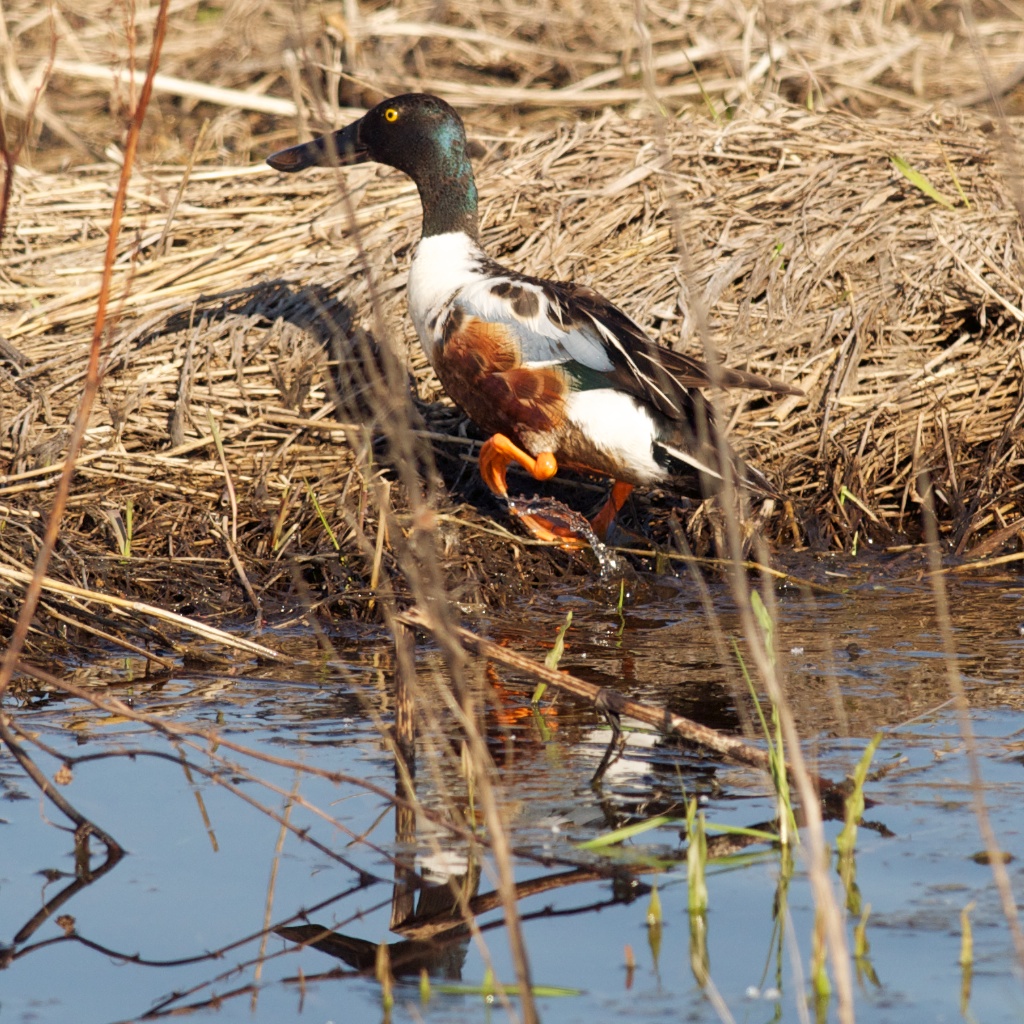
This weekend brought the annual spring species count - a team of birders fanning out to count all the bird species within an 80km radius of Calgary.  My partner and I were assigned an area north of Strathmore - a fairly unremarkable stretch of rolling prairie that was nonetheless filled with birds and we managed to round up 61 species on a lovely sunny day of birding.  The sloughs were filled to the brim from the past week of rainy weather so duck counting was a large part of the day with many Mallards, Gadwall, American Wigeon, Blue-winged Teal, and Northern Shovelers.
Northern Shoveler, Anas clypeata, looking a little goofy
Last week, when we drove out to Kinbrook Island, we had seen lots of hawks in the area immediately east of Strathmore so I was expecting more good things today.  We saw a total of 14 Swainson's Hawks and 7 Red-tailed Hawks, some at very close distances as they performed aerial courtship displays, and some on or around nests.  Another raptor highlight was a Northern Harrier, easily identified by its trademark low altitude hunting across a field and along a roadside ditch.  For one heart-stopping moment we thought that the hawk was going to be hit by a passing truck but fortunately it continued its leisurely glide to the other side and then circled around to make another close pass behind us.
Swainson's Hawk, Buteo swainsoni
There were relatively few shorebirds to be found, perhaps due to high water levels, but we did see a number of Marbled Godwits, several Wilson's Snipe, and a huge flock of Wilson's Phalaropes.  We also found a Long-billed Curlew which was very cooperative while we admired the cinnamon belly through the scope and double checked our field guide.
Wilson's Snipe, Gallinago delicata
Long-billed Curlew, Numenius americanus, Digiscoping skills are slowly improving!
Birding by ear is not an area of strength for me but I had lots of practice and a good teacher on this trip.  We found many sparrows including Savannah, Clay-coloured, Vesper, Lark and Chipping, but the "small bird" highlight for me was a large flock of Cliff Swallows swooping around our heads and under us through a culvert!  Just a short distance down the road from that experience we found three Horned Larks, another new bird for me.
Horned Lark, Eremophila alpestris
Another great day out on the prairie and I found once again that participating in a bird count is a wonderful way to hone one's birding skills.  I'll wrap this post up with a map of the route we took through the area and a list of species seen.

1 Canada Goose
2 Gadwall
3 American Wigeon
4 Mallard
5 Blue-winged Teal
6 Cinnamon Teal
7 Northern Shoveler
8 Northern Pintail
9 Canvasback
10 Redhead
11 Lesser Scaup
12 Bufflehead
13 Common Goldeneye
14 Ruddy Duck
15 Ring-necked Pheasant
16 Pied-billed Grebe
17 Horned Grebe
18 Eared Grebe
19 Great Blue Heron
20 Northern Harrier
21 Swainson's Hawk
22 Red-tailed Hawk
23 American Kestrel
24 Merlin
25 American Coot
26 Killdeer
27 American Avocet
28 Willet
29 Spotted Sandpiper
30 Long-billed Curlew
31 Marbled Godwit
32 Wilson's Snipe
33 Wilson's Phalarope
34 Rock Pigeon
35 Mourning Dove
36 Least Flycatcher
37 Western Kingbird
38 Eastern Kingbird
39 Black-billed Magpie
40 American Crow
41 Horned Lark
42 Bank Swallow
43 Cliff Swallow
44 Barn Swallow
45 House Wren
46 Marsh Wren
47 American Robin
48 European Starling
49 Yellow Warbler
50 Chipping Sparrow
51 Clay-colored Sparrow
52 Vesper Sparrow
53 Lark Sparrow
54 Savannah Sparrow
55 Red-winged Blackbird
56 Western Meadowlark
57 Yellow-headed Blackbird
58 Brewer's Blackbird
59 Brown-headed Cowbird
60 American Goldfinch
61 House Sparrow

Monday, 23 May 2011

Kinbrook Island Provincial Park

We've just returned from a great long weekend camping trip to Kinbrook Island Provincial Park near Brooks, which is about 200km south-east of Calgary.  The park is on the east shore of a large reservoir,  Newell Lake, and the campground is basically an island covered in poplar trees and surrounded by marsh.  The existence of these three habitats together in the middle of vast prairie grassland is, as you can see below, a real bird magnet.

In the campground there were several species of flycatcher ranging from the easily identified and bold to the tricky and hyperactive.  (As usual all photos in the post are click to enlarge!)
Western Kingbird, Tyrannus verticalis

Eastern Kingbird, Tyrannus tyrannus

Least Flycatcher, Empidonax minimus - OK, I heard several Least Flycatchers, this bird was close by, and it looks like a Least Flycatcher but those empids are tricky!
A birding highlight of the weekend came while I was washing breakfast dishes.  There was a flurry of activity in the understory.  A group of 4 male Brown-headed Cowbirds chasing one female were displaying to each other on branches and, ultimately, on the grass about ten yards in front of me.
Brown-headed Cowbird, Molothrus ater

Brown-headed CowbirdMolothrus ater
There are nice walks (if you aren't freaked out by bugs like our 3 year old!) around the marshes, including an interpretive trail around the northeast area that was a little long for our crew of preschoolers.  The dominant species in this area is Red-winged Blackbirds, but spaced out among these territorial birds were Yellow-headed Blackbirds and a large number of Marsh Wrens.
Marsh Wren, Cistothorus palustris

Yellow-headed Blackbird, Xanthocephalus xanthocephalus
During one of these walks we bumped into a group of birders doing the 13th Annual Brooks Species Count.  They commented on the lack of shorebirds, an observation supported throughout the weekend and the drive back to Calgary (one yellowlegs, one snipe, and three large shorebirds on a far off muddy field was all I saw).  I was generally surprised by the lack of birds on the main bodies of water in the park but along with the usually half dozen species of duck we did see Red-necked Grebes, Forster's Tern, and some American White Pelican.
American White Pelican, Pelecanus erythrorhynchos, displaying breeding season "horn"
This relative lack of species on the open water was entirely compensated for by the continual displays of flycatchers, Tree Swallows, Yellow Warblers, blackbirds, sparrows, and ever-friendly American Robins around the campsite.  I would highly recommend this campsite as a destination for the birding-inclined camper or any family looking for a prairie getaway.

In total, 48 species were seen on the weekend getaway and a birder working the area in a more focused way would have no trouble finding many more.  For those interested here's the list of species seen either at Kinbrook or in the immediate Brooks area:


Canada Goose Branta canadensis
American Wigeon Anas americana
Mallard Anas platyrhynchos
Blue-winged Teal Anas discors
Northern Shoveler Anas clypeata
Northern Pintail Anas acuta
Redhead Aythya americana
Lesser Scaup Aythya affinis
Ruddy Duck Oxyura jamaicensis
Red-necked Grebe Podiceps grisegena
American White Pelican Pelecanus erythrorhynchos
Northern Harrier Circus cyaneus
Swainson's Hawk Buteo swainsoni (on nest)
Red-tailed Hawk Buteo jamaicensis
American Coot Fulica americana
Yellowlegs sp. Tringa sp.
Wilson's Snipe Gallinago delicata
Ring-billed Gull Larus delawarensis
Forster's Tern Sterna forsteri
Rock Pigeon Columba livia
Mourning Dove Zenaida macroura
Great Horned Owl Bubo virginianus (adult with two fledglings)
Northern Flicker Colaptes auratus
Least Flycatcher Empidonax minimus
Western Kingbird Tyrannus verticalis
Eastern Kingbird Tyrannus tyrannus
Black-billed Magpie Pica hudsonia
American Crow Corvus brachyrhynchos
Common Raven Corvus corax
Tree Swallow Tachycineta bicolor (on nest - tree cavity)
Barn Swallow Hirundo rustica
Marsh Wren Cistothorus palustris
American Robin Turdus migratorius (on nest)
Hermit Thrush Catharus guttatus
European Starling Sturnus vulgaris
Yellow Warbler Dendroica petechia
Common Yellowthroat Geothlypis trichas
Chipping Sparrow Spizella passerina
Clay-colored Sparrow Spizella pallida
Vesper Sparrow Pooecetes gramineus
Song Sparrow Melospiza melodia
Red-winged Blackbird Agelaius phoeniceus
Western Meadowlark Sturnella neglecta
Yellow-headed Blackbird Xanthocephalus xanthocephalus
Brewer's Blackbird Euphagus cyanocephalus
Brown-headed Cowbird Molothrus ater
Baltimore Oriole Icterus galbula
House Sparrow Passer domesticus

Saturday, 14 May 2011

Return to Inglewood

A breezy but sunny morning greeted me as I headed out on Saturday morning for a second trip to Inglewood Bird Sanctuary in as many days.  After the success of Thursday's trip I wanted to see what I could find early in the morning and also join the BirdsCalgary group for the first part of their Big Sit.  The first sighting of note was a Swainson's Hawk flying low across the open field and then landing in the line of spruce trees that separates the field from the lagoon.  I took a guess at where it was likely to be found in the tree line and stuck my head out between the trees.  At first it seemed like the hawk was gone, until I looked right up beside me and had a big surprise.  You might think the hawk would be surprised too but there was no alarm call, no fluffed up feathers and no gaping - just "beautiful buteo" about 5 yards away from me.
Swainson's Hawk, Buteo swainsoni

In the woods on the far side of the lagoon I found "first of year" Tree Swallows which were very vocal and chasing each other on and off perches in the tallest snags.
Tree Swallow, Tachycineta bicolor
Directly below all of this dogfighting I heard a rustling in the leaf litter.  Initially discounting it as another one of the many American Robins that kept hopping across the trail it seemed a little too quiet and a little too close.  With a little persistence I made out the following spectacularly helpful view.

Given recent reports of White-crowned Sparrows, I played that call note on my iPhone to no response.  The call of a White-throated Sparrow elicited a very different reaction - the sparrow shot up onto a branch over the trail.  As if to say, "I hear your call and raise you" he performed several refrains of "Oh-sweet-Canada-Canada-Canada" and then returned to foraging in the undergrowth.  You can hear the call at Xeno-Canto
White-throated Sparrow, Zonotrichia albicollis

Saturday, 7 May 2011

McDonald Lake - 100 Alberta Birds and Counting

McDonald Lake is just north of the city limits in an area of rapid commercial/retail development next to the now defunct Balzac Gas Plant.  I heard about this waterfowl hot spot at the Bird Study Group meeting earlier this week and took a couple of hours this afternoon to check it out.  There was some discussion at the meeting regarding access but it is currently very straightforward - north on the new Metis Trail from Stoney Trail, right on the first "Crossiron" street (Crossiron Boulevard?) and then park on the dirt road behind the huge Walmart distribution centre - basically right by the lake.  Don't bother with google maps if you are trying to figure this out - things are changing so rapidly that it currently shows the distribution centre as a big pile of dirt and shows Metis Trail as not yet going to Crossiron Mills!

Before I even arrived at the lake there were signs this was going to be a good afternoon of birding.  A Swainson's Hawk chased two pigeons across Highway 2 and landed right between the Stoney Trail off-ramp and the freeway, clutching one of the pigeons in its talons.  I wasn't aware that Swainson's Hawks took pigeons but a little research confirms this is the case and I guess when you've just flown in from Argentina you'll take what you can get!

I parked near the lake and walked across the short grass closer to the shore, flushing three Savannah Sparrows, one of which landed a short distance away and sang from the top of a tall blade of grass.  One of the first birds I saw on the lake was a magnificent male Ruddy Duck which becomes my 100th Alberta bird.  There were great scope views to be had, but no photo so I include the following from the Flickr Creative Commons site.

Ruddy Duck

The were many other species to be seen including Redhead, Bufflehead, Northern Pintail, Ring-necked Duck and Lesser Scaup (the dominant duck species).  Curiously this was the first time I have ever been to a wetland in Alberta and seen no Common Goldeneye or Mallard or Canada Goose.  There were at least 50 Eared Grebes as well as a half dozen Horned Grebes.  In breeding plumage these weren't too hard to tell apart, especially with views like this:
Three Eared Grebes, Podiceps nigricollis (behind) and one Horned Grebe, Podiceps auritus (front and centre)
Standing out amongst all these ducks and grebes were the only shorebirds of the day - three American Avocet looking a little tired and windswept.
American Avocet, Recurvirostra americana
As I drove back down Metis Trail I pulled over to see my first Brewer's Blackbirds of the year, foraging beside the road and on a dirt pile in the field.
Brewer's Blackbird, Euphagus cyanocephalus 
A little further down the road was a small slough with a bunch of old wrecked cars. A Red-winged Blackbird was staking out his territory from the top of a rusty, half-submerged tractor. He was content to continue serenading a few yards away while I sat and admired three pairs of Northern Shoveler and a pair of Gadwall.

I headed home by looping around the east edge of the city, stopping at a another small slough near the East Calgary Landfill to pick up Franklin's Gulls, American Wigeon, and Canvasback to round out the day's list.

Many thanks to the Bird Study Group presenters for the tip and the resulting fun afternoon of birding.

Saturday, 2 April 2011

Owls and Pintails at Frank Lake

On Friday, I took advantage of a March break day off and headed out to Frank Lake, just east of High River to catch sunrise and hopefully some of the reported Short-Eared Owls.  Despite the struggle to haul myself out of bed, I'm confident I made the right choice based on the 15-20cm of snow I'm looking at out of the window as I write this post!  And besides, sunrises are pretty spectacular...

Sunrise, Frank Lake, AB
I started out at the south-east access point to the lake (Marked as "A" on the Google Map below).  The track was flooded past the last farmhouse so I walked a short way on foot.  Thousands of Northern Pintail were congregated in the ponds on either side of the road.  They were taking off in huge flocks, circling around and landing in neighbouring fields.  Their flight is quite elegant with their narrow pointed wings and when small groups flew past it was possible to hear the flight feathers of individual ducks cutting through the air.

View Frank Lake Birding in a larger map
There had been no owls in sight on the way to the lake so I was thrilled when I turned around to head back to the car and saw a Short-eared Owl take off from a utility pole and glide across the field, circling once before disappearing over a low ridge.  Moments later a pair of Gray Partridge flushed from the field beside the road, landed a few hundred yards away, and then did a poor job of trying to be inconspicuous with a red-orange face among the yellow stubble.
Gray Partridge, Perdix perdix
After this excitement it was time to move on to the other side of the lake.  Enroute ("B" on the map), this Rough-legged Hawk caught my eye and seemed quite happy to finish his meal while I pulled over and set-up to try digiscoping.  As you can see, holding my point-and-shoot up to the eyepiece is not working all that well - results are comparable to shooting with my 300mm lens on my SLR and then cropping down to the 1600mm equivalent magnification of the scope.  It's okay for a stop-gap measure and I'll look into a proper bracket in the future.
Rough-legged Hawk, Buteo lagopus
Further down the road (C and D) on the map there were several more small sloughs that afforded close-up views of more Pintails and a pair of Tundra Swans.
Northern Pintail, Anas acuta
Northern Pintail in flight
Tundra Swan, Cygnus columbianus
Arriving at main Frank Lake access, I parked at the gate and walked down the track.  An American Tree Sparrow popped into view in the grass, gave a couple of short songs then vanished into the tussocks of grass.  Much of the lake was frozen but the open water on the south side of the track contained a great variety of waterfowl species including Canada Goose, Mallards, and Common Goldeneye with a seriously skewed sex ratio that was leading to the few females being swarmed by frantically head-bobbing males.  There was also a lonely looking Bufflehead among a few RedheadsCanvasbacks and Scaup spp.  Seeing these last three together, at times literally in the same field of view through the scope, was a great help in sorting out their identification.

On the way out, I bumped into another member of the Albertabird community.  We traded notes and he put me on to a Great Horned Owl nest.  For obvious reasons, I didn't want to walk away from the car for photos but admiring the pair, one on the nest and one in nearby tree was a fantastic way to cap off the day.

Thursday, 24 March 2011

West Coast Sailing 3: LBJ Confusion

I know I’m not the only beginning field birder who is challenged by the “little brown jobs”.  I had a few hours birding around Victoria in February and was able to locate a lifer Spotted Towhee.  White breast, red flanks, black back and hood – straightforward enough.  Unfortunately this particular Towhee was feeding in a flock of several dozen sparrows which included such species as "the one with brown stripes", "the one with tan stripes", and "the one with brown and tan streaks".


Clearly an area that I need to improve if I want to get more serious about understanding sparrows and their behaviours, not to mention building my life list.  This issue was brought to a head when we took a hike on Russell Island, just off the south-east of Saltspring Island.  At the old homestead on the tip of island we found several American Robins along with some Dark-eyed Junco's (Oregon) and two of these guys.


This individual was very obliging in hopping out onto a branch in clear view in response to a quick "pishing" noise.  I grabbed my field guide back on the boat and quickly came to the excited conclusion, base on the white throat and yellow supraloral spot that this was an uncommon White-throated Sparrow.  Hmmm.... but the breast was just a little bit too streaky and those malar stripes are pretty dark.  I went home feeling less than comfortable with the ID.  


On the weekend, with my full library on hand, I had a look through the excellent "Sparrows of the United States and Canada: The Photographic Guide" by Beadle and Rising.  The photos available in that publication, combined with Sibley's description of the Song Sparrow as being "common and widespread in brushy areas near water", leads me to believe that Song Sparrow is the correct ID.  


Whether or not that ID is correct, I take three things away about LBJ identification from this experience:


1) Learn birdsongs
2) Get out with more experience birders more often
3) Accept that not every bird seen can be identified


Any confirmation, feedback, or tips for dealing with "little brown jobs" are welcome in the comments.