Showing posts with label Alcids. Show all posts

Thursday, 10 May 2012

Boiling Reef

At the end of April, I took my Grade 9 class on their West Coast sailing trip to British Columbia's Gulf Islands.  Like last year, I thought it would be interesting for you if I featured a few of the birds and birding hotspots that we saw during the trip.  Once again the students were unsurprisingly bemused by my birdwatching but I think I made a few connections.  At least two or three students were getting very good at identifying seabirds by the end of the trip and were doing so without any prompting from me.  We also found a beautiful Townsend's Warbler which hung around on a low branch long enough for one teenager to say "OK, I guess that's pretty cool looking"!  Progress?

The warbler was on Tumbo Island, part of the Gulf Islands National Park Reserve, just a short distance from Boiling Reef where we went to look for sea lions, porpoises, and a diverse collection of seabirds.  As you can see from the map below, the reef sits right at the convergence of currents where the tides empty and fill the Strait of Georgia.  This twice daily flow stirs up nutrients creating a rich feeding ground for all types of marine life.


View Boiling Reef Location in a larger map

The currents were in full flow when we were there, creating surging whitewater between the lighthouse on the point of Saturna Island and the reef, which was covered in Stellar's Sealions.  The loud and smelly marine mammals were certainly the most obvious life to be seen but porpoises were busy feeding between hundreds of bobbing seabirds.  Among the birds, alcids were probably the most common group of species.  These are sometimes described as the penguins of the north, swimming underwater with powerful wing strokes to propel them along in pursuit of prey, and I managed to get half-decent shots of three species during the trip (some not taken right at the above location - click images to enlarge)
Pigeon Guillemot, Cepphus columba, after a successful hunt
Common Murre, Uria aalge, this is a first year plumage bird (according to Mr. Sibley!)
Rhinoceros Auklet, Cerorhinca monocerata, - most of the alcids would dive as the boat approached and surface hundreds of metres away so it was nice to see a few in flight showing off their plumage
Alcids may have provided the diversity but it was the gulls that provided the numbers, specifically thousands of Bonaparte's Gulls rafting up and flying around in huge flocks as they prepared for their spring migration.  A little further to the north, in Active Pass, we sailed through a single tightly grouped flock which had, at a very conservative guess, 5000-7000 individuals.
It's nice to have friends - one of these Bonaparte's Gulls has lost a contact lens! (Actually they are feeding on small organisms on the surface of the water that have been stirred up by the current, which is more scientific but less funny.)
There were also some life birds to be had in the area as well.  Among the many sea ducks were White-winged Scoter, a new species for me, along with Surf Scoter.  Perhaps most exciting were Long-tailed Ducks which felt like a life bird as my previous "tick" had been long range scope views of a female in winter plumage on Glenmore Reservoir.
Oh, that's why they call it a Long-tailed Duck!
So those are some highlights of the impressive diversity of nearshore seabirds that we saw on our trip.  I'll follow-up with some passerines and more familiar landbirds in the coming weeks.

Tuesday, 5 July 2011

West Coast Whale Watching

Time for a second trip to the West Coast, previously with students, this time with family.  We started our trip in Victoria and took a whale watching tour with "Prince of Whales" on Canada Day.  We had great luck with our trip - Orcas ("Killer Whales") were right outside the Victoria Harbour.  There was a second group near San Juan Island and, on our return trip, we found the first pod again, this time breaching right out of the water.


Oh yeah, and we saw some birds too, including Rhinoceros Auklet, Pigeon Guillemot, Pelagic Cormorant, Common Murre, and of course, Bald Eagle.

Friday, 29 April 2011

Puffins and Petrels in Peril

Three years ago we visited Newfoundland for our first family vacation with our son.  The birding and wildlife watching were highlights of the trip and among our best experiences was a tour of the Witless Bay Ecological Reservejust half an hour south of St. John’s.  The reserve consists of four islands with large concentrations of nesting seabirds, notably Black-legged Kittiwakes, Atlantic Puffins, Common Murres, Razorbills, and other alcids.  We took a boat tour with the excellent O’Brien’s Whale and Bird Tours and before getting to the principal point of this post, here’s a sampling of what we saw that day. (All images clickable for full size)
Atlantic Puffins nesting in burrows - suitable island or sea stack habitat is critical so birds are protected from predators such as foxes or coyotes

"On the third day in Newfoundland my true love gave to me: three Atlantic Puffins, two Common Murre, and a Razorbill carrying capelin."

Not just about the birds: Humpback Whale beginning a deep dive

Black-legged Kittiwake family

Hundreds of thousands of nesting birds - here mostly Common Murre and Kittiwakes - this image definitely worth clicking to enlarge
Unfortunately, there is a potential threat to this ecological treasure in the form of a proposed new housing development near the island.  Artificial light sources can have a significant impact on the movement of wildlife at night and young birds, just leaving the nest and learning to fly, may be particularly vulnerable as they can easily become disoriented.  I came across this article on the ABA (American Birding Association) website earlier this week which details the issue and suggests potential courses of action.  If you have been to this reserve, would like to go one day, or just enjoy seabirds and are concerned about maintaining healthy populations, I encourage you to click through and make your voice heard. 

Tuesday, 22 March 2011

West Coast Sailing 2: Seabirds Feeding

As we cruised around the Gulf Islands there was lots of chance to practice some seabird identification.  Brant are moving through the area at the moment and six birds sat on the water in a open channel between two islands.  They allowed us to approach quite close before taking off to the north, flashing the white “V” on their rumps. 

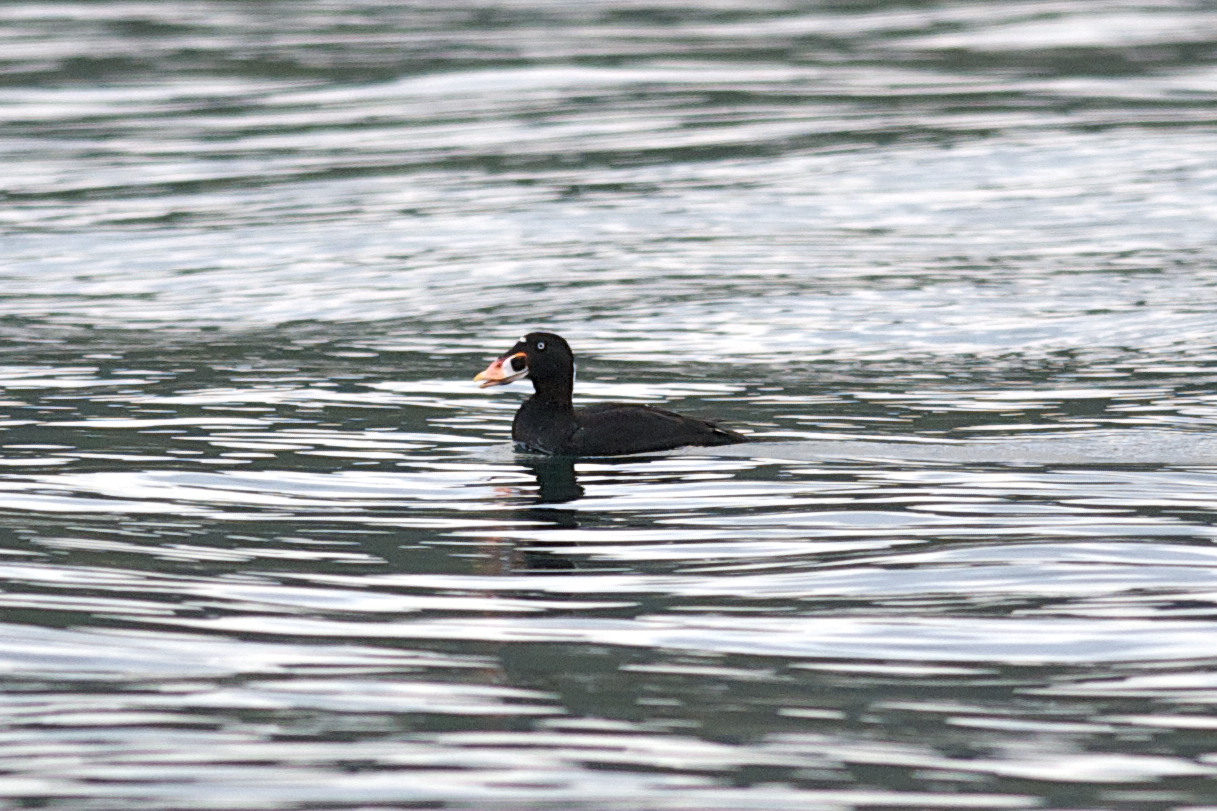
While I didn’t manage to get a picture of the Brant, I did have lots of opportunity to watch this Surf Scoter feeding on the edge of the dock where we moored on the third night.  The bird was plucking mussels off the concrete below the waterline and crunching down with that wonderful multicoloured beak.


Surf Scoter, Melanitta perspicillata

Another treat was Rhinoceros Auklets.  There were several rafts of these little alcids particularly around Swartz Bay and Fulford Harbour.  I wasn’t able to see any with fully developed horns but their “whiskers” stood out against their black plumage.  Pigeon Guillemots and Common Murres were also distinctive and were actively fishing – bobbing along on the surface then spreading their wings and quickly diving below the surface.
Pigeon Guillemot, Cepphus columba
As could be seen from my previous post, South Pender Island was a great spot for bold birds that seemed accustomed to people up close.  This female Red-breasted Merganser was peeking under the water then popping her head up to check that I wasn’t getting too close for comfort.  The ID of Red-breasted comes from the punk mohawk this bird is sporting.  The female Common Merganser is basically the same, minus mohawk.  If you feel I’m off on this identification, please let me know in the comments – it’s all part of the learning process!
Red-breasted Merganser, Mergus serrator 
More in two days – this time on to the infamous “LBJ’s”