Let's start with a typical spring bird count scene - identify these four duck species, click to enlarge if needed....
Answers at the bottom of this post!
Having missed last year's spring bird count I was excited to get out again this year. I spent about six hours exploring my fairly nondescript section of prairie north of the town of Strathmore. It's marked as area 32 on the image below...
The wet and windy weather made finding songbirds somewhat challenging, although a surprise Rose-breasted Grosbeak showed up in a little clump of woodland. The wetland birds were easy to find though, with the highlight being a slough with eight Double-crested Cormorants and seven Hooded Mergansers on the water along with an amazing eight Great Blue Herons and three Black-crowned Night-herons all lined up in less than a hundred yards of shoreline - I guess someone is keeping the fish stocked up!
Here are a few more photos from the day's count:
Black Tern, Chlidonias niger, not actually all that black but agrees that the weather is pretty crappy ;)
Wilson's Snipe, Gallinago delicata, more proof that Mother Nature has a sense of humour
Three Bank Swallows, Riparia riparia, arguing over personal space
Black-bellied Plover, Pluvialis squatarola, something of a spy shot of one of the day's rarer finds
I didn't see any Black-necked Stilts, Himantopus mexicanus, in the count area but this beauty was feeding by the road on the way home.
Yesterday I posted photos from my weekend Frank/Namaka Lake excursion, including both Alberta species of swan (Trumpeter and Tundra). The same day, I heard Brian Keating of the Calgary Zoo talking about swans on the radio! It's a great little piece discussing the history of swans in Alberta, current threats to their population, and their ecology. You can listen to the piece on the CBC website here: http://www.cbc.ca/homestretch/columnists/wildlife/2013/04/15/swans/
Tundra Swans, Cygnus columbianus, in a slough near Frank Lake
On Saturday morning, I headed out of town hoping to get some sunshine birding before the forecast storm. At first I beat the weather, then ran straight into it, but managed to find thirteen new species for the year, including a lifer! I'll let the pictures tell the tale....
My first stop was the blind at Frank Lake, east of High River. There were many American Coots, Fulica americana, calling to each other in the reeds. This is one of a few that came into clear view.
A Horned Grebe, Podiceps auritus, was diving for food in front of the blind, along with many ducks including Common Goldeneye, Lesser Scaup, Mallard, Canvasback, and more.
As I walked away from Frank Lake, this family of Trumpeter Swans, Cygnus buccinator, were also continuing their northward journey.
Heading north and east from Frank Lake the prairie is dotted with little marshes and sloughs. Some were still frozen but, with no discernible pattern, others were completely open and each one had its own little birding treasures such as these Northern Pintail, Anas acuta, surely the most dapper of ducks.
It was in these prairie potholes that I completed my set of swans for the day with this pair of Tundra Swans, Cygnus columbianus.
Just north of Blackie I drove into a wall of fog and snow as the forecast storm arrived - welcome to April, Calgarians! Pushing on to my next destination, Namaka Lake, this young Snowy Owl, Bubo scandiacus, sat forlorn in the middle of a field opposite the lake. I'm used to seeing these owls on poles but this bird sat for the whole time I was there - I hope it is not "out of gas" on its return journey north.
The main body of Namaka Lake was completely frozen over but the south wetland was open and filled with ducks. Standing on the shore were these four Wigeon and the second from the right is a male Eurasian Wigeon, Anas penelope, the last of Alberta's 33 regularly occuring species of waterfowl for me to find! As you can see in this image, the bird was aggressively chasing the two male American Wigeon, away from the female at right. What's odd about this is that the female appears to be an American Wigeon as well.
When these same four birds flew off for a few laps of the lake, the female continued, to paraphrase Tammy Wynette, to "Stand By Your Interspecific Hybridizing Man". Of course it could just be that I'm wrong about the ID on the female but after some reading it really seems like an American to me - more on Wigeon ID in a pdf article from the ABA magazine if you're so inclined.
All in all a lovely day out on the prairie, in spite of the weather. I'm looking forward to my next wetland outing on the 21st, this time to Ralph Klein Park.
The Winter List is traditionally kept between December 1st
and February 28th and records all the species seen between those
dates in the designated area. The Alberta Provincial list is usually about 120-150 species, with traditional winter
residents such as Bohemian Waxwings, American Tree Sparrows, and of course
Snowy Owls keeping company on the list with more rare winter hangers-on like
the Northern Shoveler at Weed Lake and a vagrant Northern Mockingbird in
Vulcan.
Snowy Owl, Bubo scandiacus, near Mossleigh, Alberta
What have I been up to over the last couple of months? Not much blogging and only a little bit
of birding with the Friends of Fish Creek winter birding course. Nevertheless, as of the end of the
winter listing period, I was up to fifty species for the year so far. The big question today is: why does the
list end on February 28th? To illustrate my point, here are the conditions in front of our house yesterday (March 3rd)…
Snowy weather in Calgary
Even in these kind of harsh conditions, evidence of birds is
everywhere. Judging from the
noise, the nicely sculpted tree pictured below was sheltering
a dozen or more House Sparrows and a few Black-capped Chickadees in front of a neighbour's house. Between the dense foliage and the layer
of snow, I suspect they were cozier than I was! (I should probably mention that
two of the birders over at Birds Calgary were actually out birding in this and turned up a dozen species)
Winter is clearly not yet done here in Alberta but signs of
spring are all around. On this
past Saturday’s bird group outing we had Mallards and Common Goldeneye
vigourously courting and copulating in the river, we saw our first starlings of the year, and several of the magpies we saw
were carrying nesting material.
A winter Black-billed Magpie, Pica hudsonia
I’ll be taking a break from the course for the spring
session. This change should leave
a little more time for photography and blogging, as well as home life. I’m also interested to see how early
morning starts and smaller groups impact the birds I see, although I’ll
certainly miss the group birding and learning experience. Whatever birds I see, there’ll
certainly be more time to share with you!
A highlight of the winter session - a digiscoped Barrow's Goldeneye, Bucephala islandica, at Carburn Park showing two of it's most obvious identification traits: a steeper peaked head with shorter bill than Common Goldeneye and the crescent shaped white patch in front of the eye.
The past weekend began with the fourth Saturday of the Friends of Fish Creek Park Spring Birding Course. I was a little tired out after a week in the Gulf Islands with thirty-two of my Junior High students but made this an "NMT" outing by biking to the reservoir, which is why all images in this post are through a scope. It was certainly worth the effort as the weather was lovely with the sun periodically peaking out from between the clouds. We were entertained by a pair of Red-breasted Nuthatches emptying wood chips from their nest hole and, despite the songbirds being a little thin on the ground, we also watched a Ruby-crowned Kinglet singing boldly from the top of a tall spruce.
Unfortunately I didn't capture the nest cavity cleaning process in the above video but it's nice to see breeding behaviour in action anyway
South Glenmore Park is a mix of many habitat types: a stand of old growth spruce trees borders on aspen parkland which in turn borders on fragments of boreal forest in the Weaselhead Natural Area. Alongside these woodlands there are grassy fields, a river delta, and of course the reservoir itself. It was there where we found much of the bird activity with twenty-eight species on or beside the water, twelve of which were Alberta "first of year" for me, plus a life bird - the Say's Phoebe.
My life Say's Phoebe, Sayornis saya, seems much less interested in me than I am in him
The reservoir itself was covered in birds which gave great scope (and closer) views. The variety of waterfowl made for a productive learning experience for the participants as we were able to pick out and compare species. A Canvasback paddled around beside some Redheads, two pairs of Ring-necked Ducks hung out with a small flock of Lesser Scaup, and so on. Our group was perhaps most impressed by the Western Grebes, which were actively feeding and calling just a hundred metres or less from our viewpoint.
The Western Grebe, Aechmophorus occidentals, appears both stately and savage.
As is often the case, I learned a valuable bird identification lesson myself, in the form of a flock of thirty gulls with black heads that flew across the reservoir and landed on the far side. "More Franklin's!", I called out, assuming that they would match the hundred or so that were already there. "Bonaparte's Gulls", corrected our group's leader. Not exactly a rookie mistake - they are pretty close - but I should have known better and not made the immediate logical assumption, particularly as just four days earlier I had sailed through a flock of 5000+ Bonaparte's out on the West Coast. Birding is certainly a hobby where jumping to conclusions is all too easy!
Bonaparte's Gull, Chroicocephalus philadelphia, not on Glenmore Reservoir, but earlier in the week in the rain of the Gulf Islands.
In spite of this minor setback, I thoroughly enjoyed the morning's birding and am looking forward to next week's outing. More on the West Coast to follow in May...
Here's a list of species seen on this outing (plus two en route marked with *):
Yesterday morning was the second Saturday of the Friends of Fish Creek Park spring birding course. With temperatures around 0°C and a bitter wind blowing snow from the north, the turnout was a little lower than last week but we enjoyed some good birding and stayed out for the full three hours. If there was a theme to the outing, it was "birds in trees". This probably seems somewhat trite but as you can see from the photos below there really were some birds hanging out in unusual spots, high in branches and dead trunks around the Fish Creek boat launch. Two of the bloggers from Birds Calgary lead the Sunday morning outing and you can read about their observations from last week here.
The "as advertised" highlights were the two Great Horned Owl nests in this area of Fish Creek Park. Here's Dad keeping watch near one of the nest trees. The video below shows his mate on their nest at the top of a tall dead stump.
Other bird species also take advantage of the snags, hollows, and stumps in the surrounding forest to find nest cavities.
This is business as usual for a Hairy Woodpecker, excavating a nest hole (obscured by the bird's head)
Like the owls, Canada Goose Dad stand's guard while...
...Mom sits on the nest
Wood Ducks, this one a female, are one species of waterfowl that you might expect to find in a tree, although I've not often seen one quite so high up or quite so far out on a branch.
Why do all these birds nest in trees? Here's one excellent reason...
I was far too busy enjoying watching this Coyote hunting in the undergrowth just thirty yards away to get a good photo. Still, it's no surprise that all the geese were up high.
The one sighting of note from a biogeographical standpoint were American Pipits. They have been spotted in this area most days this week - migrating through to their mountain breeding grounds. We had not seen any all morning until an eagle-eyed Rob Worona checked a section of rocky ground beside the river. The flock let us approach to within a few yards, I snapped the photos below and we counted about 30 individuals. Then they took off and we realized that 80 birds had been hiding in the rocks in front of us. Remarkable!
Three remarkably rock-coloured American Pipits
A snowed-in American Pipit
As you can see, a productive morning of birding. To conclude, I'll leave you with the list of species seen and a shot of one of our most elegant birds, the Tundra Swan...
...at its most elegant ;)
31 species total heard/seen - passerines were keeping a low profile in the wind and snow!
This afternoon I took a brief stroll around Inglewood Bird Sanctuary. There had been reports of possible Cackling Geese - a potential life bird, as well as early arrivals of Ring-billed and California Gulls, and a Harlequin Duck - a new Alberta bird for me. When I made my way down to the river, I found the number of geese slightly down from Thursday's reported "2000+" to a total of 4! There were about three dozen Mallards with half as many Common Goldeneyes and four Buffleheads, so I enjoyed watching their antics through my scope (the Bucephalae, not the Mallards - I'm not sure Mallards really do "antics" very often). I was also scanning for the Harlequin.
What followed was one of those great "who says birding can't be exciting?" moments. As I arrived at the last (furthest downstream) viewing point along the riverbank, half a dozen Mallards flushed from behind a gravel bar in a fast flowing section of river. Each bird in the group registered in turn: brown female, ring-necked male, female, another male, another, another ring-necked male... who's really tiny... and sort of blue... wait a second! Bins up... on the bird... Harlequin! And they were behind the trees.
I waited. If the birds were going to circle back to the same part of the river they would likely stay low and come back over my head, choosing the bird sanctuary rather than the busy freeway behind the opposite bank. Sure enough, a few moments later, there they were back over the trees, up the river, and landing on the far side, a hundred yards upstream. Scope in hand I raced back up the trail - much to the bemusement of a passing photographer - and I set about watching the bird and capturing the images below.
My first Alberta Harlequin. Even though this male Mallard it clearly trying to psych out the stranger, they really are pretty tiny ducks - 23" Mallard vs 16" Harlequin
The duck was keeping close company with the Mallards most of the time I was there. Notice the Common Goldeneye in the right of the frame: there was a lot of this displaying going on, much of it directed at the Harlequin. The Mallards, on the other hand were almost completely ignoring the celebrity in their midst, who seemed at times to be using them for some measure of protection. Perhaps the Goldeneyes perceive competition from other diving ducks, while the Mallards, as dabblers, are ambivalent. Any thoughts? Or perhaps you've seen this behaviour before?
That was about it for my Inglewood birding. A couple of gulls flew over while I was admiring the Harlequin. They were probably Californias. Or Ring-Bills. My day had already been made.
My local patch, just a couple of blocks from my house, is Confederation Park. This past week I picked up a new teleconverter - an attachment that goes between the camera body and lens on an SLR camera to increase the magnification of the lens. The park can be good for songbirds, small birds of prey, and miscellaneous "inner city" waterfowl so it seemed like a good place to try out my new purchase. This being February there wasn't a huge amount to be seen but I did find a flock of House Finches (first of the year - no, I haven't been out much!), before biking downtown via Prince's Island where there were several hundred Mallards with a few Canada Geese that seemed happy to pose.
Female House Finch, Carpodacus mexicanus
A male counterpart in the same bush
"Who's the fairest goose of all?"
Adding some more glass hasn't made this lens any less pin sharp - if you enlarge the image you can see the reflection of the city skyline in this lady Mallard's eye
For the photogeeks, this is the teleconverter in question.
I'm using it with a 300mm f4 lens. This type of teleconverter results in the loss of one aperture stop - in other words you get half as much light into the camera - so the effective result is a 420mm f5.6 lens that remains relatively compact. I look forward to getting more practice in San Diego and on Vancouver Island over the next couple of months.
Yesterday it was -30°C (-22°F) in Calgary - all day long. Today it had warmed up to a balmy -23°C (-10°F) by late afternoon so I headed out for a brisk walk around Inglewood Bird Sanctuary to see how the birds were making out with the weather. I snapped a few photos (click to enlarge as usual!) along the river and enjoyed the company of friendly chickadees.
A huddle of Canada Geese settling down for the night
This Northern Flicker landed quite nearby and then hopped on to another nearby rock. Why?....
...even in the coldest weather a bird's got to drink!
More riverside geese with Common Goldeneye in the background.
I ended up finding ten species in the forty-five minutes that I was able to handle the cold:
Canada Goose
Mallard
Common Goldeneye
Bald Eagle
Northern Flicker
Hairy Woodpecker
Black-billed Magpie
Black-capped Chickadee
Bohemian Waxwing
European Starling
It's remarkable how many birds seem so utterly unfazed by even the coldest weather - if you've got the clothing, go out and see what you can find!
2012 found us waking up in Canmore so there was a good
chance that the all important first bird of the year would be something more
interesting than last year’s House Sparrow. Sure enough as I drove over to Banff for some morning
birding a pair of Common Ravens flew
over the Highway, the first of many for the day.
A rooftop Raven, Corvus corax, in Banff
Driving through Banff, which was relatively deserted except
for groups of skiers waiting for shuttle buses, I picked up Black-billed Magpie on my way to Cave
Avenue. More excitingly, as soon
as I stepped out of the car, there was a group of Mountain
Chickadees making trips between a large pine tree and a feeder - a target bird both for the day and for the year. I had great views, although with the sun
still not up above the mountains my efforts at photography were, umm,
impressionistic!
Oddly enough, given the terrible photo, this shows the critical field mark for Mountain Chickadee, Poecile gambeli - it looked better through binoculars!
I took a walk down the Cave and Basin boardwalk where there
were Red-breasted Nuthatches and a
flock of White-winged Crossbills
dropping cones on to the path. The crossbills were so quiet and diligent in their feeding that I first thought I was being targeted by a squirrel with a sense of humour. Suddenly the tree erupted with a flock of a dozen birds which settled into a tree that afforded better views. Down at the hot springs I was hoping for dippers but found only a small
group of Mallards paddling around in
the steaming water.
Click to enlarge and see how many White-winged Crossbills, Loxia leucoptera, you can spot
After this walk I headed over to Vermillion Lakes Drive, a
flock of Rock Pigeons flying
overhead. Alongside the road at
Vermillion Lakes there are several patches of water kept ice-free by underground
springs. In one I found a muskrat
keeping company with a rather forlorn female Bufflehead. A Townsend’s Solitaire perched overhead –
the second year I've found this bird on my first day of birding. More surprisingly was a group of Green-winged Teal at the limit of their winter range. They were huddled together in a tiny open stretch of water and I wonder how they will make out when we finally have a real cold snap.
Green-winged Teal, Anas crecca, Alberta's smallest duck on the smallest remaining part of Vermillion Lakes
On my way back to Canmore I stopped at Exshaw hoping for
Gray-crowned Rosy-finch but found only Black-capped
Chickadee and House Sparrow to
add to my list. As a footnote to
this trip report, I should add that we skied in to Boom Lake today where Gray Jay’s made their usual begging appearance. All in all a
good start to the year’s birding.
A convenient perch for a hopeful Gray Jay, Perisoreus canadensis
This weekend brought the annual spring species count - a team of birders fanning out to count all the bird species within an 80km radius of Calgary. My partner and I were assigned an area north of Strathmore - a fairly unremarkable stretch of rolling prairie that was nonetheless filled with birds and we managed to round up 61 species on a lovely sunny day of birding. The sloughs were filled to the brim from the past week of rainy weather so duck counting was a large part of the day with many Mallards, Gadwall, American Wigeon, Blue-winged Teal, and Northern Shovelers.
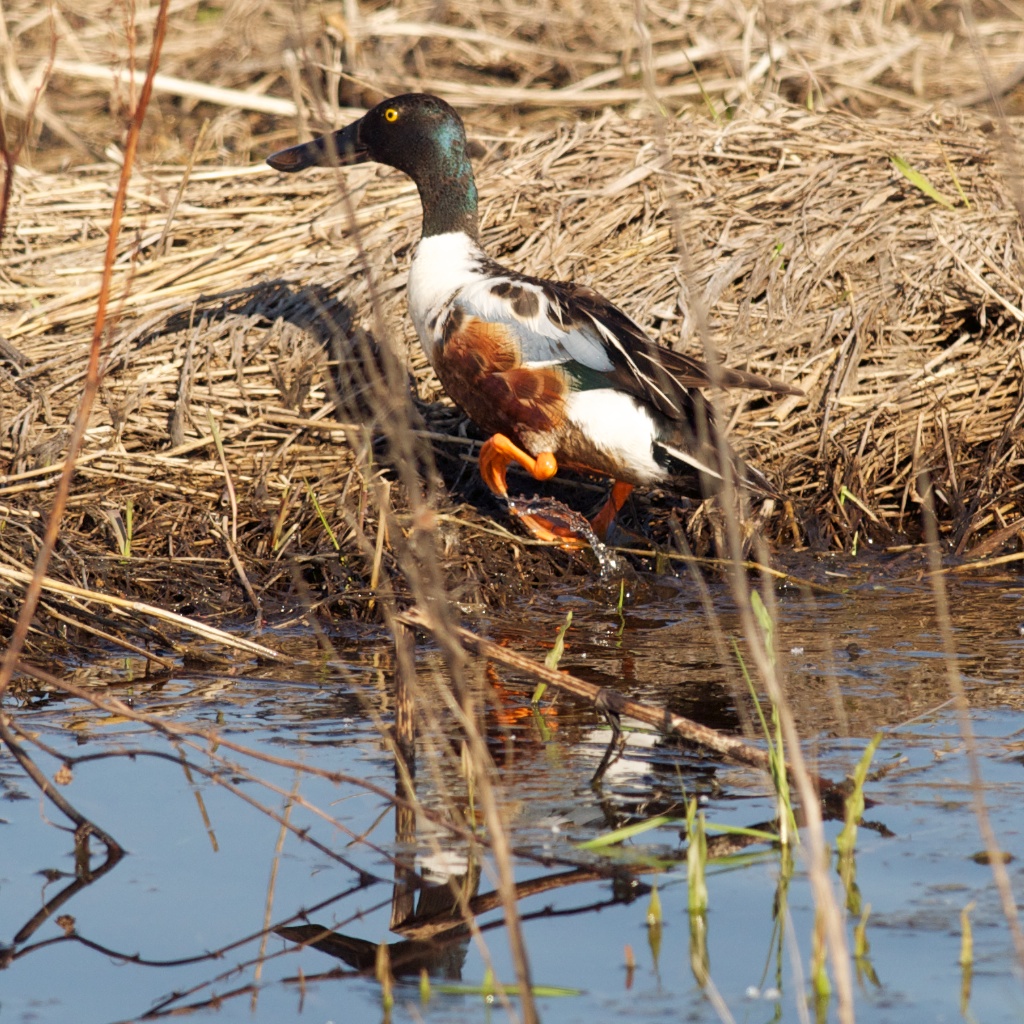
Northern Shoveler, Anas clypeata, looking a little goofy
Last week, when we drove out to Kinbrook Island, we had seen lots of hawks in the area immediately east of Strathmore so I was expecting more good things today. We saw a total of 14 Swainson's Hawks and 7 Red-tailed Hawks, some at very close distances as they performed aerial courtship displays, and some on or around nests. Another raptor highlight was a Northern Harrier, easily identified by its trademark low altitude hunting across a field and along a roadside ditch. For one heart-stopping moment we thought that the hawk was going to be hit by a passing truck but fortunately it continued its leisurely glide to the other side and then circled around to make another close pass behind us.
Swainson's Hawk, Buteo swainsoni
There were relatively few shorebirds to be found, perhaps due to high water levels, but we did see a number of Marbled Godwits, several Wilson's Snipe, and a huge flock of Wilson's Phalaropes. We also found a Long-billed Curlew which was very cooperative while we admired the cinnamon belly through the scope and double checked our field guide.
Wilson's Snipe, Gallinago delicata
Long-billed Curlew, Numenius americanus, Digiscoping skills are slowly improving!
Birding by ear is not an area of strength for me but I had lots of practice and a good teacher on this trip. We found many sparrows including Savannah, Clay-coloured, Vesper, Lark and Chipping, but the "small bird" highlight for me was a large flock of Cliff Swallows swooping around our heads and under us through a culvert! Just a short distance down the road from that experience we found three Horned Larks, another new bird for me.
Horned Lark, Eremophila alpestris
Another great day out on the prairie and I found once again that participating in a bird count is a wonderful way to hone one's birding skills. I'll wrap this post up with a map of the route we took through the area and a list of species seen.
.jpg)

.jpg)