Showing posts with label Calgary. Show all posts

Friday, 7 June 2013

Birding in Bowmont Park

Last weekend I joined a small group of intrepid birders in braving the rain and heading out to explore Bowmont Natural Environment Park.  This park is on the north bank of the Bow River, below the community of Varsity in northwest Calgary (click on the location above for a map).  There is some great birding habitat in this area: riparian habitat, small ponds, deciduous woodland, and shrubby ravines.  The area is actually scheduled for redevelopment to reduce the impact of dogs on the river and to reintegrate the old gravel pit into the natural park, among other goals.  You can check out the redevelopment plan and, for the next couple of weeks, provide feedback on the City of Calgary website.

As was to be expected with the intermittent, at times heavy rain, the light was not very good for photography but I did get a few decent shots, as captioned below.  There's also a species list at the bottom of this post which is probably fairly typical for this area at this time of year, although Violet-Green Swallow and Common Yellowthroat were nice treats and we were surprised not to hear any Warbling Vireo.

Osprey, Pandion haliaetus, bringing nesting material back to a platform beside the riverbank 
Lincoln's Sparrow, Melospiza lincolnii, is differentiated from other Melospiza sparrows by gray "eyebrow" and slightly buffy sides, finer streaking on the breast, and of course voice. 
Downy Woodpeckers, Picoides pubescens, don't always come to the hand even in the winter, so it was a nice surprise to have a visit from this male.
This White-crowned Sparrow, Zonotricha leucophrys, was clearly a male - indistinguishable by appearance but singing boldly while his mate was keeping a low profile further down in the bush.
There were lots of Grey Catbirds, Dumetella carolinensis, mewing from inside the silverberry bushes.  They don't just do cat impressions either - also Robin, Flycatcher, Kinglet, and on and on.  Check this out...
Species List for this outing...
  1. Canada Goose
  2. Mallard
  3. Blue-winged Teal
  4. Common Goldeneye
  5. Common Merganser
  6. Ring-necked Pheasant
  7. Osprey
  8. Spotted Sandpiper
  9. Rock Pigeon
  10. Downy Woodpecker
  11. Western Wood-Pewee
  12. Alder Flycatcher
  13. Least Flycatcher
  14. Eastern Kingbird
  15. Black-billed Magpie
  16. American Crow
  17. Common Raven
  18. Northern Rough-winged Swallow
  19. Tree Swallow
  20. Violet-green Swallow
  21. Bank Swallow
  22. Black-capped Chickadee
  23. Red-breasted Nuthatch
  24. White-breasted Nuthatch
  25. House Wren
  26. American Robin
  27. Gray Catbird
  28. European Starling
  29. Cedar Waxwing
  30. Orange-crowned Warbler
  31. Common Yellowthroat
  32. Yellow Warbler
  33. Chipping Sparrow
  34. Clay-colored Sparrow
  35. Savannah Sparrow
  36. Song Sparrow
  37. Lincoln's Sparrow
  38. White-crowned Sparrow
  39. Red-winged Blackbird
  40. Brown-headed Cowbird
  41. House Finch
  42. American Goldfinch
  43. House Sparrow 

Saturday, 11 May 2013

Mega-Rarity Purple Sandpiper at Inglewood Bird Sanctuary

On Thursday, May 9th, local birder and photographer Eddy Matuod found and photographed an unusual sandpiper at Inglewood Bird Sanctuary here in Calgary.  Uncertain if it was a Rock or Purple Sandpiper, or possibly a weird looking Least Sandpiper, he posted his find to Albertabird.  After some discussion online, opinion seemed to crystallize around this being a Purple Sandpiper, Calidris maritima.  The bird was present on Friday morning and observed by many birders, who all seemed to agree on the Purple identification.  If accepted, this would be a first Alberta record for this species.

After work on Friday, I popped over to Inglewood to have a look for myself and snapped these photos as well as some video.  The video is not great (tricky to shoot video handholding at 400mm!) but may be useful for identification.  The starlings in the second half of the clip were behaving very aggressively towards the little peep, as was a magpie.  This may have contributed to the birds apparent departure, as of Saturday morning.


For best results with this video, go to full screen and select 1080p HD for the quality...


Monday, 22 April 2013

Waterways of Calgary

Today's post was to have been a detailed exploration of the new Ralph Klein Park, on the south-east edge of Calgary.  My plan to spend a morning exploring this manufactured wetland was pleasantly thwarted by a call to help out with the early morning birding course at Inglewood Bird Sanctuary.  After a chilly, windy walk along the Bow River at Inglewood, I stopped by Elliston Park, Calgary's second largest body of water. Finally, with a little time to spare before meeting up with the family for a trip to the model train show, I stopped briefly at the new wetland.

The following little photo essay takes you through my morning jaunt through river, lake, and wetland.  Click on any image to view as a slideshow....
Spot the pipits!  Flocks of American Pipits, Anthus rubescens, migrate through Calgary every spring.  They are often found on gravel bars along the river and are extraordinarily well camouflaged, as these two birds show. 
In contrast to 2012, it is still cold and snowy in Calgary and many winter residents are abundant.  This Bohemian Waxwing, Bombycilla garrulus, was part of a flock that briefly flew down to the river for a drink.  This one flashed the rusty orange under its tail that helps tell it apart from its Cedar Waxwing summer cousins.
The next stop was Elliston Park where Lesser Scaup, Aythya affinis, were the most abundant species.  Here one female at centre and five males.
The males have only one thing on their minds at this time of year...
...and she is fed up with all the attention...
...but unfortunately there's no escape, even in the air - that's six males trying to box her in!
There were songbirds present at Elliston as well, including this stunning Red Crossbill, Loxia curvirostra.
The last stop I made was Ralph Klein Park, where I snapped this heavily-cropped, long-range shot of a Red-breasted Merganser, Mergus serrator, (bottom left) a regular but rare migrant through the Calgary area.  By the way, that's a pink-legged Herring Gull showing off above the two Common Goldeneyes, likely trying to mind their own business.
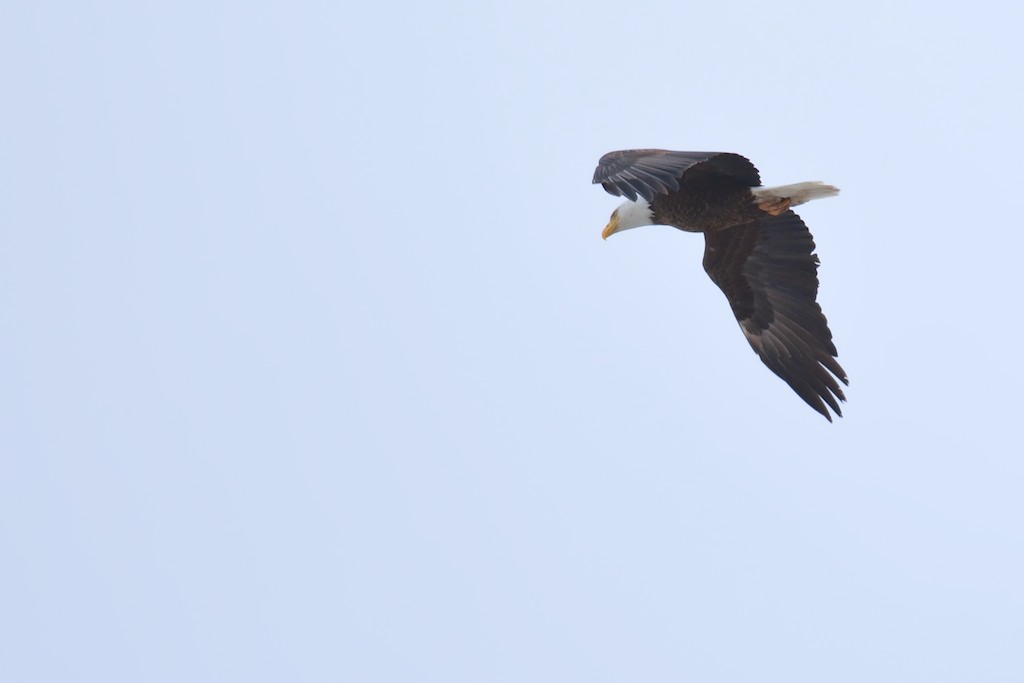
The Red-breasted Merganser didn't stick around for long as this Bald Eagle, Haliaeetus leucocephalus, flew in, flushing dozens of waterfowl and hundreds of gulls into a tower of circling noise.
Two more new birds for the year, feeding in another part of the park, were Black-necked Stilt, Himantopus mexicanus, and Greater Yellowlegs, Tringa melanoleuca.  A lovely way to end the morning's birding.

Update: Our intrepid leader for the morning, Dan Arndt of Birds Calgary, posted his images from the Inglewood outing here.  He's been playing around with a loaner Swarovski scope and digiscoping setup

Sunday, 10 March 2013

Year of the Woodpecker?

Regular followers of this blog may remember that my nemesis bird in Alberta was the Pileated Woodpecker.  I finally tracked one down early last year and finally had some decent views in the fall.  This year seems to be off to a different start on the woodpecker front!

To begin with, a Pileated Woodpecker was the very first bird I saw for the entire year. Arriving at dawn in the Shannon Terrace parking lot of Fish Creek Provincial Park for our January 1st bird count, one of these crow-sized woodpeckers flew across the valley calling as it went.  There have been more sightings since then, notably a pair of birds feeding at ground level by the bike path in Bebo Grove a short distance from our bird course group.

Above: Pileated Woodpecker, Dryocopus pileatus, Bebo Grove, Fish Creek Provincial Park
Below: Example of flight call from xeno-canto.org
On that January 1st bird count, even the Pileated wasn’t the woodpecker highlight of the day, as we found a Black-backed Woodpecker later in the morning.  There had been some sightings earlier in the winter and we soon found tell-tale signs of the feeding activity of a three-toed woodpecker species.  The three species in this group are specialist woodpeckers, needing mature coniferous forests with dead and dying trees, from which they meticulously peel the bark, searching for insect larvae.  The resulting pile of fine bark shavings in the snow around the base of these trees is distinctive but sometimes finding the responsible bird is a little trickier.  Eventually one of our group members spotted this beauty feeding high up on spruce trunk and we were able to watch it at work.
Black-backed Woodpecker, Picoides arcticus, Marshall Springs, Fish Creek Provincial Park
In the same genus (for now?) as the three-toed woodpeckers are the Calgary area's more common species – the Hairy Woodpecker and the ubiquitous Downy Woodpecker - both of which we also saw on that woodpecker-filled New Year's Day.  Although common, these two species can play tricks on birders, as they can be confused with each other.  Here’s the Hairy Woodpecker, in South Glenmore Park last year.
Hairy Woodpecker, Picoides villosus, South Glenmore Park, Calgary.
The red spot indicates that this is a male bird.
There are a few physical characteristics that help to separate the two species.  The Hairy is larger than the Downy, although there is a tiny bit of overlap between the smallest and largest of the two species.  The outer tail feathers on a Hairy are pure white - although this can be hard to see and is not universally true.  Less ambiguously, the bill is always proportionately larger in the Hairy – as long as the head.  However, the easiest way to tell the two species apart is their calls.  The Hairy is fairly flat in pitch while the Downy's call is distinctly descending (“Downy goes down”).  Here’s the Downy Woodpecker, this one at Inglewood Bird Sanctuary.  If you look closely you can see the black spots on the outer tail feathers and the bill is clearly shorter than the bird above, but it's that call that makes it clear, as you can hear below.
Above: Downy Woodpecker, Picoides pubescens, Inglewood Bird Sanctuary, Calgary.
No red spot on the head means this is a female.
Below: Example of call from xeno-canto.org
Four of Calgary’s woodpecker species on January 1st is a pretty good start to any birding year.  I’ve seen Northern Flicker since then which leaves three more common Southern Alberta woodpeckers – American Three-toed, Red-naped Sapsucker, and Yellow-bellied Sapsucker – to turn up for the remainder of the year.  Here’s to the year of the woodpecker!

Monday, 4 March 2013

The End of Winter?


The Winter List is traditionally kept between December 1st and February 28th and records all the species seen between those dates in the designated area.   The Alberta Provincial list is usually about 120-150 species, with traditional winter residents such as Bohemian Waxwings, American Tree Sparrows, and of course Snowy Owls keeping company on the list with more rare winter hangers-on like the Northern Shoveler at Weed Lake and a vagrant Northern Mockingbird in Vulcan.
Snowy Owl, Bubo scandiacus, near Mossleigh, Alberta
What have I been up to over the last couple of months?  Not much blogging and only a little bit of birding with the Friends of Fish Creek winter birding course.  Nevertheless, as of the end of the winter listing period, I was up to fifty species for the year so far.  The big question today is: why does the list end on February 28th?  To illustrate my point, here are the conditions in front of our house yesterday (March 3rd)…
Snowy weather in Calgary
Even in these kind of harsh conditions, evidence of birds is everywhere.  Judging from the noise, the nicely sculpted tree pictured below was sheltering a dozen or more House Sparrows and a few Black-capped Chickadees in front of a neighbour's house.  Between the dense foliage and the layer of snow, I suspect they were cozier than I was! (I should probably mention that two of the birders over at Birds Calgary were actually out birding in this and turned up a dozen species)

Winter is clearly not yet done here in Alberta but signs of spring are all around.  On this past Saturday’s bird group outing we had Mallards and Common Goldeneye vigourously courting and copulating in the river, we saw our first starlings of the year, and several of the magpies we saw were carrying nesting material. 
A winter Black-billed Magpie, Pica hudsonia
I’ll be taking a break from the course for the spring session.  This change should leave a little more time for photography and blogging, as well as home life.  I’m also interested to see how early morning starts and smaller groups impact the birds I see, although I’ll certainly miss the group birding and learning experience.  Whatever birds I see, there’ll certainly be more time to share with you!
A highlight of the winter session - a digiscoped Barrow's Goldeneye, Bucephala islandica, at Carburn Park showing two of it's most obvious identification traits: a steeper peaked head with shorter bill than Common Goldeneye and the crescent shaped white patch in front of the eye. 

Saturday, 22 December 2012

Christmas Bird Count - Calgary

Plans for a quiet Christmas around town enable me to participate in three Christmas Bird Counts this year.  The first of these was last weekend's Calgary count where I counted with four other birders in South Glenmore Park and the Weaselhead Natural Area.  This area has been referred to as "the long walk" by some as it's a relatively remote area for an urban count, has historically low species diversity and is therefore assigned to birders willing to spend six or seven hours wandering the woods in winter weather.  Nevertheless, I've had fun on this count the last couple of years and looked forward to our day out.  Here are a few shots of some of the twenty-one species we encountered.


Although I've seen a lot of Golden-crowned Kinglets, Regulus satrapa, I've not had much luck photographing them.  That's perhaps not surprising as they are Alberta's tiniest songbirds, barely bigger than our smallest hummingbirds, and weighing in at just six grams - less than a loonie!  Their flight reminds me of hummingbirds too as they flit around the shadowy branches of spruce trees looking for food and somehow eking out a living at thirty below.  This particular bird finally sat still in the sun long enough for me to get a decent shot.


Believe it or not, this photo is also an improvement on previous work.  Of course that's easy when I have never managed to photograph Brown CreeperCerthia americana, in Alberta!


Pileated Woodpecker, Dryocopus pileatus, started the year as a bit of nemesis for me - never seen in Alberta or anywhere since I started birding in earnest a few years ago.  I finally found one in the spring and then got fantastic looks a few weeks ago.  Two of the members of our group, who were newer birders, had been having similar issues so it was nice to relive my experience through them as we got great looks and a startlingly close flypast from this female.


I don't have much to say about this photo except that it's a Common Redpoll, it's very pretty, we saw a hundred and thirty others just like it, and no, we didn't see any Hoary Redpolls.  But that's fine because these birds are perfectly lovely with their streaks intact.


Boreal ChickadeesPoecile hudsonicus, are a target species for this count area and we found a half dozen of them hanging out with various flocks of Black-capped Chickadees.  They are distinguishable by their brown caps, reddish-brown flanks and different calls but this uncharacteristically bold individual made life easier by feeding a few feet away while we ate lunch.

At the end of the day, we had another great count experience and I look forward to the next one - Sheep River/Turner Valley on December 29th.  There's a full list of counts on the Birds Calgary website and lots of time to get involved.  Hope to see you out there!

Monday, 19 November 2012

A Nemesis No Longer

Some of my childhood was spent in Ontario and I clearly remember seeing Pileated Woodpeckers a few times in the forests around Peterborough and Ottawa, mostly while out cross-country skiing.  When I started keeping track of my bird sightings a few years ago, I assumed it would be a quick addition to my Alberta list.  No such luck!  Eventually I followed some advice to Griffith Woods in early March of this year and got my "tick" - a quick disappointing flash of distinctive white underwing vanishing into the trees across the Elbow River.  With that backdrop in mind, you may understand why I was approaching this past weekend's Friends of Fish Creek Birding in Bebo Grove, where Pileateds had been reported all week, with more than the usual excitement.

View Bebo Grove in a larger map

The first thirty minutes of our outing was extremely quiet with a handful of Black-billed Magpies, Pine Grosbeaks, Black-capped Chickadees, and a flyover Sharp-shinned Hawk.
Sharp-shinned Hawk (possibly the same bird), Accipiter striatus, that we connected with later in the morning
Eventually we made it to the creek where we enjoyed the company of Brown Creepers, Boreal and Black-capped Chickadees, and Golden-crowned Kinglets.  Unnoticed by the main group, the star of the show - a Pileated Woodpecker - flew across the creek behind us and alit on a trunk right in front of three birders who had lingered by the water.  As soon as they got our attention it flew off downstream, landing among some picnic tables that were a more comfortable distance from our mob of nearly two dozen birders.
More deeply unsatisfying views of my nemesis (this is a 420mm lens) - right in the centre of the frame, apparently headless!
Given the woodpecker's tolerance of birders earlier in the week, I decided to play a hunch and headed off by myself to make a giant (and hopefully nonthreatening) loop around through the trees to get the sun behind me and hopefully to move closer to the bird.  As you can see from these photos, it worked...
Male Pileated Woodpecker, Dryocopus pileatus

Pileated Woodpeckers are, probably needless to say, the largest of North American woodpeckers, about the size of a crow.  They chisel away at trees with their large powerful beaks, often foraging close to the ground where they excavate rectangular holes to feed on ants and other insects inside the tree.  The whole woodpecker family has evolved a number of fascinating adaptations to enable this feeding behaviour: stout bills with an elastic layer of tissue between bill and skull bones, long barbed tongues that curl around the back the skull, nasal tuft feathers (visible above) that protect their nostrils from flying wood chips, and stiffened central tail feather shafts (visible below) that help prop the bird up on the trunk.
Going up!
That was the main excitement of the morning - certainly no Citrine Wagtail or Hepatic Tanager but a stunning bird and an important sighting for me.  We concluded our morning by heading down to the westernmost bridge in the park, on the off chance of an American Dipper, but "settled" for the first Common Redpolls of the season, along with more friendly Black-capped Chickadees and a particularly characterful Red Squirrel.
Black-capped Chickadee, Poecile atricapillus
Red Squirrel, Tamiasciurus hudsonicus

Sunday, 11 November 2012

Technology in Birding

Earlier this week, Dan Arndt and I presented to the Nature Calgary Bird Study Group at their monthly meeting.  We spent about 75 minutes trying to illuminate the world of birding software and birding on the internet to a group of about fifty or sixty birders.  Dan did a fantastic sales pitch for eBird, highlighting its value both as a conservation tool and for sharing information about bird sightings.  We spent some time going over digital field guides with our tablets plugged into the projector.  Finally, we spread the word on some Alberta and North American blogs and tried to demonstrate that Facebook can be a force for good!

Anyway, this post is largely for the benefit of those that are Alberta birders and wanted to see the slides that were presented - all of the links in the slides should work.  If you have problems viewing these you can contact me as described under the "About Me" tab above.  Enjoy!

Nature Calgary Bird Study Group Presentation - November 2012

Sunday, 17 June 2012

It's All About Birdsong

This weekend's Friends of Fish Creek Park outing headed to South Glenmore Park, where our focus was on songbirds.  We were particularly interested in locating a hybrid Rose-breasted x Black-headed Grosbeak that had been sighted in the area.  The clouds cleared by the end of our morning and we spent about three hours traipsing through the forest in the near constant company of Least Flycatchers, Yellow Warblers, and Red-eyed Vireos loudly marking out their territories.
View FFCPP Birding South Glenmore Park in a larger map
On my way to meet the group, I stopped by the sailing club on the south edge of the reservoir.  The water level is still very low as the city prepares for forecasted high river levels.  There were hundreds of gulls, predominantly Franklin's Gulls, along with Ring-billed, feeding on the mud as well as Great Blue Herons and the usual selection of waterfowl.  I snapped this terrible digiscoped image to give you a sense of what this all looked like - imagine another 3 frames of the same stitched on the left hand side of the image:
Once we started walking, a Least Flycatcher was among the first birds to give good views to all participants.  I think it was somewhat frustrating for some novice birders to locate such a drab bird in the dark understory but once we were all on the little flycatcher he put on a good show feeding and calling loudly.
Least Flycatcher, Empidonax minimus, photo from Brooks, May 2012, not on this trip
We walked on through the forest and heard Veery singing from the bushes.  A new species for me but definitely on the "BVD" (better view desired!) list.  Here's a recording of the song from xeno-canto.  Our leaders for the outing gave two descriptions of the call which seemed to me a very accurate characterization - the song sounds like the bird is "winding down" and "singing from the bottom of a rain barrel".  You can actually see the winding down part in the sonogram.
Eventually we reached an overlook with well stocked bird feeders.  These attracted Pine Siskins, White-breasted Nuthatch, American Goldfinch, Brown-headed Cowbird, Clay-coloured Sparrow, and another visitor which you will see below.  Here are a few photos taken at the feeders before we returned by the same route.
Female Brown-headed Cowbird, Molothrus ater
Enjoying some niger seed, a Pine Siskin, Spinus pinus (isn't that a fantastic latin name)
Clay-coloured Sparrow, Spizella pallida
At one point there were three of these Red Squirrels, along with a Least Chipmunk, enjoying the sunflower seeds on and under the railing.
But what about that Grosbeak?  We had seen nothing and heard little by the time we made it back to the parking lot but two of the group had taken a slight detour and found the bird singing right beside the main bike pathway.  Once I heard this I went back by myself and soon heard the bird in the spot they had described.  Rose-breasted Grosbeaks sound like "Robins in a hurry":
However, in a moment of classic birding frustration, despite the continuous singing within 30 feet of my face, I could not see the source of this distinctive song.  So, in conclusion, did we find the elusive hybrid?  Fourteen birders did not, two saw the bird as clear as day, and one (I) heard a Grosbeak right in front of me, grudgingly checked it off my list, and want to return for another look soon.

Monday, 11 June 2012

Hummingbird Hunt

The last couple of weeks have been a little hectic.  My grandfather in England passed away peacefully at the age of 91.  I went over for the funeral and that had the roll on effect of putting me behind at school, just as report cards are coming due.  Nonetheless, I'm really glad I was able to go over and, as this is a nature blog, I should mention that there was some good birding in the UK.  I will post more on Granddad and the British birds at a later date.

In the here and now, it was nice to rejoin the Friends of Fish Creek Provincial Park birding group after a two week absence.  Last weekend we looked around Bowmont Park and this week we went back to the Weaselhead Natural Area to look for Calliope and Rufous hummingbirds.  These smallest of birds once again proved to be great ambassadors for birding and the session was very well attended despite the recent heavy rains and muddy trails.  Here are a few photos from the day:

Strictly an ID photo!  This profile view shows the purple and white throat streaks characteristic of a male Calliope Hummingbird, Stellula calliope.  This is the smallest bird species in North America, north of Mexico.

A somewhat clearer image of a Rufous Hummingbird, Selasphorous rufus, showing its buffy red flanks and shimmering orange-red gorget (throat feathers).
In the same bushy riverside area where we found the Rufous Hummingbirds there were lots of very approachable Cedar Waxwings, Bombycilla cedrorum.  These ones had pulled a flower from a caragana bush and...
...were passing it back and forth between them, an activity that helps to strengthen bonds between mates and within flocks.  Both of these images also show the red waxy droplets on the wings, from which we derived their name.
The Eastern Phoebe we had seen back in April was now a pair with a nest under the bridge.  This individual waited for us to move on before delivering the package in its beak to the waiting young.
If you are interested in looking for these hummingbirds yourself, check out this excellent post over on "Birds Calgary" which has detailed directions and maps.