Showing posts with label Life List. Show all posts

Thursday, 5 July 2012

Purple Martins' Majesty

Another school year is finished with a mad flurry of activity but CalgaryBirder now finds himself enjoying vacation sunshine on the west side of Vancouver Island.  En route, we spent two rainy days in North Vancouver and I took the opportunity to checkout the Maplewood Flats Conservation Area.  This is considered to be a "must see" birding spot in BC's Lower Mainland and, as it's been well covered by local bloggers, I'll simply leave you with these two links and move on to the digiscoped photos:
  1. Birding in Vancouver has a site guide with recommended trails, and,
  2. BirdtrekkerBC has some photos and a species checklist
The species I particularly wanted to see were Purple Martins, which nest on the piers out on the mudflats.  So far I've missed these in Alberta - just haven't been in the right place at the right time.  There were certainly no trouble to find as they were bombing around the shoreline hunting and calling loudly.
Nestboxes out on the mudflats 
Purple Martins pausing for a rest between feedings.  The two birds with the pale faces are juveniles.
Other birds also make use of the piers (I think that's the right term?).   This is a Bald Eagle, like I needed to tell you that!

The "flats" part of Maplewood Flats looks like this.  I didn't see any shorebirds, as early July is the narrow window between northbound stragglers and southbound early-birds.  There were 6 Great Blue Herons, almost all in the arc of this photo.
Purple Martins weren't the only life bird for the morning.  Although I'm fairly certain I've seen this particular flycatcher before, I've never had the chance to confirm the ID, which is by song.  Anyway, here's the bird:
An Empidonax Flycatcher, but which one?
And here's the ID...
Handheld videoscoping doesn't give great results but it's the soundtrack that counts - "rrritz-bew" is unmistakably a Willow Flycatcher, common enough but still eluding me in Alberta.

I'm off on a sea kayaking trip tomorrow but will keep the blog updated with some more sightings, although if you want a sneak preview have a look under "Checklists".

Tuesday, 15 May 2012

Gulf Island Passerines

This is the second in a series of posts on my recent Gulf Islands sailing trip.  You can find Part 1 here.

The Gulf Islands are dotted with parks and protected areas, both marine and terrestrial.  The flagship park is the Gulf Islands National Park Reserve which was established in 2003 and covers 36 square kilometres of land scattered around the islands.  There are also eight provincial parks, including Montague Harbour where we spent one night on the trip.  Of course all of these protected areas, with thick forests and dense shrubbery, provide rich habitat for bird life.
Spotted Towhee, Pipilo maculatus, love tangled overgrown shrubbery so they love the Pacific Northwest.  They call "Drink TEA" and occasionally pop up to more visible perches to sing, look around, or be photographed.
Russell Island is a small island off Saltspring entirely held under the Gulf Islands National Park.  We woke up in this anchorage to hear Pacific Wrens singing across the water and found this Orange-crowned Warbler, Oreothlypis celata, during a hike around the trails.
Golden-crowned Sparrows, Zonotrichia atricapilla, are common on the coast but this was a new species for me when I spotted this one mixed in with a flock of White-crowned Sparrows.
Here's one of the aforementioned White-crowned Sparrows, Zonotrichia leucophrys, a few weeks before they show up in Calgary.
I know this is not a passerine, but I wanted to include this Rufous Hummingbird, Selasphorous rufus, as it was another bird that succeeded in drawing the interest and admiration of my crowd of non-birding teenagers.
Those are few of the smaller birds that we saw on our trip but the hummingbird was not the bird that most wowed the crowd, as we'll see next week....

Monday, 30 April 2012

South Glenmore Park with Friends of Fish Creek

The past weekend began with the fourth Saturday of the Friends of Fish Creek Park Spring Birding Course.  I was a little tired out after a week in the Gulf Islands with thirty-two of my Junior High students but made this an "NMT" outing by biking to the reservoir, which is why all images in this post are through a scope.  It was certainly worth the effort as the weather was lovely with the sun periodically peaking out from between the clouds.  We were entertained by a pair of Red-breasted Nuthatches emptying wood chips from their nest hole and, despite the songbirds being a little thin on the ground, we also watched a Ruby-crowned Kinglet singing boldly from the top of a tall spruce.
Unfortunately I didn't capture the nest cavity cleaning process in the above video but it's nice to see breeding behaviour in action anyway

South Glenmore Park is a mix of many habitat types: a stand of old growth spruce trees borders on aspen parkland which in turn borders on fragments of boreal forest in the Weaselhead Natural Area.  Alongside these woodlands there are grassy fields, a river delta, and of course the reservoir itself.  It was there where we found much of the bird activity with twenty-eight species on or beside the water, twelve of which were Alberta "first of year" for me, plus a life bird - the Say's Phoebe.
My life Say's Phoebe, Sayornis saya, seems much less interested in me than I am in him
The reservoir itself was covered in birds which gave great scope (and closer) views.  The variety of waterfowl made for a productive learning experience for the participants as we were able to pick out and compare species.  A Canvasback paddled around beside some Redheads, two pairs of Ring-necked Ducks hung out with a small flock of Lesser Scaup, and so on.  Our group was perhaps most impressed by the Western Grebes, which were actively feeding and calling just a hundred metres or less from our viewpoint.
The Western Grebe, Aechmophorus occidentals, appears both stately and savage. 
As is often the case, I learned a valuable bird identification lesson myself, in the form of a flock of thirty gulls with black heads that flew across the reservoir and landed on the far side.  "More Franklin's!", I called out, assuming that they would match the hundred or so that were already there.  "Bonaparte's Gulls", corrected our group's leader.  Not exactly a rookie mistake - they are pretty close - but I should have known better and not made the immediate logical assumption, particularly as just four days earlier I had sailed through a flock of 5000+ Bonaparte's out on the West Coast.  Birding is certainly a hobby where jumping to conclusions is all too easy!
Bonaparte's Gull, Chroicocephalus philadelphia, not on Glenmore Reservoir,  but earlier in the week in the rain of the Gulf Islands.
In spite of this minor setback, I thoroughly enjoyed the morning's birding and am looking forward to next week's outing.  More on the West Coast to follow in May...

Here's a list of species seen on this outing (plus two en route marked with *):

  1. Canada Goose
  2. Trumpeter Swan
  3. Gadwall
  4. American Wigeon
  5. Mallard
  6. Blue-winged Teal
  7. Northern Shoveler
  8. Northern Pintail
  9. Canvasback
  10. Redhead
  11. Ring-necked Duck
  12. Lesser Scaup
  13. Bufflehead
  14. Common Goldeneye
  15. Common Merganser
  16. Common Loon
  17. Horned Grebe
  18. Eared Grebe
  19. Western Grebe
  20. Red-necked Grebe*
  21. American Coot
  22. Spotted Sandpiper
  23. Greater Yellowlegs
  24. Bonaparte's Gull
  25. Franklin's Gull
  26. Gull sp. (probably California)
  27. Downy Woodpecker
  28. Northern Flicker
  29. Say's Phoebe
  30. Black-billed Magpie
  31. American Crow
  32. Common Raven
  33. Black-capped Chickadee (heard only)
  34. Red-breasted Nuthatch
  35. Ruby-crowned Kinglet
  36. Savannah Sparrow*
  37. Pine Siskin
  38. House Sparrow

Wednesday, 25 April 2012

Garden-variety Birds

This is the fourth and final in a series of posts featuring birds from our recent trip to San Diego.  You can find the other parts here: part 1, part 2, and part 3.

When thinking about birding around San Diego, there are so many habitats - like the lagoons, beaches, and deserts in the previous posts - it is easy to overlook the great variety of birds that can be found in backyards throughout the area.  We were fortunate in finding a rental property that shared a lovely garden with our very generous hosts.  This habitat provided some great birding from the moment we woke up on our first morning.
Almost the first birds we saw on the trip - Anna's Hummingbird, Calypte anna, and Black Phoebe, Sayornis nigricans, side by side above the back fence.
The Black Phoebes were quite common and we saw them at almost every park we stopped at along the coast.  Similarly hummingbirds were widespread and often seen feeding on flowers in the same parks and gardens - we had three in the yard at the same time one afternoon.  Of course certain species are very cosmopolitan and we found several species that would be considered "the usual suspects" in Calgary, at a different time of year.
A House Finch regaling us with morning song - the yellow-orange coloration is not a morph I've seen in Alberta 
Yellow-rumped Warblers (Audubon's subspecies) are year-round residents in parts of California but didn't show up in Alberta until about four weeks after I took this photo
Similarly, White-crowned Sparrows spend the winter here and should be showing up any day now
However the backyard birds aren't just different colour morphs or out of season Alberta birds.  In some cases the populations are dramatically different, like what seems to be a swap in numbers between House Sparrows and Song Sparrows, with the latter flitting around in every bush and picnic area.  There are also those birds that are commonplace in the San Diego area but never seen north of the 49th parallel such as the above Black Phoebe and the aptly named California Towhee.  These birds were everywhere, announcing their presence with a distinct, slightly metallic "teek" as they forage in the brush or on the ground.
This California Towhee was feeding underneath a Hyacinth Macaw at the San Diego Zoo - I took a little flak from my wife for taking this photo first!  Definitely an "LBJ" but also a real stunner - it's all in the eyes.
I hope you've enjoyed this little overview of my brief exposure to southern California birding.  I look forward to the next visit and recommend this to anyone looking for a different birding experience.
Bins and beer - probably signs of a good holiday!

Wednesday, 18 April 2012

Hotspot

This is the third part of a series on our recent trip to San Diego - you can find part 1 here, and part 2 here.


This looks promising...
A successful birding trip is usually preceded by careful preparations and review.  When visiting a completely new area this is particularly important, so for our California trip there were three pieces to those preparations.  Firstly, following the appropriate listserv (email bird alerts) to get a flavour for species and locations.  Secondly, based on this information, generating and studying a list of common and target species.  The final piece was researching nearby hotspots - in the case of the non-birding holiday, nearby being the critical word.  "A Birder's Guide to Southern California" by Brad Schram was a fantastic resource and, along with online research, I discovered that our rented vacation property was less than a mile from the San Elijo Lagoon - complete with trails, several different habitat types, and an interpretive centre.

View San Elijo Lagoon in a larger map
Looking west across the marsh from the bend in the river just below the blue place mark above.
The two CalgaryBirder Jr's and I heading up the trail 180° from the above photo.
I made two visits to the lagoon - one with the family for a short walk and later an early morning solo excursion for a couple of hours.  This totalled 39 species including on the adjacent Cardiff State Beach.  The total species count for the lagoon is around 300, with 65 recorded as breeding, which gives you some idea of how I was just scratching the surface.  Here are a few highlights, mostly digiscoped - a scope is very useful although not vital as the waterfowl and waders seemed generally less skittish than in Alberta wetlands.  For more information on San Elijo and the species found there you can look at the lagoon conservancy website or at this birder's overview of the various trails.
Great Egret, Ardea alba, with American Wigeon in the background 
Digiscoping hummingbirds is often difficult (without a feeder) but this male Anna's Hummingbird, Calypte anna, was very cooperative
A Green-winged Teal, Anas crecca, with a small flock of dowitchers - almost certainly Long-billed Dowitchers, Limnodromus scolopaceus 
Certainly the highlight of the lagoon, possibly of the entire trip, this normally secretive Virginia Rail, Rallus limicola, was just wandering about in plain view, at least by Rail/Sora standards.
Passerines tend to be tricker to photograph, but I managed to get a half-decent shot of another lifer - the Blue-gray Gnatcatcher, Polioptila cerulean.
A taste of home - American Avocet, Recurvirostra americana, and Least Sandpipers, Calidris minutia
A quiet, reflective moment for this Snowy Egret, Egretta thula

Wednesday, 11 April 2012

Anza-Borrego Desert Birds

This is the second part of a series on our recent trip to San Diego - you can find part 1here.

Although numerous amusement parks and zoos make the San Diego area a great destination for families with small children, we are really more backcountry and wilderness people at heart.  As a result, by day 4 of our trip we needed a break from the crowds and drove east, across the Laguna Mountains, for a little taste of desert hiking.

Anza-Borrego Desert State Park is the second largest state park in the US at 2400km² and it is certainly of interest to birders.  The local hawkwatch program counted 9000 Swainson's Hawks making their way north last spring, forming large kettles during the day and roosting in the town of Borrego Springs at night.  The small oases of palm trees, irrigated land, and the nearby Salton Sea also provide waypoints and wintering habitat for migratory birds and it was to one such location that we headed for our hike.

Our first stop was the park visitor centre where I was pleased to find Verdin in the parking lot, as well as a Costa's Hummingbird feeding on cactus blooms in front of the main entrance.
Verdin, an active little songbird native that seems to fill a similar role in desert scrub that the Chickadee does in coniferous forests here - looks better enlarged!
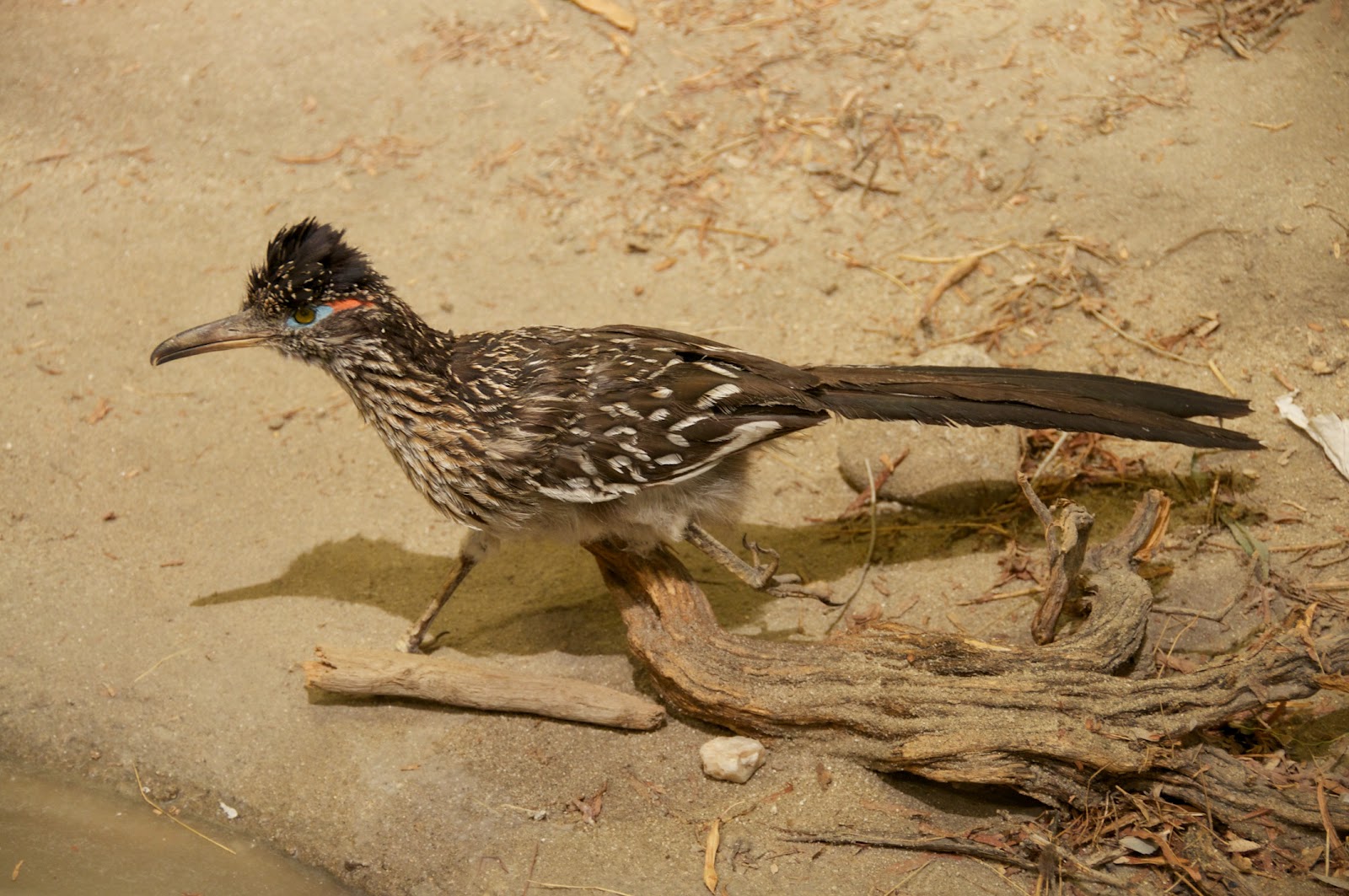
The visitor centre itself is staffed by friendly volunteers and provides a good overview of indigenous people's history in the area, early Spanish exploration, and the flora and fauna of the area.  There were several stuffed specimens of birds, reptiles and mammals, providing an opportunity to photograph the Greater Roadrunner, a live specimen having appropriately run across the road in front of us on our drive in.
This roadrunner isn't doing much running anymore
After checking out the visitor centre and grabbing lunch in town, we headed over to the Borrego Palm Canyon trailhead.  This short (3 mile) walk takes hikers up a dry desert canyon and around a corner to reveal a cool creek complete with waterfall and small palm tree forest.  Unsurprisingly, this little patch of green is a magnet for migratory and resident birds.  Two California Quail were wandering about in the lower section of the trail and we saw them more than once, sometimes quite close.  Black-throated Sparrows, a desert specialist with striking white facial stripes contrasting with a dark black bib, also made an appearance giving great binocular views but sadly no photograph of these little stunners.
California Quail on the trail
Hiking at preschooler pace, it took us a while to reach the creek but when we did we were suddenly surrounded by green bushes and young palm trees growing between the boulders.  There were lots of songbirds here too, including Black-tailed Gnatcatcher, Orange-crowned Warbler, Pacific-slope Flycatcher, and House Finch.  Anna's Hummingbird were also feeding in the bushes and, according to the signage, Hooded Orioles nest in the palm trees, although we didn't see any.
Exploring the habitat in the upper canyon 
I've gone back and forth on the identification of this bird and I'm definitely still open to suggestions but... I believe this is a Pacific-slope Flycatcher based on 1) appropriate range for late March migration for this species but not for Cordillerian, 2) probability based on e-bird distribution, 3) species is mentioned as migrant in regional guidebook.  In any event it seems all wrong for the one "expected" flycatcher in this area which is the Ash-throated (primary projection is too short, no rufous in tail, it has an eye ring etc.).  Now that I've finished talking myself into that, feel free to let me have it in the comments!
If you are in Southwestern California, for birds or any other reason, I would recommend making a detour to this scenic desert location and checking out some of the great birding for yourself.

Wednesday, 4 April 2012

Vacation Birding

We've just returned from a family holiday in San Diego.  Much fun was had by kids and adults alike at the Zoo, Legoland, and so on.  By keeping my binoculars close at hand, and taking a couple of hours early one morning to bird a local hotspot, I also saw 74 species of bird including 28 lifers.  I plan on sharing a few photos as well as details of some great birding locations over the next few weeks.  Hope you enjoy - all photos click to enlarge as usual!
Brown Pelican was one lifer that was a sure thing heading down to southern California.  Very impressive to watch small flocks cruising along the cliff tops like wide-bodied aircraft coming into land, then turning out to sea and plunge diving with unexpected speed and precision.
Western Gulls were another "guaranteed" lifer.  These are BIG gulls made more impressive by the contrasting dark backs and clean heads.  This trio was cleaning up after a show at SeaWorld.
Also looking for handouts at SeaWorld, a Snowy Egret - yet another life bird posing beautifully for the camera.
Visitors to the Calgary Zoo will find many House Sparrows under their picnic tables and dashing around animal enclosures looking for scraps.  At the San Diego Zoo and Safari Park it seems to be Brewer's Blackbirds that fill the same role in a much more aesthetically pleasing manner! 
Migrant shorebirds were fairly abundant on beaches and lagoons in the area.  Here a flock of Whimbrel do a formation flypast...
...and a little further up the shore Black-bellied Plover and a lone Willet hunt for evening snacks along the tideline.
Next week, the San Diego posts head to the desert!

Meanwhile, for those interested, here are those 28 life birds:
Wild Turkey
California Quail
Brown Pelican
Snowy Egret
White-tailed Kite
Peregrine Falcon
Virginia Rail
Least Sandpiper
Western Gull
Heermann's Gull
Common Tern
White-winged Dove
Greater Roadrunner
Costa's Hummingbird
Acorn Woodpecker
Pacific-slope Flycatcher
Black Phoebe
Cassin's Kingbird
Verdin
Bushtit
Black-tailed Gnatcatcher
Blue-gray Gnatcatcher
Wrentit
Northern Mockingbird
California Towhee
Black-throated Sparrow
Great-tailed Grackle
Lesser Goldfinch

Friday, 23 March 2012

2 Days, 20 Minutes, 2 Calgary Lifers

This was a going to be a quiet bird week, filled with parent-teacher interviews and other end of term craziness.  However on Thursday morning I found myself running an errand in the Foothills Industrial Park, just a couple of blocks from where a Harris's Sparrow has been periodically reported over the winter.  Figuring that a quick detour couldn't hurt, I drove past the location and, unlike my previous visits, found the bird almost immediately singing from the middle of a bush.  Using my glovebox "backup binoculars" I took a few minutes to enjoy this new life bird (also picking up first-of-the-year American Tree Sparrows) before carrying on with my day.

Early this evening, as I was getting ready to pop out to run some errands, I checked Albertabird only to find that a Barred Owl had been spending the day in a front yard in Bayview, a Calgary neighbourhood on the south shore of Glenmore Reservoir.  Quickly grabbing camera and binoculars and mentally remapping my errands, I ran out of the door very thankful for daylight savings time.  Arriving at the posted address I found a small but growing group of birders and my life Barred Owl.
The crowd...
...and more impressively, the Barred Owl, Strix varia
Among the visiting birders were Russell Cannings and Jeremy Kimm, in from BC and fresh off finding a Lesser Black-Backed Gull at Inglewood Bird Sanctuary earlier in the day.  I also bumped into Bob Lefebvre and Dan Arndt from Birds Calgary who will likely post their own images and information shortly.  I should also mention that Ian Maton posted some much better photos than mine on his Flickr photo stream (perhaps he remembered his tripod - doh!)

Lastly many thanks to the patient and generous homeowner who made the information public, and happily kept company with an assortment of strangers on their lawn through the afternoon and evening.  A great lesson in the importance of birders and photographers being courteous and respectful in their pursuit of sightings.

I updated this post shortly after making it, to include this crop out of a much larger image.  For some reason it struck me, in its weird "impressionism", as capturing the peacefulness of the bird as it seemed utterly content with us just a few feet away.


Tuesday, 21 February 2012

Rosy Finches - Third Time's the Charm

One of my target birds for 2012 was the Gray-crowned Rosy Finch.  These little songbirds spend the summer nesting in cliffs or rock piles in high alpine or arctic tundra, such as at Sunshine Meadows near Banff.  However, rather than spending July hunting out nesting pairs while dangling from cliffs and dodging grizzly bears, a simpler option is to look for them in the winter when large flocks descend to valley floors to feed and to spend the cold season in more sheltered conditions.  Having struck out twice in recent months I was not holding my breath as my daughter and I drove over to Exshaw early on Sunday morning to check the feeders along Barrier Mountain Drive.  However, this time the supposed "sure thing" did materialize and, as you can see from these photographs, we had great views of a large flock along with a few dozen Pine Siskins and a couple of Mountain Chickadees.
I really needed my wider angle lens - less than a fifth of one flock of Gray-crowned Rosy Finches, Leucosticte tephrocotis
The particularly neat thing about this sighting is that the flock contained both of the two main subspecies (out of 6+) of this type of Rosy-finch.  The littoralis subspecies ("Hepburn's Rosy-Finch") and the nominate tephrocotis subspecies are both fairly migratory and since western Alberta is close to the overlap of their ranges it's not surprising to see them together.  Why are there so many subspecies?  The most likely explanation is their breeding habitat, which puts small populations in relatively isolated alpine and island locales.  This reduces gene flow between the groups, particularly the four less widespread subspecies.  Drawing meaningful taxonomic lines is challenging and some scientists consider the whole Rosy-finch complex (3 North American and 1 Asian species) to be a single species.  This conclusion is supported to some extent by the extensive hybridization observed and by DNA sequencing.  In any case it's an interesting example of the complexities of avian genetics.  Here are a few pictures from Exshaw showing the key differences (click to enlarge as usual).
Leucosticte tephrocotis tephrocotis - note the gray crown which stops at the eyeline
Leucosticte tephrocotis littoralis - aka. "Hepburn's Rosy-Finch", note the completely gray head
On reviewing my pictures later in the day, I realized that by pure luck I had both subspecies in the same frame on one shot
Hope you enjoyed these finches as much as I did!

Information for this post taken from Dunn and Alderfer's Field Guide to the Birds of North America, 6th ed. (great subspecies maps!) and Kaufman's Lives of North American Birds.

Wednesday, 21 December 2011

Christmas Bird Count Continued

As promised, a few more Christmas Bird Count images to brighten up your mid-week.  More on Flickr if you're interested and Dan Arndt posted his own recollections of our count over on the Birds Calgary blog.
Our count group in the Weaselhead
Common Redpolls busy feeding
Hairy Woodpecker hammering away
A fairly appalling photo of a lifer juvenile Northern Goshawk
I believe I already mentioned there were a LOT of Pine Grosbeaks (male above, female "on approach")