Showing posts with label Swallows. Show all posts

Saturday, 1 June 2013

Magic Moments at the Nest Box


This term I’m teaching a short course to my Jr. High students called “Environmental Stewardship”.  One of the projects we have undertaken is building nest boxes under the guidance of local birder Andrew Stiles.  He uses recycled and recovered wood to construct a simple design that, with precut wood, takes kids about an hour to nail together.  You can find out more about the design and his program on his website.  I also came across this short video of him putting one together and talking about the different types of nest.
One of our decorated nestboxes
We enjoyed a sunny afternoon on the walkway in front of the school putting our nest boxes together and later decorating them.  As many of last year’s boxes had ended up abandoned at the back of the classroom, I wanted to take it one step further this year and actually visit some appropriate habitat to put up the boxes.  With Andrew’s help we picked a spot on the west edge of the city and headed out.
Student and parent volunteer attaching a box to the fencepost
I was a little skeptical about how much success we would have with attracting birds, due to the urban location, and late May timing.  But then something magical happened….
Another student and parent at work - take a look in the upper right, just above the horizon!
At first just one pair of Tree Swallows appeared in agitated flight overhead.  I thought that we had disturbed a nest somehow but couldn’t see any possible nest site.   Then two more pairs arrived circling and swooping along the fence as we made our way down the line putting up the boxes.  Finally the penny dropped as one pair landed on the box, the female inspecting inside while the male kept watch from the wire.
Tree Swallows, Tachycineta bicolor, at nest box
Can there be any better way to connect with birds than putting up a nest box that you have made and then watching as, seconds later, it is occupied by a mated pair?  Of course teens will be teens and there was a little feigned indifference but I’m certain that those tree swallows connected with some students that afternoon and made them appreciate the natural world just a little bit more.
Photo by Prairie Birder, Charlotte Wasylik, used by permission
Hopefully the above sight will greet any students that (carefully, quietly, and briefly!) check on their boxes in a few weeks time.  That photo was taken by “Prairie Birder”, barely out of Junior High herself and with a huge passion for birds.  You can find more information and examples of nest boxes on her website here, here, and here.

Saturday, 16 July 2011

Victoria Songbirds

To wrap up the West Coast vacation posts (previous posts here and here), here are a few shots of birds taken in Victoria and elsewhere on the Saanich Peninsula.  As usual, all photos can be clicked to enlarge.

Violet-green Swallow feeding young at nestbox at the Butchart Gardens
Dark-eyed Junco, "Oregon" variety, also at the Butchart Gardens
A very poor photo, included only because it was a life bird! - A Bewick's Wren in shrubby pathway area in Victoria
In the same general location, another denizen of photography-challenging dark shrubs and leaf litter, one of many Spotted Towhee
The poorly named Pelagic Cormorant at Sidney docks
Female Anna's Hummingbird, one of several fighting over my Aunt and Uncle's feeder


Thursday, 9 June 2011

Back in the saddle...

Literally!  After a family emergency and a persistent out-of-season cold I managed to get out again for the first time since the May species count day.  As usual it was a short after-work bike ride that did the trick and I headed down to Edworthy Park, then back along the south side of the river, through Lawrey Gardens.  There is a decent size colony of Cliff Swallows under the pedestrian bridge at Edworthy.  It was fun to stand on the bridge and have them swoop just a few meters away, although the best views of the nests were to be had from the riverbank (or what's left of it during this peak meltwater time).
Under the bridge - nests visible through the upper circle and at the top of the frame
Zooming in - Cliff Swallow, Petrochelidon pyrrhonota, in centre
and zooming in again (a bad digital crop)
There were more swallows to be found further along the trail, in this case Tree Swallows perching and presumably nesting in the dead trees along the river bank.  The Cedar Waxwings are back in force now too - I saw 5 individuals today and heard a few more, although neither the numbers nor the noise matched up with the flock in our yard and alley on the weekend.  Yellow Warblers were also vocal and numerous but the real treat of the day came, as is so often the case, just when it was time to head home.

As I was biking along a few hundred metres west of Crowchild Trail there was flash of gray across the trail and, as I screeched to a stop, a Gray Catbird alit on branch by the trail and then disappeared into the undergrowth.  It turned out to be a pair and a likely nest.  Perhaps unsurprisingly, given their proximity to the busy bike path, they were quite relaxed and cooperative and I had great views and managed to get a couple of decent shots in the shady undergrowth.
Gray Catbird, Dumetella carolinensis 
All in all a nice hour or so of weekday birding and great to be out enjoying the birds on a sunny day again.

Monday, 30 May 2011

Calgary May Species Count

This weekend brought the annual spring species count - a team of birders fanning out to count all the bird species within an 80km radius of Calgary.  My partner and I were assigned an area north of Strathmore - a fairly unremarkable stretch of rolling prairie that was nonetheless filled with birds and we managed to round up 61 species on a lovely sunny day of birding.  The sloughs were filled to the brim from the past week of rainy weather so duck counting was a large part of the day with many Mallards, Gadwall, American Wigeon, Blue-winged Teal, and Northern Shovelers.
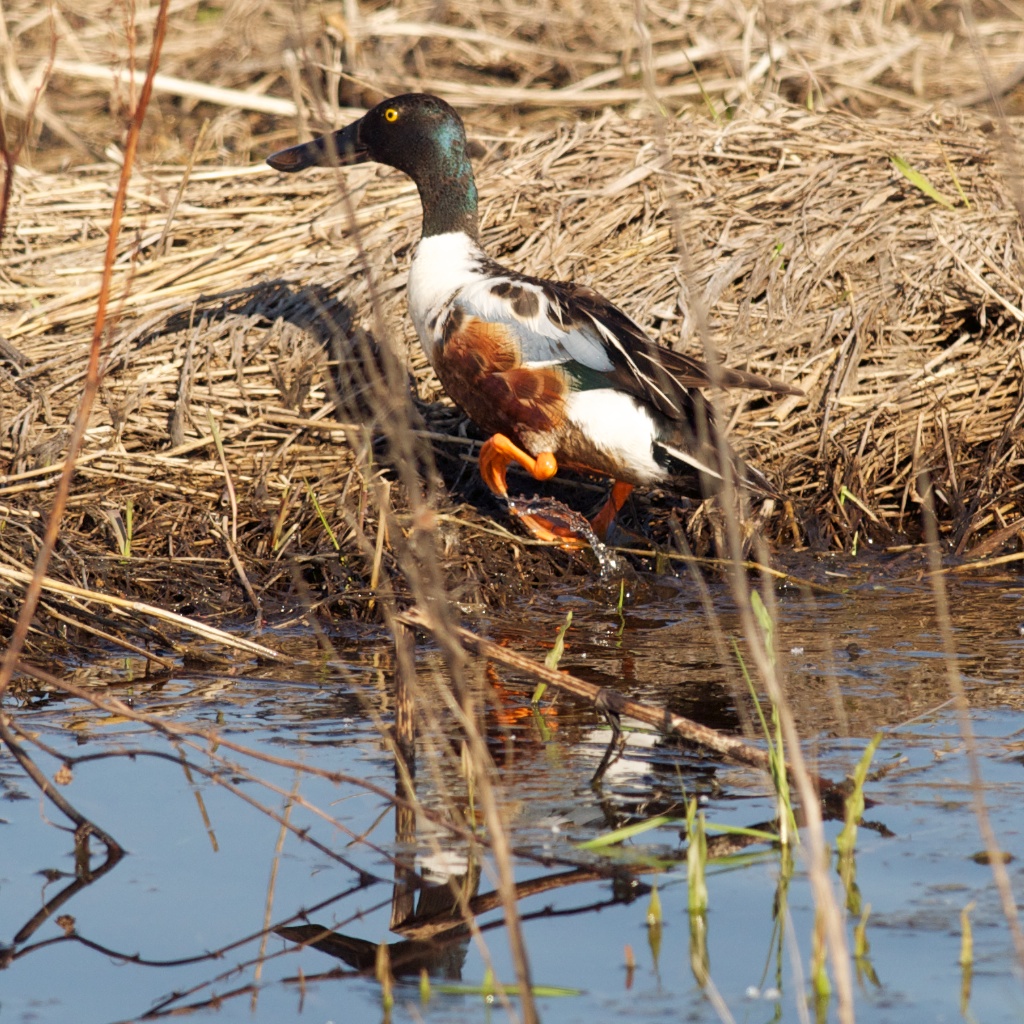
Northern Shoveler, Anas clypeata, looking a little goofy
Last week, when we drove out to Kinbrook Island, we had seen lots of hawks in the area immediately east of Strathmore so I was expecting more good things today.  We saw a total of 14 Swainson's Hawks and 7 Red-tailed Hawks, some at very close distances as they performed aerial courtship displays, and some on or around nests.  Another raptor highlight was a Northern Harrier, easily identified by its trademark low altitude hunting across a field and along a roadside ditch.  For one heart-stopping moment we thought that the hawk was going to be hit by a passing truck but fortunately it continued its leisurely glide to the other side and then circled around to make another close pass behind us.
Swainson's Hawk, Buteo swainsoni
There were relatively few shorebirds to be found, perhaps due to high water levels, but we did see a number of Marbled Godwits, several Wilson's Snipe, and a huge flock of Wilson's Phalaropes.  We also found a Long-billed Curlew which was very cooperative while we admired the cinnamon belly through the scope and double checked our field guide.
Wilson's Snipe, Gallinago delicata
Long-billed Curlew, Numenius americanus, Digiscoping skills are slowly improving!
Birding by ear is not an area of strength for me but I had lots of practice and a good teacher on this trip.  We found many sparrows including Savannah, Clay-coloured, Vesper, Lark and Chipping, but the "small bird" highlight for me was a large flock of Cliff Swallows swooping around our heads and under us through a culvert!  Just a short distance down the road from that experience we found three Horned Larks, another new bird for me.
Horned Lark, Eremophila alpestris
Another great day out on the prairie and I found once again that participating in a bird count is a wonderful way to hone one's birding skills.  I'll wrap this post up with a map of the route we took through the area and a list of species seen.

1 Canada Goose
2 Gadwall
3 American Wigeon
4 Mallard
5 Blue-winged Teal
6 Cinnamon Teal
7 Northern Shoveler
8 Northern Pintail
9 Canvasback
10 Redhead
11 Lesser Scaup
12 Bufflehead
13 Common Goldeneye
14 Ruddy Duck
15 Ring-necked Pheasant
16 Pied-billed Grebe
17 Horned Grebe
18 Eared Grebe
19 Great Blue Heron
20 Northern Harrier
21 Swainson's Hawk
22 Red-tailed Hawk
23 American Kestrel
24 Merlin
25 American Coot
26 Killdeer
27 American Avocet
28 Willet
29 Spotted Sandpiper
30 Long-billed Curlew
31 Marbled Godwit
32 Wilson's Snipe
33 Wilson's Phalarope
34 Rock Pigeon
35 Mourning Dove
36 Least Flycatcher
37 Western Kingbird
38 Eastern Kingbird
39 Black-billed Magpie
40 American Crow
41 Horned Lark
42 Bank Swallow
43 Cliff Swallow
44 Barn Swallow
45 House Wren
46 Marsh Wren
47 American Robin
48 European Starling
49 Yellow Warbler
50 Chipping Sparrow
51 Clay-colored Sparrow
52 Vesper Sparrow
53 Lark Sparrow
54 Savannah Sparrow
55 Red-winged Blackbird
56 Western Meadowlark
57 Yellow-headed Blackbird
58 Brewer's Blackbird
59 Brown-headed Cowbird
60 American Goldfinch
61 House Sparrow

Monday, 23 May 2011

Kinbrook Island Provincial Park

We've just returned from a great long weekend camping trip to Kinbrook Island Provincial Park near Brooks, which is about 200km south-east of Calgary.  The park is on the east shore of a large reservoir,  Newell Lake, and the campground is basically an island covered in poplar trees and surrounded by marsh.  The existence of these three habitats together in the middle of vast prairie grassland is, as you can see below, a real bird magnet.

In the campground there were several species of flycatcher ranging from the easily identified and bold to the tricky and hyperactive.  (As usual all photos in the post are click to enlarge!)
Western Kingbird, Tyrannus verticalis

Eastern Kingbird, Tyrannus tyrannus

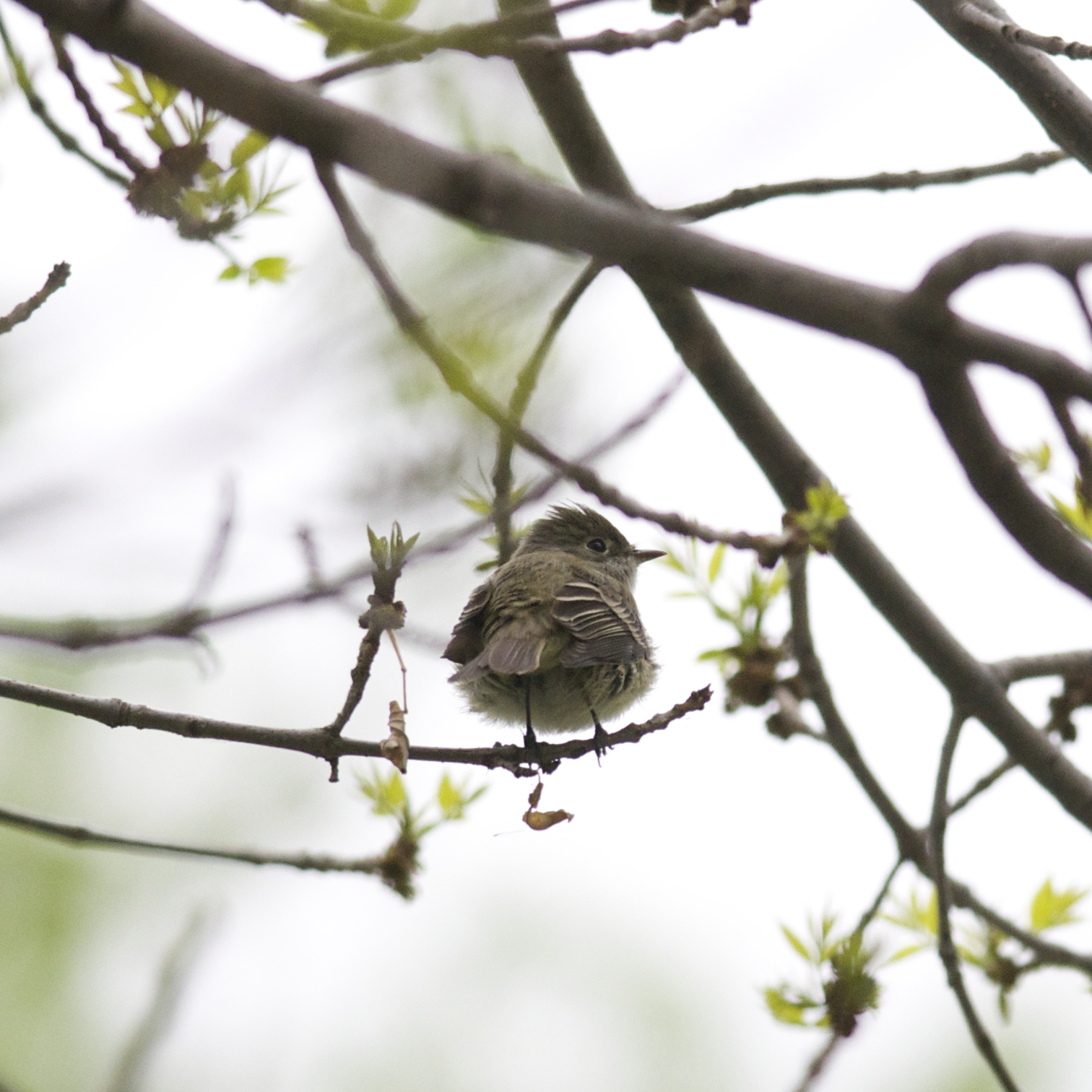
Least Flycatcher, Empidonax minimus - OK, I heard several Least Flycatchers, this bird was close by, and it looks like a Least Flycatcher but those empids are tricky!
A birding highlight of the weekend came while I was washing breakfast dishes.  There was a flurry of activity in the understory.  A group of 4 male Brown-headed Cowbirds chasing one female were displaying to each other on branches and, ultimately, on the grass about ten yards in front of me.
Brown-headed Cowbird, Molothrus ater

Brown-headed CowbirdMolothrus ater
There are nice walks (if you aren't freaked out by bugs like our 3 year old!) around the marshes, including an interpretive trail around the northeast area that was a little long for our crew of preschoolers.  The dominant species in this area is Red-winged Blackbirds, but spaced out among these territorial birds were Yellow-headed Blackbirds and a large number of Marsh Wrens.
Marsh Wren, Cistothorus palustris

Yellow-headed Blackbird, Xanthocephalus xanthocephalus
During one of these walks we bumped into a group of birders doing the 13th Annual Brooks Species Count.  They commented on the lack of shorebirds, an observation supported throughout the weekend and the drive back to Calgary (one yellowlegs, one snipe, and three large shorebirds on a far off muddy field was all I saw).  I was generally surprised by the lack of birds on the main bodies of water in the park but along with the usually half dozen species of duck we did see Red-necked Grebes, Forster's Tern, and some American White Pelican.
American White Pelican, Pelecanus erythrorhynchos, displaying breeding season "horn"
This relative lack of species on the open water was entirely compensated for by the continual displays of flycatchers, Tree Swallows, Yellow Warblers, blackbirds, sparrows, and ever-friendly American Robins around the campsite.  I would highly recommend this campsite as a destination for the birding-inclined camper or any family looking for a prairie getaway.

In total, 48 species were seen on the weekend getaway and a birder working the area in a more focused way would have no trouble finding many more.  For those interested here's the list of species seen either at Kinbrook or in the immediate Brooks area:


Canada Goose Branta canadensis
American Wigeon Anas americana
Mallard Anas platyrhynchos
Blue-winged Teal Anas discors
Northern Shoveler Anas clypeata
Northern Pintail Anas acuta
Redhead Aythya americana
Lesser Scaup Aythya affinis
Ruddy Duck Oxyura jamaicensis
Red-necked Grebe Podiceps grisegena
American White Pelican Pelecanus erythrorhynchos
Northern Harrier Circus cyaneus
Swainson's Hawk Buteo swainsoni (on nest)
Red-tailed Hawk Buteo jamaicensis
American Coot Fulica americana
Yellowlegs sp. Tringa sp.
Wilson's Snipe Gallinago delicata
Ring-billed Gull Larus delawarensis
Forster's Tern Sterna forsteri
Rock Pigeon Columba livia
Mourning Dove Zenaida macroura
Great Horned Owl Bubo virginianus (adult with two fledglings)
Northern Flicker Colaptes auratus
Least Flycatcher Empidonax minimus
Western Kingbird Tyrannus verticalis
Eastern Kingbird Tyrannus tyrannus
Black-billed Magpie Pica hudsonia
American Crow Corvus brachyrhynchos
Common Raven Corvus corax
Tree Swallow Tachycineta bicolor (on nest - tree cavity)
Barn Swallow Hirundo rustica
Marsh Wren Cistothorus palustris
American Robin Turdus migratorius (on nest)
Hermit Thrush Catharus guttatus
European Starling Sturnus vulgaris
Yellow Warbler Dendroica petechia
Common Yellowthroat Geothlypis trichas
Chipping Sparrow Spizella passerina
Clay-colored Sparrow Spizella pallida
Vesper Sparrow Pooecetes gramineus
Song Sparrow Melospiza melodia
Red-winged Blackbird Agelaius phoeniceus
Western Meadowlark Sturnella neglecta
Yellow-headed Blackbird Xanthocephalus xanthocephalus
Brewer's Blackbird Euphagus cyanocephalus
Brown-headed Cowbird Molothrus ater
Baltimore Oriole Icterus galbula
House Sparrow Passer domesticus

Saturday, 14 May 2011

Return to Inglewood

A breezy but sunny morning greeted me as I headed out on Saturday morning for a second trip to Inglewood Bird Sanctuary in as many days.  After the success of Thursday's trip I wanted to see what I could find early in the morning and also join the BirdsCalgary group for the first part of their Big Sit.  The first sighting of note was a Swainson's Hawk flying low across the open field and then landing in the line of spruce trees that separates the field from the lagoon.  I took a guess at where it was likely to be found in the tree line and stuck my head out between the trees.  At first it seemed like the hawk was gone, until I looked right up beside me and had a big surprise.  You might think the hawk would be surprised too but there was no alarm call, no fluffed up feathers and no gaping - just "beautiful buteo" about 5 yards away from me.
Swainson's Hawk, Buteo swainsoni

In the woods on the far side of the lagoon I found "first of year" Tree Swallows which were very vocal and chasing each other on and off perches in the tallest snags.
Tree Swallow, Tachycineta bicolor
Directly below all of this dogfighting I heard a rustling in the leaf litter.  Initially discounting it as another one of the many American Robins that kept hopping across the trail it seemed a little too quiet and a little too close.  With a little persistence I made out the following spectacularly helpful view.

Given recent reports of White-crowned Sparrows, I played that call note on my iPhone to no response.  The call of a White-throated Sparrow elicited a very different reaction - the sparrow shot up onto a branch over the trail.  As if to say, "I hear your call and raise you" he performed several refrains of "Oh-sweet-Canada-Canada-Canada" and then returned to foraging in the undergrowth.  You can hear the call at Xeno-Canto
White-throated Sparrow, Zonotrichia albicollis