This weekend's Friends of Fish Creek Park outing headed to South Glenmore Park, where our focus was on songbirds. We were particularly interested in locating a hybrid Rose-breasted x Black-headed Grosbeak that had been sighted in the area. The clouds cleared by the end of our morning and we spent about three hours traipsing through the forest in the near constant company of Least Flycatchers, Yellow Warblers, and Red-eyed Vireos loudly marking out their territories.
On my way to meet the group, I stopped by the sailing club on the south edge of the reservoir. The water level is still very low as the city prepares for forecasted high river levels. There were hundreds of gulls, predominantly Franklin's Gulls, along with Ring-billed, feeding on the mud as well as Great Blue Herons and the usual selection of waterfowl. I snapped this terrible digiscoped image to give you a sense of what this all looked like - imagine another 3 frames of the same stitched on the left hand side of the image:
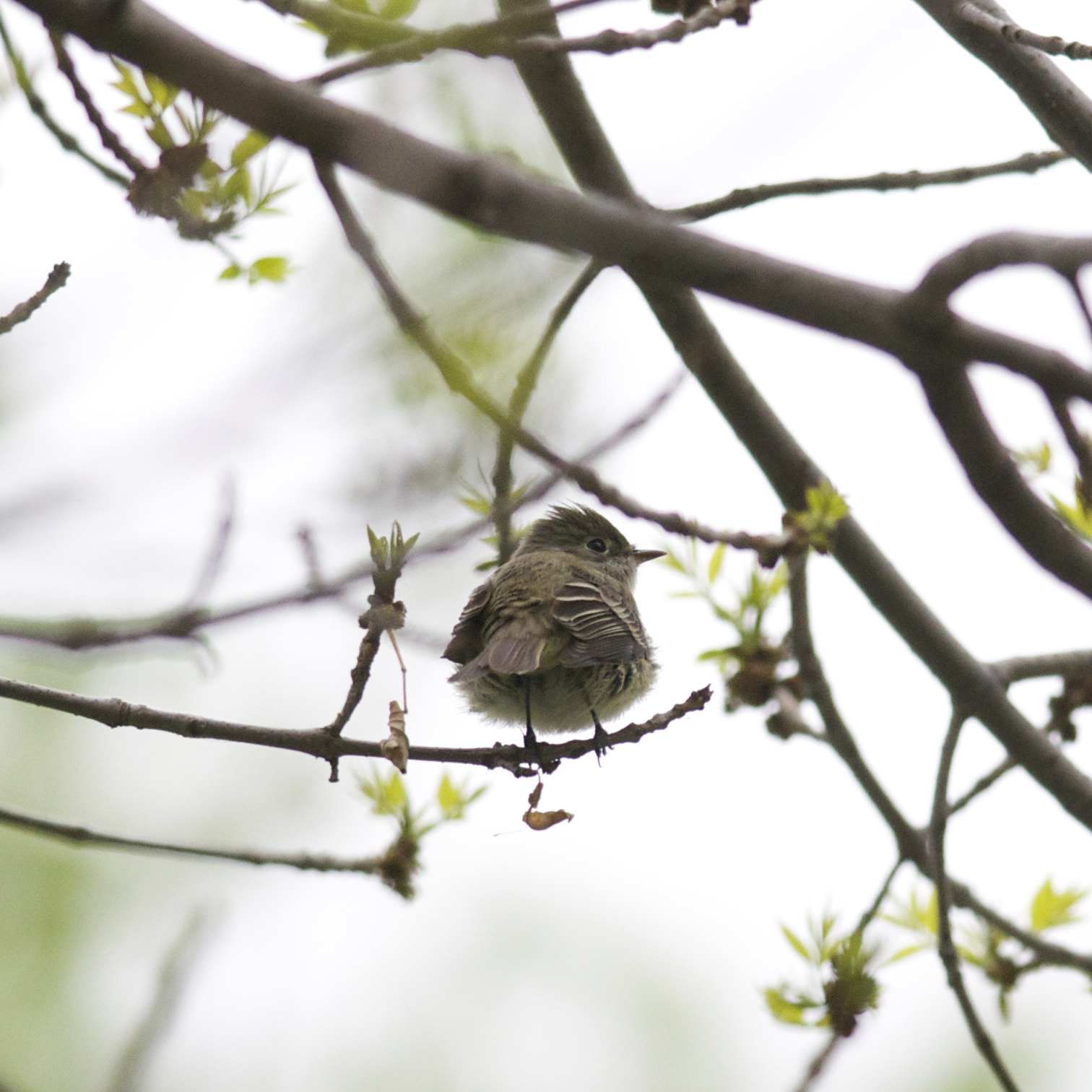
Once we started walking, a Least Flycatcher was among the first birds to give good views to all participants. I think it was somewhat frustrating for some novice birders to locate such a drab bird in the dark understory but once we were all on the little flycatcher he put on a good show feeding and calling loudly.
Least Flycatcher, Empidonax minimus, photo from Brooks, May 2012, not on this trip
We walked on through the forest and heard Veery singing from the bushes. A new species for me but definitely on the "BVD" (better view desired!) list. Here's a recording of the song from xeno-canto. Our leaders for the outing gave two descriptions of the call which seemed to me a very accurate characterization - the song sounds like the bird is "winding down" and "singing from the bottom of a rain barrel". You can actually see the winding down part in the sonogram.
Eventually we reached an overlook with well stocked bird feeders. These attracted Pine Siskins, White-breasted Nuthatch, American Goldfinch, Brown-headed Cowbird, Clay-coloured Sparrow, and another visitor which you will see below. Here are a few photos taken at the feeders before we returned by the same route.
Female Brown-headed Cowbird, Molothrus ater
Enjoying some niger seed, a Pine Siskin, Spinus pinus (isn't that a fantastic latin name)
Clay-coloured Sparrow, Spizella pallida
At one point there were three of these Red Squirrels, along with a Least Chipmunk, enjoying the sunflower seeds on and under the railing.
But what about that Grosbeak? We had seen nothing and heard little by the time we made it back to the parking lot but two of the group had taken a slight detour and found the bird singing right beside the main bike pathway. Once I heard this I went back by myself and soon heard the bird in the spot they had described. Rose-breasted Grosbeaks sound like "Robins in a hurry":
However, in a moment of classic birding frustration, despite the continuous singing within 30 feet of my face, I could not see the source of this distinctive song. So, in conclusion, did we find the elusive hybrid? Fourteen birders did not, two saw the bird as clear as day, and one (I) heard a Grosbeak right in front of me, grudgingly checked it off my list, and want to return for another look soon.
The past weekend began with the fourth Saturday of the Friends of Fish Creek Park Spring Birding Course. I was a little tired out after a week in the Gulf Islands with thirty-two of my Junior High students but made this an "NMT" outing by biking to the reservoir, which is why all images in this post are through a scope. It was certainly worth the effort as the weather was lovely with the sun periodically peaking out from between the clouds. We were entertained by a pair of Red-breasted Nuthatches emptying wood chips from their nest hole and, despite the songbirds being a little thin on the ground, we also watched a Ruby-crowned Kinglet singing boldly from the top of a tall spruce.
Unfortunately I didn't capture the nest cavity cleaning process in the above video but it's nice to see breeding behaviour in action anyway
South Glenmore Park is a mix of many habitat types: a stand of old growth spruce trees borders on aspen parkland which in turn borders on fragments of boreal forest in the Weaselhead Natural Area. Alongside these woodlands there are grassy fields, a river delta, and of course the reservoir itself. It was there where we found much of the bird activity with twenty-eight species on or beside the water, twelve of which were Alberta "first of year" for me, plus a life bird - the Say's Phoebe.
My life Say's Phoebe, Sayornis saya, seems much less interested in me than I am in him
The reservoir itself was covered in birds which gave great scope (and closer) views. The variety of waterfowl made for a productive learning experience for the participants as we were able to pick out and compare species. A Canvasback paddled around beside some Redheads, two pairs of Ring-necked Ducks hung out with a small flock of Lesser Scaup, and so on. Our group was perhaps most impressed by the Western Grebes, which were actively feeding and calling just a hundred metres or less from our viewpoint.
The Western Grebe, Aechmophorus occidentals, appears both stately and savage.
As is often the case, I learned a valuable bird identification lesson myself, in the form of a flock of thirty gulls with black heads that flew across the reservoir and landed on the far side. "More Franklin's!", I called out, assuming that they would match the hundred or so that were already there. "Bonaparte's Gulls", corrected our group's leader. Not exactly a rookie mistake - they are pretty close - but I should have known better and not made the immediate logical assumption, particularly as just four days earlier I had sailed through a flock of 5000+ Bonaparte's out on the West Coast. Birding is certainly a hobby where jumping to conclusions is all too easy!
Bonaparte's Gull, Chroicocephalus philadelphia, not on Glenmore Reservoir, but earlier in the week in the rain of the Gulf Islands.
In spite of this minor setback, I thoroughly enjoyed the morning's birding and am looking forward to next week's outing. More on the West Coast to follow in May...
Here's a list of species seen on this outing (plus two en route marked with *):
This Saturday morning, and for most of the next 11 Saturdays, I'm assisting with guiding a spring birdwatching course run by the Friends of Fish Creek Provincial Park. These courses are very popular with well over 100 participants going out basically every day of the week to various locations in Calgary. If you're interested, there are a few spots available for some days and the course information can be found here (update April 14th: link no longer works - just goes to FFCPP website as registration is closed). We had a nice morning birding North Glenmore Park and the Weaselhead. Highlights included great views of a very early arriving Eastern Phoebe, a small flock of White-winged Crossbills feeding low down in the trees, and a Northern Shrike - a life bird for me. It was also nice to see small groups of Trumpeter Swans on the Glenmore Reservoir, along with that other harbinger of spring waterfowl, a Northern Pintail. A few photos follow below, along with a complete species list.
A pair of Blue Jays flew through the parking lot while I was waiting for the rest of the group to arrive - nice birds for Calgary
Maybe they call it a Least Chipmunk because it fits in a tuna can bird feeder.
In a few days there will be no Pine Grosbeaks left in Calgary, as they head north, but this youngster was still hanging out doing it's best at a spring song.
A Red-breasted Nuthatch, also looking for treats at the feeders
This Eastern Phoebe has returned unusually early to a customary nesting site under the wooden arch bridge on the Weaselhead trails. We didn't see any insects but this bird was certainly finding them on the surface of the snow-covered creek. While the bird sat on a bankside perch performing the tell-"tail" phoebe tail flick, I was able to snap this shot which captures another good field mark - the dark smudges on either side of the breast.
We had great views of a small group of White-winged Crossbills feeding unusually low in the trees. As crossbill photos go, this one turned out ok.
Checking my list when I got home, I was surprised to find that this White-breasted Nuthatch was my first of the year - must be a book-keeping error!
A nice morning of birding with a friendly and keen group of people - I'm looking forward to the next one! Here's the list of species seen/heard:
We've just returned from a great long weekend camping trip to Kinbrook Island Provincial Park near Brooks, which is about 200km south-east of Calgary. The park is on the east shore of a large reservoir, Newell Lake, and the campground is basically an island covered in poplar trees and surrounded by marsh. The existence of these three habitats together in the middle of vast prairie grassland is, as you can see below, a real bird magnet.
In the campground there were several species of flycatcher ranging from the easily identified and bold to the tricky and hyperactive. (As usual all photos in the post are click to enlarge!)
Western Kingbird, Tyrannus verticalis
Eastern Kingbird, Tyrannus tyrannus
Least Flycatcher, Empidonax minimus - OK, I heard several Least Flycatchers, this bird was close by, and it looks like a Least Flycatcher but those empids are tricky!
A birding highlight of the weekend came while I was washing breakfast dishes. There was a flurry of activity in the understory. A group of 4 male Brown-headed Cowbirds chasing one female were displaying to each other on branches and, ultimately, on the grass about ten yards in front of me.
Brown-headed Cowbird, Molothrus ater
Brown-headed Cowbird, Molothrus ater
There are nice walks (if you aren't freaked out by bugs like our 3 year old!) around the marshes, including an interpretive trail around the northeast area that was a little long for our crew of preschoolers. The dominant species in this area is Red-winged Blackbirds, but spaced out among these territorial birds were Yellow-headed Blackbirds and a large number of Marsh Wrens.
During one of these walks we bumped into a group of birders doing the 13th Annual Brooks Species Count. They commented on the lack of shorebirds, an observation supported throughout the weekend and the drive back to Calgary (one yellowlegs, one snipe, and three large shorebirds on a far off muddy field was all I saw). I was generally surprised by the lack of birds on the main bodies of water in the park but along with the usually half dozen species of duck we did see Red-necked Grebes, Forster's Tern, and some American White Pelican.
American White Pelican, Pelecanus erythrorhynchos, displaying breeding season "horn"
This relative lack of species on the open water was entirely compensated for by the continual displays of flycatchers, Tree Swallows, Yellow Warblers, blackbirds, sparrows, and ever-friendly American Robins around the campsite. I would highly recommend this campsite as a destination for the birding-inclined camper or any family looking for a prairie getaway.
In total, 48 species were seen on the weekend getaway and a birder working the area in a more focused way would have no trouble finding many more. For those interested here's the list of species seen either at Kinbrook or in the immediate Brooks area: