Showing posts with label Bird Counts. Show all posts

Saturday, 25 May 2013

Counting in the Rain

Let's start with a typical spring bird count scene - identify these four duck species, click to enlarge if needed....
Answers at the bottom of this post!
Having missed last year's spring bird count I was excited to get out again this year.  I spent about six hours exploring my fairly nondescript section of prairie north of the town of Strathmore.  It's marked as  area 32 on the image below...

The wet and windy weather made finding songbirds somewhat challenging, although a surprise Rose-breasted Grosbeak showed up in a little clump of woodland.  The wetland birds were easy to find though, with the highlight being a slough with eight Double-crested Cormorants and seven Hooded Mergansers on the water along with an amazing eight Great Blue Herons and three Black-crowned Night-herons all lined up in less than a hundred yards of shoreline - I guess someone is keeping the fish stocked up!

Here are a few more photos from the day's count:
Black Tern, Chlidonias niger, not actually all that black but agrees that the weather is pretty crappy ;)
Wilson's Snipe, Gallinago delicata, more proof that Mother Nature has a sense of humour
Three Bank Swallows, Riparia riparia, arguing over personal space
Black-bellied Plover, Pluvialis squatarola, something of a spy shot of one of the day's rarer finds
I didn't see any Black-necked Stilts, Himantopus mexicanus, in the count area but this beauty was feeding by the road on the way home.
 Duck Quiz Answers (left to right): Gadwall, Canvasback, Blue-winged Teal, Lesser Scaup

Sunday, 10 March 2013

Year of the Woodpecker?

Regular followers of this blog may remember that my nemesis bird in Alberta was the Pileated Woodpecker.  I finally tracked one down early last year and finally had some decent views in the fall.  This year seems to be off to a different start on the woodpecker front!

To begin with, a Pileated Woodpecker was the very first bird I saw for the entire year. Arriving at dawn in the Shannon Terrace parking lot of Fish Creek Provincial Park for our January 1st bird count, one of these crow-sized woodpeckers flew across the valley calling as it went.  There have been more sightings since then, notably a pair of birds feeding at ground level by the bike path in Bebo Grove a short distance from our bird course group.

Above: Pileated Woodpecker, Dryocopus pileatus, Bebo Grove, Fish Creek Provincial Park
Below: Example of flight call from xeno-canto.org
On that January 1st bird count, even the Pileated wasn’t the woodpecker highlight of the day, as we found a Black-backed Woodpecker later in the morning.  There had been some sightings earlier in the winter and we soon found tell-tale signs of the feeding activity of a three-toed woodpecker species.  The three species in this group are specialist woodpeckers, needing mature coniferous forests with dead and dying trees, from which they meticulously peel the bark, searching for insect larvae.  The resulting pile of fine bark shavings in the snow around the base of these trees is distinctive but sometimes finding the responsible bird is a little trickier.  Eventually one of our group members spotted this beauty feeding high up on spruce trunk and we were able to watch it at work.
Black-backed Woodpecker, Picoides arcticus, Marshall Springs, Fish Creek Provincial Park
In the same genus (for now?) as the three-toed woodpeckers are the Calgary area's more common species – the Hairy Woodpecker and the ubiquitous Downy Woodpecker - both of which we also saw on that woodpecker-filled New Year's Day.  Although common, these two species can play tricks on birders, as they can be confused with each other.  Here’s the Hairy Woodpecker, in South Glenmore Park last year.
Hairy Woodpecker, Picoides villosus, South Glenmore Park, Calgary.
The red spot indicates that this is a male bird.
There are a few physical characteristics that help to separate the two species.  The Hairy is larger than the Downy, although there is a tiny bit of overlap between the smallest and largest of the two species.  The outer tail feathers on a Hairy are pure white - although this can be hard to see and is not universally true.  Less ambiguously, the bill is always proportionately larger in the Hairy – as long as the head.  However, the easiest way to tell the two species apart is their calls.  The Hairy is fairly flat in pitch while the Downy's call is distinctly descending (“Downy goes down”).  Here’s the Downy Woodpecker, this one at Inglewood Bird Sanctuary.  If you look closely you can see the black spots on the outer tail feathers and the bill is clearly shorter than the bird above, but it's that call that makes it clear, as you can hear below.
Above: Downy Woodpecker, Picoides pubescens, Inglewood Bird Sanctuary, Calgary.
No red spot on the head means this is a female.
Below: Example of call from xeno-canto.org
Four of Calgary’s woodpecker species on January 1st is a pretty good start to any birding year.  I’ve seen Northern Flicker since then which leaves three more common Southern Alberta woodpeckers – American Three-toed, Red-naped Sapsucker, and Yellow-bellied Sapsucker – to turn up for the remainder of the year.  Here’s to the year of the woodpecker!

Wednesday, 21 December 2011

Christmas Bird Count Continued

As promised, a few more Christmas Bird Count images to brighten up your mid-week.  More on Flickr if you're interested and Dan Arndt posted his own recollections of our count over on the Birds Calgary blog.
Our count group in the Weaselhead
Common Redpolls busy feeding
Hairy Woodpecker hammering away
A fairly appalling photo of a lifer juvenile Northern Goshawk
I believe I already mentioned there were a LOT of Pine Grosbeaks (male above, female "on approach")

Sunday, 18 December 2011

Christmas Bird Count

I joined 5 other birders for the 60th Annual Calgary Area Christmas Bird Count today.  We had a terrific day out exploring South Glenmore Park and the Weaselhead in lovely warm winter weather.  This year continues to be a great one for finches with dozens and dozens of Pine Grosbeaks.  We also found a few pleasant surprises such as Northern Goshawk, Hoary Redpoll, Ruffed Grouse, and Boreal Chickadee.  Here are a few photos with comments as necessary - I'll post some more later in the week.  I have also uploaded some to my Flickr account and Dan Arndt said he would be doing likewise in the next day or two.
If the day had a "theme" bird, I think this was it.  I forget the final tally but we certainly saw a lot more than the 6 Pine Grosbeaks of last year's count!
A single Boreal Chickadee tagging along with half a dozen Black-capped gave me best ever views of this species.
A pair of Ruffed Grouse flushed up into the trees as we walked along a trail beside the reservoir.  The intricate pattern of this bird's feathers is remarkable.
We engaged in what John Acorn refers to as "the Great Redpoll Debate" but remain confident that this is a Hoary Redpoll (in front of a Common) based on the white tail coverts, broad white band on the wing, and overall "frostier" appearance.

Monday, 30 May 2011

Calgary May Species Count

This weekend brought the annual spring species count - a team of birders fanning out to count all the bird species within an 80km radius of Calgary.  My partner and I were assigned an area north of Strathmore - a fairly unremarkable stretch of rolling prairie that was nonetheless filled with birds and we managed to round up 61 species on a lovely sunny day of birding.  The sloughs were filled to the brim from the past week of rainy weather so duck counting was a large part of the day with many Mallards, Gadwall, American Wigeon, Blue-winged Teal, and Northern Shovelers.
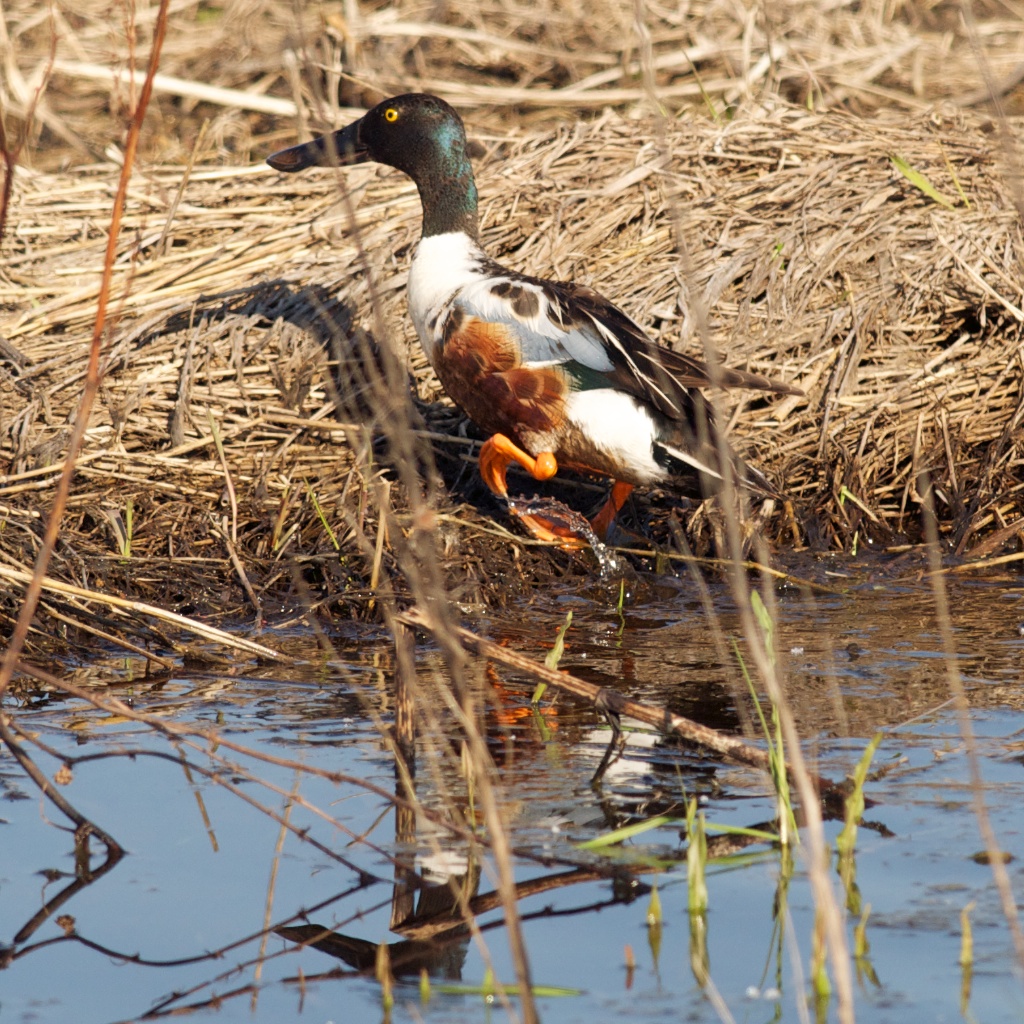
Northern Shoveler, Anas clypeata, looking a little goofy
Last week, when we drove out to Kinbrook Island, we had seen lots of hawks in the area immediately east of Strathmore so I was expecting more good things today.  We saw a total of 14 Swainson's Hawks and 7 Red-tailed Hawks, some at very close distances as they performed aerial courtship displays, and some on or around nests.  Another raptor highlight was a Northern Harrier, easily identified by its trademark low altitude hunting across a field and along a roadside ditch.  For one heart-stopping moment we thought that the hawk was going to be hit by a passing truck but fortunately it continued its leisurely glide to the other side and then circled around to make another close pass behind us.
Swainson's Hawk, Buteo swainsoni
There were relatively few shorebirds to be found, perhaps due to high water levels, but we did see a number of Marbled Godwits, several Wilson's Snipe, and a huge flock of Wilson's Phalaropes.  We also found a Long-billed Curlew which was very cooperative while we admired the cinnamon belly through the scope and double checked our field guide.
Wilson's Snipe, Gallinago delicata
Long-billed Curlew, Numenius americanus, Digiscoping skills are slowly improving!
Birding by ear is not an area of strength for me but I had lots of practice and a good teacher on this trip.  We found many sparrows including Savannah, Clay-coloured, Vesper, Lark and Chipping, but the "small bird" highlight for me was a large flock of Cliff Swallows swooping around our heads and under us through a culvert!  Just a short distance down the road from that experience we found three Horned Larks, another new bird for me.
Horned Lark, Eremophila alpestris
Another great day out on the prairie and I found once again that participating in a bird count is a wonderful way to hone one's birding skills.  I'll wrap this post up with a map of the route we took through the area and a list of species seen.

1 Canada Goose
2 Gadwall
3 American Wigeon
4 Mallard
5 Blue-winged Teal
6 Cinnamon Teal
7 Northern Shoveler
8 Northern Pintail
9 Canvasback
10 Redhead
11 Lesser Scaup
12 Bufflehead
13 Common Goldeneye
14 Ruddy Duck
15 Ring-necked Pheasant
16 Pied-billed Grebe
17 Horned Grebe
18 Eared Grebe
19 Great Blue Heron
20 Northern Harrier
21 Swainson's Hawk
22 Red-tailed Hawk
23 American Kestrel
24 Merlin
25 American Coot
26 Killdeer
27 American Avocet
28 Willet
29 Spotted Sandpiper
30 Long-billed Curlew
31 Marbled Godwit
32 Wilson's Snipe
33 Wilson's Phalarope
34 Rock Pigeon
35 Mourning Dove
36 Least Flycatcher
37 Western Kingbird
38 Eastern Kingbird
39 Black-billed Magpie
40 American Crow
41 Horned Lark
42 Bank Swallow
43 Cliff Swallow
44 Barn Swallow
45 House Wren
46 Marsh Wren
47 American Robin
48 European Starling
49 Yellow Warbler
50 Chipping Sparrow
51 Clay-colored Sparrow
52 Vesper Sparrow
53 Lark Sparrow
54 Savannah Sparrow
55 Red-winged Blackbird
56 Western Meadowlark
57 Yellow-headed Blackbird
58 Brewer's Blackbird
59 Brown-headed Cowbird
60 American Goldfinch
61 House Sparrow