Monday, 3 October 2011

Birding When You Can't Bird

Two weeks of silence on this blog correlates to two weeks of little to no birding for me.  A big flock of Common Grackle's moving through the neighbourhood were a treat (and a new NMT bird) while walking the dog.  A Blue Jay was a colourful and relatively rare sight in urban Calgary.  And a Bald Eagle made a majestic low pass over our raft when I was out with my students on the river on Friday - it was nice to see Grade 8's getting excited about birds.  Anyway, those are slim pickings for migration season but the new school year and some busy goings-on at home have kept the scope in the cupboard and the field guide on the shelf.

All this inactivity has got me thinking about ways we enjoy birds when, for whatever set of reasons, we can't actually go out and "bird".  The first, and for many people only, point of engagement with wild birds are feeders.  My own experience with these in Alberta has been somewhat frustrating.  With memories of vast flocks of American Goldfinch swarming over the niger seed at my Mom and Dad's house in Ontario, when we moved into this house I gamely hung feeders in the front and back yards filled with bags of supermarket bird seed.  This did not go well.  The front yard was largely the domain of House Sparrows, with the occasional brave Black-capped Chickadee and Rock Pigeons picking over the mess underneath.  The backyard was just House Sparrows.

With some help from the experts at The Wild Bird Store, on Macleod Trail , I now have a plan.  With three feeders, all in the backyard, there is one place for the inescapable House Sparrows to fill up on millet (on the plus side, I'm feeding the Merlins too!)  The two feeders closer to the house hold high quality nuthatch and chickadee mix and a finch friendly mix.  As you can see, the results have been positive.
A young House Finch, Carpodacus mexicanus
Adult House Finch (on the right) seems prepared to brave the aggressive sparrows...
...but the sparrows don't like that
By far the best views I've had of a Pine Siskin, Spinus pinus, and looking forward to more over the winter
It will be interesting to see what sort of birds I can attract once winter begins.  In any case I will keep the blog updated with any worthwhile photos.

On the topic of photos, I'll have another post in the next few days highlighting another way to bird when you can't bird and showcase a few talented fellow Albertan photographers.

Sunday, 18 September 2011

Fall Migrants at Namaka Lake

"Of course as soon as the first snow hits, everything just disappears"

That's a comment overheard at the last Nature Calgary Bird Study Group meeting.  As we approach late September in Alberta there is a certain inevitability to the first snowfall and it will indeed chase away many lingering migrants.  With an uncertain and dwindling number of good migratory birding days left, I've been trying to squeeze in a few trips.

On Friday morning I managed to swing by Confederation Park on my way to school.  Large flocks of Wilson's and Yellow-rumped Warblers were a nice way to start the day.  My NMT list (explanation here) grew as well, with Orange-crowned Warbler, Ruby-crowned Kinglet, and (with the help of some experienced fellow birders) a Red-eyed Vireo.
MABO - Red-eyed Vireo - band 715
Red-eyed Vireo looks like it means business!  Image From Flickr Creative Commons taken by SeabrookeLeckie.com
Feeling suitably pumped up by that experience I dragged myself out of bed in the dark this morning and headed out to Namaka Lake, 70km SE of the city near Strathmore.  This is a designated Important Bird Area and a spot that I had been wanting to check out for some time.  Namaka certainly made a great first impression.  A fiery sunrise lit up the sky ahead of me all the way there and I arrived at the east access point five minutes before the sun broke the horizon.  As I walked towards the lake the grass was lit up golden brown.  I couldn't resist the urge to stride through stands that were five feet high, with the loaded ears bouncing off my chest sending seeds for next year flying out in all directions.  

Overblown pastoral prose aside, the lighting was pretty great for the birds too.  One of the first that I saw was a Le Conte's Sparrow.  A life bird for me and, based on my reading back at home, an amazingly cooperative example of its kind!
Le Conte's Sparrow, click to enlarge, image colour has not been manipulated - the sunrise was just this awesome! 
On the lake itself there was no shortage of bird life either.  A few late shorebirds were hanging around the shoreline: a flock of Semipalmated Sandpipers hanging out with a couple of Lesser Yellowlegs, and a few Killdeer scattered around.  The waterfowl were much more numerous with American Coot, and three Grebe species (Eared, Horned, and Western) being particularly noticeable.  The real treat on the water though was the American White Pelicans.
I know it's out of focus but this image cracks me up for some reason.  American White Pelican and a family of Ruddy Ducks
 The flocks of pelicans gorging themselves was quite a sight and I captured some digiscope video.


The video looks pretty decent in fullscreen.  Sorry about the sniffling - it was a cool but great morning of birding!

Saturday, 10 September 2011

The Warbler That Thinks It's a Nuthatch

Nuthatches are an interesting group of birds - superficially related to woodpeckers in habitat and behaviour but in fact a distinct group.  They forage for food by running up and (unlike the woodpeckers) down tree trunks, foraging for insects and seeds.  In the Calgary region, there are two common species - Red-breasted and White-breasted, which is pictured below at Pearce Estates.  This profile view highlights the slightly upturned beak, wonderfully adapted for prying under bark.
White-breasted Nuthatch, Sitta carolinensis
During our August vacation to Ontario, we spent some time on an island cottage on the Rideau Canal.  As we were hauling bags from the boathouse to the main building I saw some movement in the corner of my eye which that little part of my brain that is always birding (yes, you all know what I'm talking about!) processed as "black and white on the head + running around tree trunk = white-breasted nuthatch".  When I had a chance to put down the bags, pick up my binos, and head back out I realized it was something a little more special.  In addition to Song Sparrows, American Goldfinches, Cedar Waxwings, Nashville Warblers, and an Eastern Phoebe, our little island was also home to a pair of Black and White Warblers.

Black-and-white Warbler, Mniotilta varia - Click image to enlarge
As you can see, this quirky species feeds much like the nuthatches and creepers, foraging between the bark for insects.  So strongly is this behaviour exhibited that they were once mistakenly named "black-and-white creepers".  The great benefit for birdwatchers is that the birds' feeding habits draw them down from the tree canopy making them more readily observable than many other warblers.  Add to this the bold stripes that make identification a snap compared to many other warblers and I may have a new favourite wood-warbler!
More nuthatch-like antics! - again click to enlarge
This is supposedly a Calgary bird blog so what about the Alberta distribution of these birds?  I have yet to add one to my Alberta list but the Official List of the Birds of Alberta gives them a 'findability' of 2:  "species [that] are generally less abundant and widespread".  Despite the lower ranking, and the fact that Alberta is the western limit of their range, these birds are still regulars in Calgary and were reported last week in Confederation Park.  A couple of weeks before that I was with a group that found one in Inglewood Bird Sanctuary, although I wasn't able to get on the bird before it disappeared.

In any case these are charming and unique warblers.  Next time you are out in the spring, summer, or fall, if a flash of black and white running around a tree catches your eye, I recommend taking a closer look.


Monday, 5 September 2011

Fallout

Last week was the first week of school - 3 days of meetings and planning followed by 2 days of new kids, new classes, and new routines makes for an exciting and busy week.  That should explain the lack of posts, as well as the monumentally poor timing (from my perspective!) of 36 straight hours of rain resulting in a substantial fallout in the Calgary area.

What is a fallout?  In birding terms, fallout refers to a weather system that grounds migratory birds and/or forces seabirds to land.  A recent example is the frenetic birding on the east coast as a result of Hurricane Irene which merited its own blog.  You can also read a nice summary of the hurricane birding to be found here.  White-tailed Tropicbirds and South Polar Skuas are fantastic birds for New England (or anywhere?) but there were also some remarkable science stories that emerged from this storm.  I was particularly struck by this tale of a radio-tagged Whimbrel, which flew more or less straight through the hurricane and emerged unscathed.

While our recent wet weather was considerably less dramatic than a Category 3 hurricane, the resulting clouds of warblers and vireos delighted local birders.  A particularly nice spot to catch migrating songbirds is an area of shrubby wetland in Confederation Park (click on the link at the top of this post for a map).  One observer reported eleven species of warbler on his morning commute around this location while another added Chestnut-sided Warbler to the list on the same day.  This area has the added bonus of being my "local patch" - a short walk from work and home.

Can you find 11 species of warbler in this photo?  (Photo taken with smartphone)
Joking aside, I didn't even have time to grab my camera but just headed straight over to the park after school to see what I could find.  Fall warblers are really not an area of strength in my birding skill set but there was much to see.  The bushes were jumping with tiny birds, busily refuelling for the next leg of their migration.  I was able to positively identify Wilson's Warbler, Tennessee Warbler, American Redstart, Northern Waterthrush, Blackpoll Warbler, and Yellow-rumped Warbler, several of which are new NMT (non-motorized transport) birds for me.  Other highlights included a pair of handsomely streaked Lincoln's Sparrows and a Rose-breasted Grosbeak.  This last bird was an Alberta first for me and a special species, as it was partially responsible for getting me into birding in the first place (read under "About Me" for more details).

Not bad for a half-hour of neighbourhood birding and whenever there is poor weather bringing the potential of fallout, I will remember to get out and investigate.

Thursday, 25 August 2011

A Prairie Drive and A Milestone

Yesterday I headed out on a hot prairie drive to Frank Lake and Weed Lake, two of the best spots for waterfowl and shorebirds in the Calgary region.  I had an enjoyable day out and, when I tabulated my list at home, I made a pleasant discovery - scroll down for more.

A map of my route (I went anti-clockwise).  Click to enlarge.

Highlights included a juvenile Black-crowned Night Heron that I flushed from the reeds and a Northern Harrier hunting shorebirds along the edge of Frank Lake.  I had my digiscoping kit with me and caught some images of the shorebirds and others.
Long-billed Curlews are stunningly elegant birds
Marbled Godwits aren't bad either
As I've mentioned before, sometimes the scope is kind of overkill!  Nevertheless, this Barn Swallow  apparently doesn't mind posing.
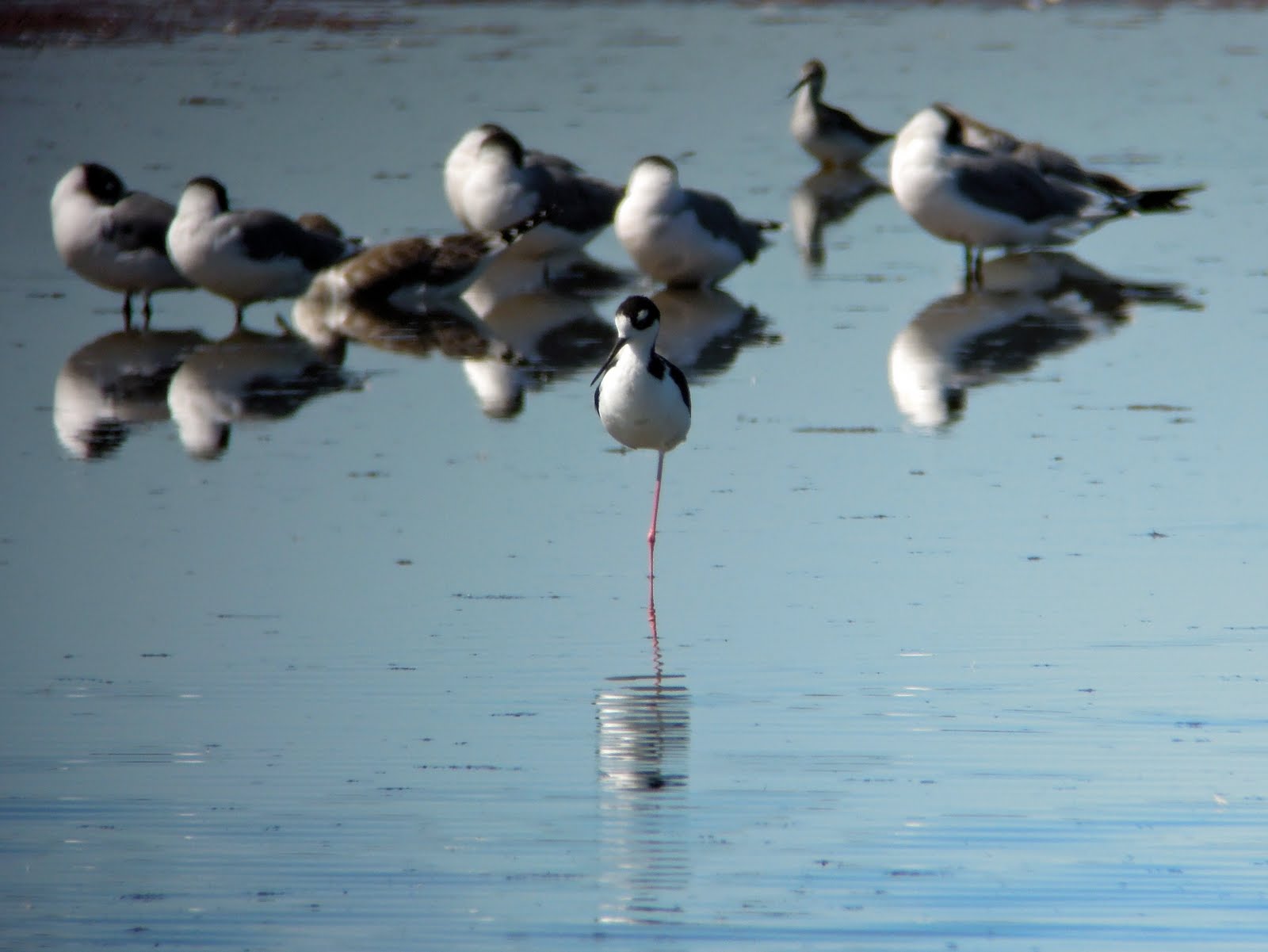
A Black-necked Stilt pauses to reflect (while Franklin's Gulls take a nap)
These are Red-necked Phalaropes - at least I hope it's not a botched identification because that's my 200th ABA (i.e. North American) species!
Calidris sandpipers are confusing - what species do you think this one is, and why?

Saturday, 20 August 2011

Calgary Birder now Smartphone Friendly!

For the 2% of my readers last month that were on mobile devices, there is now an smartphone friendly version of this website.  Visit the site on your mobile and check it out!

Have a nice day and good birding!

Friday, 19 August 2011

Looking for Warblers at the Bird Sanctuary

I joined a Nature Calgary outing to look for fall migrants at the Inglewood Bird Sanctuary.  After a slow start we eventually found 5 species of warbler: Yellow-rumped, Yellow, Blackpoll, Wilson's and Northern Waterthrush (which is of course, not a thrush).  There were a host of other great birds to be had, as can be seen below (click any image to enlarge)
Immature Great Blue Heron sitting on the rail within a few yards of us! 
Another immature, this one a Baltimore Oriole
Northern Rough-winged Swallow - dozens of them sitting on bushes by the water 
By far the best views I've had of Warbling Vireo - half-decent photos too!
Same vireo again, foraging in the branches
Western Wood Pewee - nice to have an expert guide to help sort out the Flycatchers
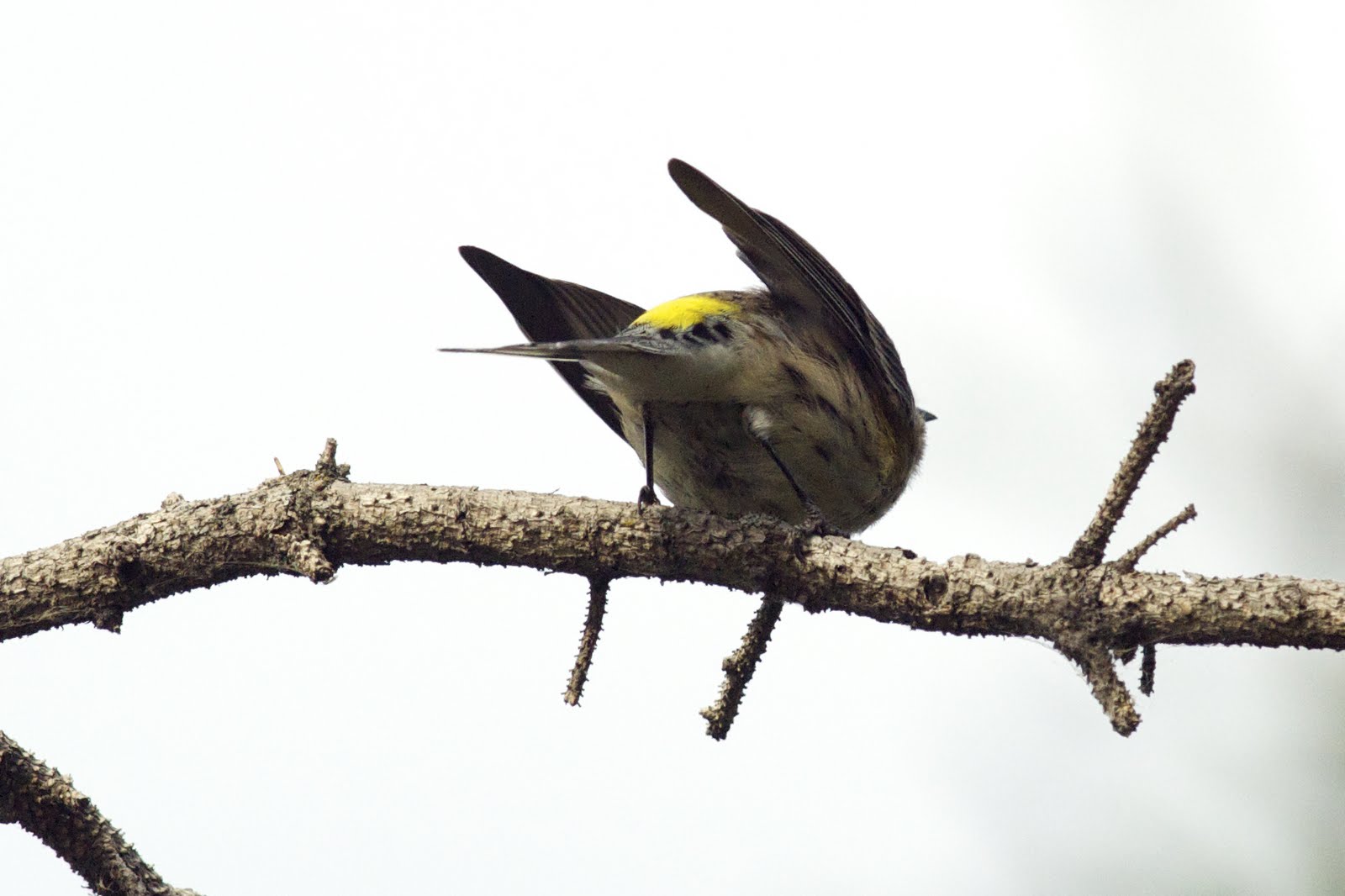
The only warbler I managed to photograph.  What species is this....?

...Yellow-rumped!  This is a hatch year bird.