Thursday, 25 August 2011

A Prairie Drive and A Milestone

Yesterday I headed out on a hot prairie drive to Frank Lake and Weed Lake, two of the best spots for waterfowl and shorebirds in the Calgary region.  I had an enjoyable day out and, when I tabulated my list at home, I made a pleasant discovery - scroll down for more.

A map of my route (I went anti-clockwise).  Click to enlarge.

Highlights included a juvenile Black-crowned Night Heron that I flushed from the reeds and a Northern Harrier hunting shorebirds along the edge of Frank Lake.  I had my digiscoping kit with me and caught some images of the shorebirds and others.
Long-billed Curlews are stunningly elegant birds
Marbled Godwits aren't bad either
As I've mentioned before, sometimes the scope is kind of overkill!  Nevertheless, this Barn Swallow  apparently doesn't mind posing.
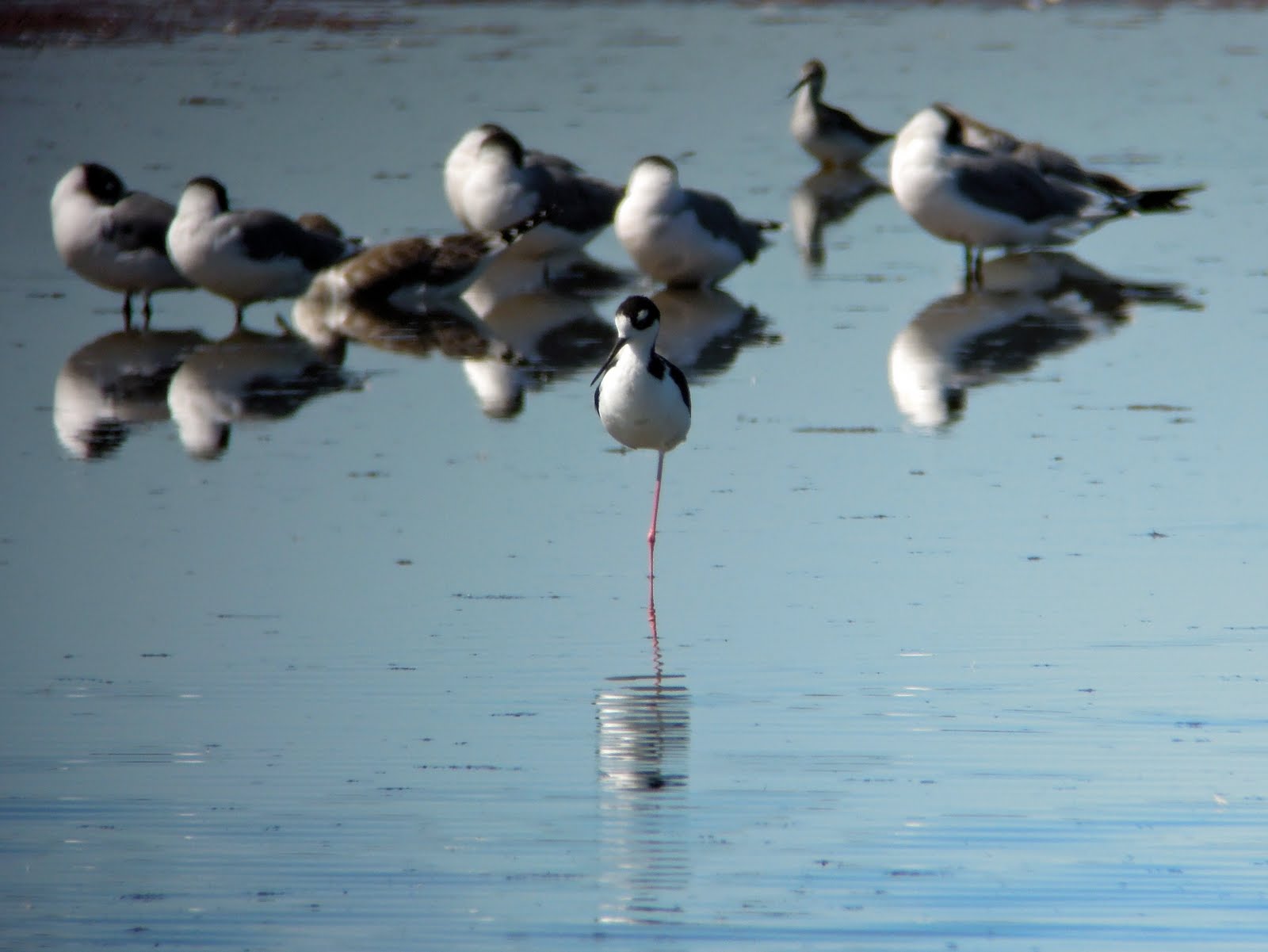
A Black-necked Stilt pauses to reflect (while Franklin's Gulls take a nap)
These are Red-necked Phalaropes - at least I hope it's not a botched identification because that's my 200th ABA (i.e. North American) species!
Calidris sandpipers are confusing - what species do you think this one is, and why?

Saturday, 20 August 2011

Calgary Birder now Smartphone Friendly!

For the 2% of my readers last month that were on mobile devices, there is now an smartphone friendly version of this website.  Visit the site on your mobile and check it out!

Have a nice day and good birding!

Friday, 19 August 2011

Looking for Warblers at the Bird Sanctuary

I joined a Nature Calgary outing to look for fall migrants at the Inglewood Bird Sanctuary.  After a slow start we eventually found 5 species of warbler: Yellow-rumped, Yellow, Blackpoll, Wilson's and Northern Waterthrush (which is of course, not a thrush).  There were a host of other great birds to be had, as can be seen below (click any image to enlarge)
Immature Great Blue Heron sitting on the rail within a few yards of us! 
Another immature, this one a Baltimore Oriole
Northern Rough-winged Swallow - dozens of them sitting on bushes by the water 
By far the best views I've had of Warbling Vireo - half-decent photos too!
Same vireo again, foraging in the branches
Western Wood Pewee - nice to have an expert guide to help sort out the Flycatchers
The only warbler I managed to photograph.  What species is this....?

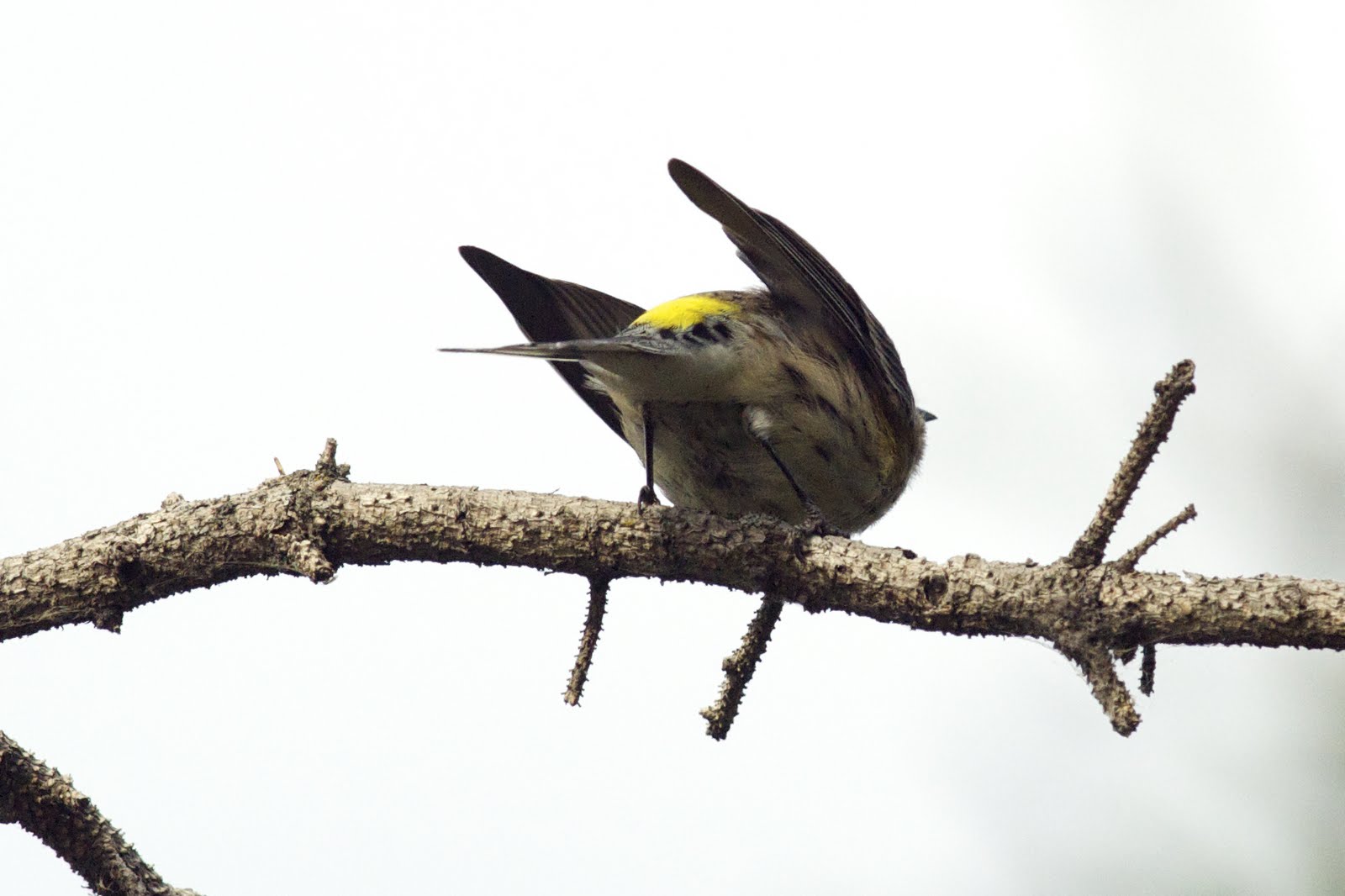
...Yellow-rumped!  This is a hatch year bird.


Wednesday, 17 August 2011

Weaselhead by Water

Tuesday was a lovely day for a paddle on the Glenmore Reservoir.  The water levels are still very high and I was also able to paddle a long way up the Elbow River.  The marshy area where the river enters the reservoir was extensively flooded and there was some very cool paddling in among the bushes.
West end of Glenmore Reservoir, photo taken with smartphone
The birding was relatively sparse, at least in part because of the time of day (11:30 to 2:30).  Despite this there were some neat sightings along the way.
Spotted Sandpipers aren't very spotted at this time of year but there were many of them along the south shore of the reservoir, including these two squabbling for space on a log.  There were also many Cedar Waxwings and some tantalizing glimpses of warblers such as Wilson's and Yellow Warblers.  Closer to the west end of the reservoir I enjoyed watching this Least Flycatcher hunting among some shrubs.
Just around the corner I surprised a juvenile Cooper's Hawk.  This was to be the first of two accipiters for the day as a Sharp-shinned Hawk flew across in front of me as I was paddling up a narrow channel in the Weaselhead.
Heading back across the reservoir there were a few ducks, gulls, and grebes scattered across the water but I most enjoyed watching three Double-crested Cormorants swimming and sunning themselves along the mouth of the river.

Friday, 5 August 2011

Birding in Ontario

We're off on holiday again and have spent a few days with friends in Eastern Ontario cottage country.  It's interesting to notice how birds that may be unusual in one area of the country have entirely different distributions elsewhere - one person's rarity is another person's "trash" bird (although I'm really not a big fan of that term).  Turkey Vultures are an obvious Alberta vs. Ontario example.  Another example is the Common Loon, which you get to see up close all the time here.  Our hosts were reminding me of this as they had been very excited about Bald Eagles on the west coast when we were kayaking with them a few years ago.  We had a laugh when they slowly realized that there is seemingly one on every island and here in Ontario the tables are turned!
Common Loon, Gavia immer
The islands on Big Rideau Lake are filled with songbirds, which merit their own post at a later date.  However, there was plenty to see out on the water as well, including this lifer Caspian Tern which wheeled and dove over the lake affording great view of its hunting prowess.
Caspian Tern, Hydroprogne caspia

Saturday, 30 July 2011

Fish Creek NMT Birding

A nice sunny Thursday led to a great bike ride along the Bow River.  I took the C-train (Calgary's light rail transit) down to Fish Creek Provincial Park in the city's south and then rode home along the river.  It was a great opportunity to increase my NMT list (Non-Motorized Transport), for which I'm allowing myself transit use, as long as I return home under my own power - this seems within the spirit of low impact birding.  Here's my route back from the LRT station.  The distance was actually about 45km but the online map cuts the corners and I didn't want to pinpoint my house on a public google map!

View Fish Creek to Home via Bow River Pathway in a larger map

This route passes through a lot of Calgary's birding hotspots, mostly riverside poplar stands and some open grassland areas.  Here's what I saw along with some photos.

The first birds to pop in to view were Rock Pigeons and House Sparrows, but I soon found a more interesting Brown-Headed Cowbird juvenile which was waiting for food from some unsuspecting host.  A Northern Flicker was nearby and calling to its mate as it circled around a tall snag.  I then headed to the creek, finding friendly Black-capped Chickadees as well as Downy Woodpeckers and a White-breasted Nuthatch.  In the creek itself, this family of Common Mergansers were learning how to find food and navigate the swift water.
"Hey Mom, what are you looking at?"
"Follow me kids!"
Further down the creek I discovered a small colony of Bank Swallows and set up the scope to have a good look from a discreet distance.  I tried to digiscope a couple of shots but met with limited success on the swallows, although a nearby Spotted Sandpiper gave better results.

Is that Bigfoot? A UFO?  The second gunman behind the grassy knoll?  No, it's a Bank Swallow!
The Spotted Sandpiper worked out a lot better!
Continuing east towards the river, I saw an Osprey flying overhead and then a Swainson's Hawk high up over the south edge of the valley.  There were many flycatchers working an open area of meadow surrounded by poplars and Eastern Phoebe and Least Flycatcher were both identifiable, as were small flocks of Cedar Waxwings and a pair of American Goldfinch.  Watching over the whole area from a wire perch was this American Kestrel.
American Kestrel
Arriving at Hull's Wood and the boat launch on the Bow River, the kestrel's cousin the Merlin was high up in a tree, as well as the first American Robin of the day.  Close to the river there were many small songbirds evident such as Yellow Warblers and Clay-coloured Sparrows.   There were also tricky to identify immatures and fleeting glimpses such as the backside of what was probably a vireo.  On the upside there were several House Wrens which were both bold and vocal - my general sense was of a nervous breeding pair with some fairly mature and curious youngsters.
House Wren
Having taken about two and half hours to ride less than ten kilometres, I unfortunately needed to pick up the pace a little and headed up the Bow River.  There was still much to see: a Double Crested Cormorant flew up the river and an American White Pelican was heading in the opposite direction.  There were the usual Mallards and Canada Geese on the river and, just before I left the park, there were two Eastern Kingbirds, perched on the only piece of tall shrubbery in the middle of a huge meadow in Bankside.  A pair of Gray Catbirds were "meowing" to each other on the edge of a shallow pond and more Least Flycatchers were hunting nearby.
Gray Catbird
At Carburn Park, there were Common Goldeneye and Chipping Sparrows to add to the list as I rode through and a Bald Eagle on the far bank of the river - they are always worth stopping for.  Heading up the Western Headworks Canal, more sandpipers prowled the banks while a lone Hooded Merganser was hunting in the water and Cliff Swallows swooped under the bridges.  Rejoining the Bow River at Pearce Estates, another small pond revealed Red-winged Blackbirds and Tree Swallows, and the weir improvements had a flock of Ring-billed Gulls.  

That about wrapped up the day except for American Crows and remarkably the first Black-billed Magpies  of the day, which I managed to ride 44.6 of 44.9 km back to my house without seeing!  A surprising end to a relaxed day of birding and exercise.

Monday, 25 July 2011

Brood Parasitism in Action

We spent the weekend in Canmore and, while enjoying a patio dinner, spotted a Dark-eyed Junco busy providing dinner to a juvenile.  The young bird seemed altogether too big- perhaps 20% larger than the "parent" - and on closer investigation turned out to be a Brown-headed Cowbird.
Dark-eyed junco - the unsuspecting foster parent
All three species of cowbird that breed in North America are brood parasites - they lay their eggs in the nest of other breeding species.  Some birds such as Redhead and Ruddy Ducks as well as the two North American Cuckoo species do this on an occasional, opportunistic basis.  Brown-headed Cowbirds however, like the Old World Cuckoos, have entirely done away with nesting and lay a dozen or more eggs per season  in the nests of over 200 different species.  Unlike the European cuckoos, cowbird hatchlings do not push their foster siblings out of the nest but are usually larger and born sooner so the host species offspring only survive if they are not outcompeted for food.
Young cowbird waiting for its next meal...
...and having a little nap!
The impact of this breeding behaviour on songbird populations is significant.  Some species have defences against the cowbird.  For example, the Gray Catbird can recognize the parasitic eggs and eject them from the nest while the Yellow Warbler simply builds a new nest right on top of the parasitized nest and starts with a new batch of eggs.  Most birds do not have this mechanism and, while that's all well and good for common species such as the above Junco, it can be a real threat to rarer species such as Kirtland's Warbler and Black-headed Vireo.  In fact there's a pernicious one-two punch at work here, as some species are threatened by clearing and fragmentation of forest and the cowbirds thrive in marginal habitat - the border between grassland and forest created when forest is cleared.

Information in this post is from The Sibley Guide to Bird Life and Behaviour and the excellent Birdwatcher's Companion to North American Birdlife by C.W. Leahy

Update July 28th - I just discovered that there was a similar post on another Calgary bird blog a couple of weeks ago.  You can find it here