Friday, 29 April 2011

Puffins and Petrels in Peril

Three years ago we visited Newfoundland for our first family vacation with our son.  The birding and wildlife watching were highlights of the trip and among our best experiences was a tour of the Witless Bay Ecological Reserve, just half an hour south of St. John’s.  The reserve consists of four islands with large concentrations of nesting seabirds, notably Black-legged Kittiwakes, Atlantic Puffins, Common Murres, Razorbills, and other alcids.  We took a boat tour with the excellent O’Brien’s Whale and Bird Tours and before getting to the principal point of this post, here’s a sampling of what we saw that day. (All images clickable for full size)
Atlantic Puffins nesting in burrows - suitable island or sea stack habitat is critical so birds are protected from predators such as foxes or coyotes

"On the third day in Newfoundland my true love gave to me: three Atlantic Puffins, two Common Murre, and a Razorbill carrying capelin."

Not just about the birds: Humpback Whale beginning a deep dive

Black-legged Kittiwake family

Hundreds of thousands of nesting birds - here mostly Common Murre and Kittiwakes - this image definitely worth clicking to enlarge
Unfortunately, there is a potential threat to this ecological treasure in the form of a proposed new housing development near the island.  Artificial light sources can have a significant impact on the movement of wildlife at night and young birds, just leaving the nest and learning to fly, may be particularly vulnerable as they can easily become disoriented.  I came across this article on the ABA (American Birding Association) website earlier this week which details the issue and suggests potential courses of action.  If you have been to this reserve, would like to go one day, or just enjoy seabirds and are concerned about maintaining healthy populations, I encourage you to click through and make your voice heard. 

Tuesday, 26 April 2011

Lifer Grebes in the Park

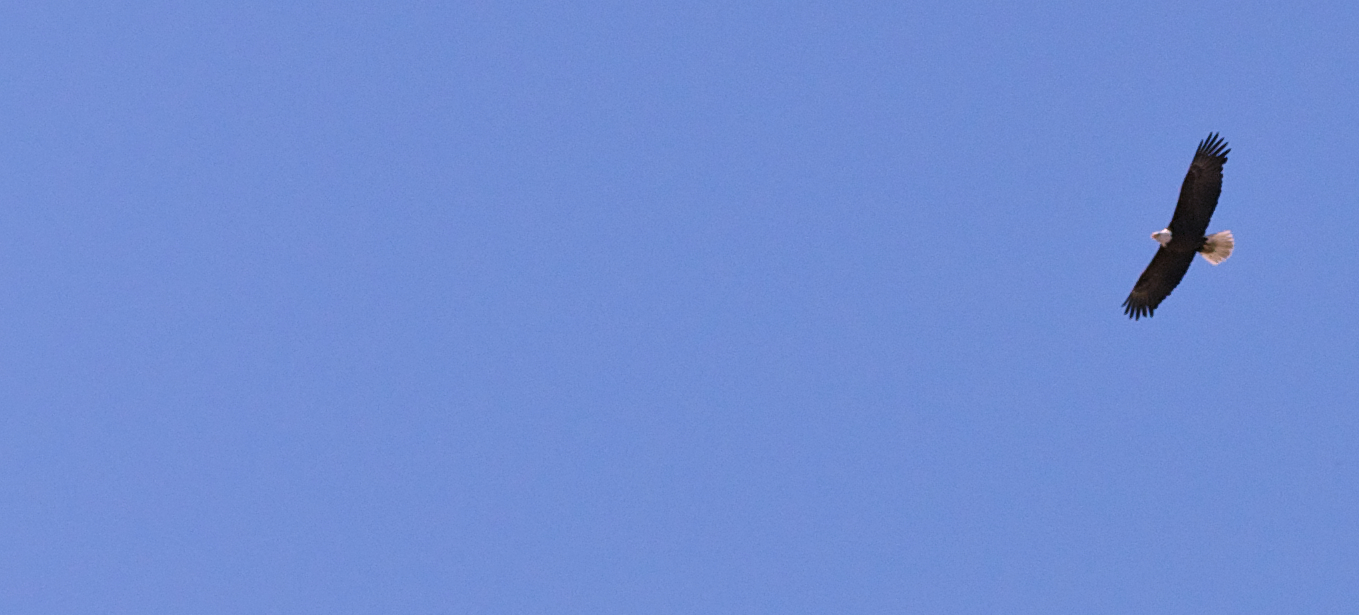
As promised, some more photos from Sunday's outing to Carburn Park.  My main motivation for picking this destination was the reports of Red-necked Grebes on the Bow River at this spot.  With some glorious spring sunshine I spent about half an hour exploring the brush along the east bank of the river.  There were many of "the usual suspects" including Black-capped Chickadees looking for handouts, Northern Flicker chasing each other around a tree trunk, and a friendly White-breasted Nuthatch (first of the year, surprisingly enough).  Watching over all of this, way, way up in the blue, was a Bald Eagle.
Bald Eagle, Haliaeetus leucocephalus 
Eventually I headed down to the Eric Harvie Bridge, which links the park to the Southland dog park.  I wasn't anticipating finding much here, because of all the dogs swimming in this section of the river.  To my surprise though this Horned Grebe was hunting right underneath the bridge.
Horned Grebe, Podiceps auritus
Although the water was a little murky with the spring runoff, the grebe could be seen paddling around under the water with those big lobed toes.  Apparently there was something grebe friendly about this spot in the river, where the water slows down and the channel widens before splitting around an island.  Upstream of the bridge was this scene...
One of these Grebes is not like the others
All of these are Red-necked Grebes except for the Horned Grebe front and centre.  There was an angler on the bank just 20 or 30 yards from these snoozing birds so I felt comfortable walking up and snapping a few closer shots and, although the sun was on exactly the wrong side of the river, I managed to get a half decent picture of the namesake field mark and the nice clean white cheeks.
Red-necked Grebes, Podiceps grisegena
A few minutes later I was heading back to the car, via a brief encounter with the previously blogged Yellow-rumped Warbler.  Two life birds, two more first of year, and I was sweating in shorts and a T-shirt - finally spring birding in spring weather!

Sunday, 24 April 2011

A Warbler for Earth Day Weekend

Based on the buzz on Albertabird, it seemed like Carburn Park was a good bet for a quick hour of Sunday afternoon birding.  My target species were the reported Horned and Red-necked Grebes which were potential lifers - yes, I know I'm new at this!  More on those when I have time to process photos later in the week.  As I was getting ready to leave I had a pleasant surprise in the form of a Yellow-Rumped Warbler.
Yellow-rumped Warbler (Myrtle), Dendroica coronata coronata, Click to Enlarge
This male was of the "myrtle" sub-species.  Some sources suggest that, like the red and yellow-shafted Northern Flickers, these sub-species were divided by the last North American glaciation.  Those birds on the west of the glaciation became Audubon's warblers (or red-shafted Flickers) and those on the east became Myrtle's warblers (or yellow-shafted Flickers).  Now that we are in a warming period these populations can hybridize and Calgary is close to the zone of hybridization, according to my copy of Peterson's Warblers.  While this is probably fairly dry stuff to the non-biology geeks among you, I once heard someone (I fairly sure it was John Acorn but I could be mistaken), draw a wonderful analogy explaining how the distribution of species and genetic diversity illuminates the physical history of the planet.  I think it's pretty amazing that this little bird can express not only the current health of our world but also its past as well.

Saturday, 23 April 2011

Ospreys Return (and Mate)

Thursday gave us great weather for a class field trip to the Calgary Zoo.  Having read some reports of returning Ospreys on Albertabird earlier in the week I had one eye on the nesting platform on the east end of the Zoo island.  Sure enough, there was a pair on the platform, although a little too far away to effectively show to my students.  Fortunately, while we were touring the Canadian Wilds area after lunch, the same pair put on a great display soaring over our heads.
Osprey, Pandion haliaetus
After these sightings, I decided to bike out to the nest platform at Crowchild Trail and Memorial Drive.  There was another osprey pair here and I was able to get some photos of this pair mating.  Coincidentally, the theme of our Zoo field trip earlier in the day had been reproductive strategies - the above photo was taken at the whooping crane exhibit just as we were discussing the "cloacal kiss".  This momentary contact between the male and female urogenital openings allows sperm from the male to pass into the female.  To illustrate just how momentary this contact was I've included the camera's timestamps for each image in the sequence below, taken from the pedestrian overpass east of Crowchild Trail.
4:40:15, both birds on nest

4:40:34, Bird on nest takes off and does rapid wide loop around valley

4:40:37, Approach

4:40:38, Landing
4:40:42, getting lined up

4:40:48, "Cloacal Kiss"

4:40:49, Done!
If anyone has any more specific information about Osprey's mating feel free to add it in the comments.  My impression was always that they mate for life but according to Sibley's "Guide to Bird Life and Behaviour" Osprey's may demonstrate polygyny.  In any case they are beautiful raptors and here's a photo of the female (I assume the female is on the bottom?) from the sequence above.  The pair at the zoo have a nestcam which can be found at the Enmax website.


Monday, 18 April 2011

Raptor Commute

Another sunny day meant another pleasantly meandering bike commute.  I headed for Confederation Park where I soon heard a harsh "jaaay, jaaay" from the bushes that took my mind back to Ontario.  Sure enough there was a Blue Jay, noisily foraging in the bushes.

Further down I met an experienced birder - really nice binoculars are a good sign of someone who might be able to teach me something!  He kindly put me on to an accipiter which he identified as a probable Cooper's Hawk.  I had some good views and snapped a few shots but, as I re-examine the photos, the size (11-13" based on the branch diameter) and the squareness of the tail have me thinking Sharp-shinned Hawk.  Comments would be appreciated as Cooper's would be a lifer for me so I am particularly wary on rushing to judgment.

Unidentified Accipiter, top image is 1/4 frame crop of 170mm image, bottom image is further crop from same, Click to Enlarge
Further along I found a Northern Flicker, looking very unconcerned about traffic, cyclists, or accipiters...
Northern Flicker, Colaptes auratus

...as well as this muskrat feeding in the creek.
Muskrat, Ondatra zibethicus
After picking the kids up I was heading up the 10th St. hill when I spotted a Merlin engaged in what I can only describe as a dogfight with an American Crow.  I watched these aerobatics for a moment, until they disappeared from view over the crest of the hill.  Rounding the corner at the top of hill and somewhat out of breath from the climb, I was pleasantly surprised to find a merlin, presumably the same bird, sitting in the top of a spruce tree.  A beautiful falcon and this one nicely showing off the paler brown of the prairie subspecies. 
Merlin, Falco columbarius (richardsonii)
 Not bad for an hour of cycle commuting!

Tuesday, 12 April 2011

More Local Owl Pictures

I'm doing an owl pellet dissection with my Grade 7's tomorrow so I thought I would take a good camera and revisit the downtown Great Horned Owl family - it's always nice to have something topical and up to date to share with students.  Both adult and juvenile were in almost exactly the same place as they were last week.  Several people rode past me with a "why is that crazy guy taking photos of a tree?" look on their faces, but I shouldn't judge - I'm sure I've walked under many, many owls and will do so again!

(Click to enlarge)
Great Horned Owl, Bubo virginianus, Juvenile

Great Horned Owl, Bubo virginianus, Adult

Monday, 11 April 2011

Signs of Spring, Remnants of Winter

We took a scenic drive out to Canmore on Saturday and saw scattered but clear evidence that spring is arriving.  Just west of Cochrane were three Red-Tailed Hawks doing an impressive cartwheeling aerial display over the highway.  Further down the road, about halfway between Morley and Seebee, we spotted our first Mountain Bluebird of the year.

The real treat was Sunday morning, when I opened the door to discover a flock of 50+ Bohemian Waxwings. In contrast to the newly arrived bluebirds, these winter residents were clearing out the mountain ash trees in our neighbours' yards - presumably getting ready to move north to breed.
Bohemian Waxwing, Bombycilla garrulus, in Mountain Ash
Besides having a great Latin name, these birds have a couple of interesting behavioural traits.  Due to the concentrated and variable nature of their food supply they are highly social and will sit on branches passing berries down a line of birds.  This behaviour is also exhibited in courtship where males will pass berries back and forth with females.  If you'll excuse the anthropomorphism, this individual may not have been doing so well....
"Hey handsome, how about sharing some of those berries"
"Anything for a fine looking mate.  Here you go gorgeous."
"So, my nest or yours?"
"See you later sucker!"