Monday, 11 July 2011

Birding the Rainforest with "Just Birding"

Well, temperate rainforest at least!  While out on Vancouver Island last week, I joined George Bradd of Tofino's "Just Birding" for a morning of guided birding in the Pacific Rim National Forest.  While the conditions were a little challenging at times, with fairly high winds keeping birds buried in the dense undergrowth, it was an educational and productive experience.

With two other birders, we started out at the Tofino mudflats.  In the spring, this is the location of mass gatherings of migratory peeps, particularly Western Sandpipers and Dunlin.  As it was midsummer, things were a little quieter but we did see Western Sandpipers, Short-billed Dowitchers, and Whimbrel.  A mixed flock of Chestnut-backed Chickadees and Golden-crowned Kinglets made their way through the treetops along the water's edge and a Belted Kingfisher dove into the water, making a successful catch.
Chestnut-backed Chickadee, Poecile rufescens
After checking out a small flock of Eurasian Collared Doves in the parking lot, we moved in to the Pacific Rim National Park.  We spent the remainder of the morning's birding on the South Beach Trail at Wickaninnish Beach (map here - trail is at #4).  In the parking lot we heard Fox and Song Sparrows and just a short distance further along, a Swainson's Thrush, which made a brief appearance in the middle of the trail before returning to the shubbery.  We also took some time near the parking lot to scan the ocean through our scopes, picking up Surf Scoters, Pelagic Cormorant, and most excitingly, a pair of Red-throated Loons diving under the heavy swell.

Through a combination of patience and pishing, George skillfully located all three species of breeding warbler in the park - Townsend's, Orange-crowned, and Wilson's.  Orange-crowned was a lifer for me and these were by far the best views I've ever had of the stunning Townsend's.  In fact, I was so captivated with the binocular and scope views that I only got my camera out for the Wilson's!
Wilson's Warbler, Wilsonia pusilla
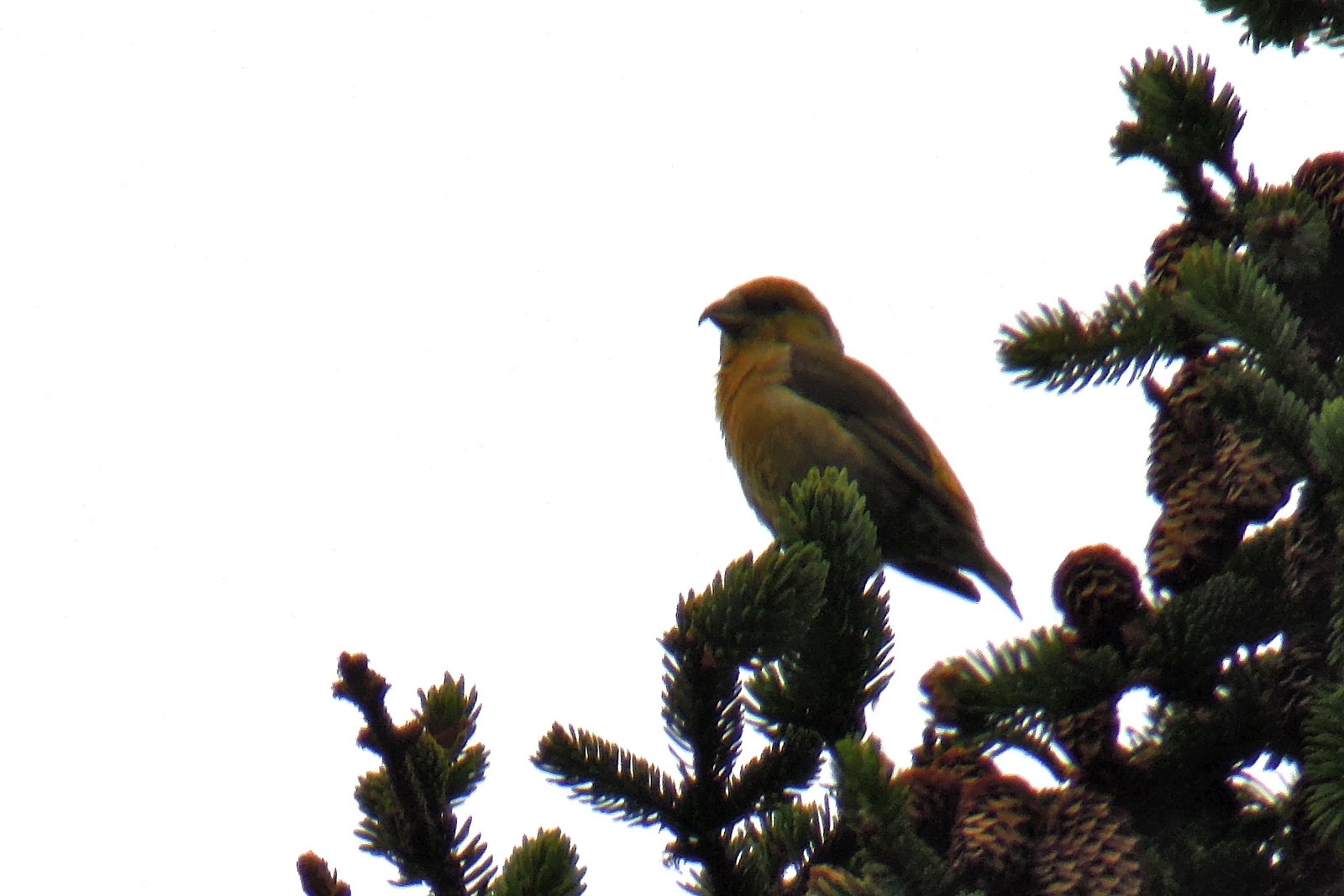
We finished up at the end of the trail on South Beach, where there was a large flock of Glaucous-winged Gulls and a dozen or so Pelagic Cormorants sheltering from the wind on a rocky outcrop.  In the forest behind us were more chickadees and a flock of Red Crossbills moving through the treetops.
Red Crossbill, Loxia curvirostra, female - digiscoped
We spent a fair amount of time enjoying the beach and watching a Bald Eagle flush all of the gulls off the rock - the eagle isn't visible in the photo below but the gulls' reaction is!  According to our guide, last year the pair of nesting eagles in the bay had eaten every gull chick off the entire colony.

A Brandt's Cormorant made a fly past appearance and there were more scoters as well as some Pigeon Guillemots.  This picture was taken on a boat trip the previous day but it seemed worth including here.
Pigeon Guillemots, Cepphus columba
To finish off a great day of birding a Black Oystercatcher flew into the bay and started making short work of the mussels along the water's edge.  I captured the video below through my scope, so I apologize for the shaky image!


Thanks to George and Just Birding for an informative morning of birding - we saw about 30 species but more importantly I learned a lot about all of them.  The tour was well worth the price and I recommend it to anyone who is fortunate enough to have a chance to bird the Pacific Rim National Park.

Tuesday, 5 July 2011

West Coast Whale Watching

Time for a second trip to the West Coast, previously with students, this time with family.  We started our trip in Victoria and took a whale watching tour with "Prince of Whales" on Canada Day.  We had great luck with our trip - Orcas ("Killer Whales") were right outside the Victoria Harbour.  There was a second group near San Juan Island and, on our return trip, we found the first pod again, this time breaching right out of the water.


Oh yeah, and we saw some birds too, including Rhinoceros Auklet, Pigeon Guillemot, Pelagic Cormorant, Common Murre, and of course, Bald Eagle.

Friday, 1 July 2011

Warbling in the Rain - Father's Day Outing Part 2

After returning from the Drumheller outing I took some time in the evening to wander around the local bird sanctuary, which led me to the following random observations:

- Mosquitos are okay, even when they're flying right at your face, because they're the reason that Yellow Warbler is foraging six feet in front of you.

- Rain is okay, because it keeps the mosquitos away, when you're done looking at the warbler.

- Sometimes a scope is really handy...
Spotted Sandpiper, Actitis macularia
- ...and sometimes it's just overkill!
Northern Flicker, Colaptes auratus
- Maintaining a network of blogs is useful, especially when they help you with ID's.  This post, on "Birding Is Fun", finally helped all the pieces fall into place in identifying a loud but well hidden Warbling Vireo (third photo down on the linked page).  They sound like this and I'm sure I won't forget that call again.

- And finally, urban parks are wonderful places where you can be surprised by nature...

- ...and nature can be surprised by you!

Tuesday, 28 June 2011

Loggerhead Shrike on the Radio

I caught an interesting interview on CBC Radio's "As It Happens" this evening, discussing the Loggerhead Shrike with Rebecca Magnus of Nature Saskatchewan.  There was a good description of the bird's interesting life history, focusing of course on the habit of impaling prey on barbed wire and thorns.  There was also discussion of the threats to the species and the decline in the Alberta and Saskatchewan populations.

To listen to the interview follow this link, click on "Listen to Part 2", then fast forward to about 17:20.  More information on the Shrike monitoring program can be found at Nature Saskatchewan.  Lastly, here's a photo of the bird in question, taken by the interviewee - click on the image to link through to their Flickr account:
Loggerhead Shrike

Monday, 27 June 2011

Life Bird #200 - Father's Day Outing Part 1

The past week has been filled with report cards, exams and other end of term activities.  There has been little time for birding and therefore zero time for blogging (putting blogging about birding before actual birding would be kind of silly!).

Last weekend was Father's Day and we took a day trip to the Royal Tyrrell Museum in Drumheller.  After touring the museum we drove back by a scenic route, spotting various birds along the way, including some lovely Mountain Bluebirds in the ghost town of Wayne.  With more time to explore I suspect this stretch of road is a fantastic spot for songbirds of all types, with a mix of prairie and riparian habitat.


The real highlight was in a slough on Hwy 56 just north of Hussar.  We found at least 10 nesting pairs of American Coot, some of them right by the road's edge.

We also spotted a pair of black birds flitting back and forth across the marsh, picking insects from the surface.  Eventually we figured out that they were Black Terns, a lifer for me.  These birds are graceful in flight with a slightly notched tail and slender wings.  They migrate out of Alberta in September, wintering as far south as Central America.  Sadly their populations have been declining, due to habitat loss, over the last few decades.


Despite dodging rainstorms all day it was a pleasant prairie drive and I discovered a number of spots that I will try to return to in the summer.  There was also an opportunity to go out exploring in the evening, more of which in my next post.

Sunday, 19 June 2011

Black Bird Down

The Black-billed Magpies nesting in the spruce tree in front of our house were unusually noisy the other day - every time we went in or out of the door they were positively screaming at us from the eavestrough.  In the evening, I had a few minutes to poke around in the rain to figure out what the fuss was all about and under our neighbour's hedge this little fledgling was hiding.
Black-billed Magpie, Pica hudsonia, fledgling
Given the number of outdoor cats in our neighbourhood I didn't feel optimistic about this young bird's chances, although Mom and Dad were clearly going to be pretty serious about defending it.  There was no sign of the fledgling the next day and the parents had settled down.  I've read that fledglings are much more capable of flight and/or self-defense than we generally assume so perhaps it made it through after all?
What's going on down there?
No pictures please!


Thursday, 9 June 2011

Back in the saddle...

Literally!  After a family emergency and a persistent out-of-season cold I managed to get out again for the first time since the May species count day.  As usual it was a short after-work bike ride that did the trick and I headed down to Edworthy Park, then back along the south side of the river, through Lawrey Gardens.  There is a decent size colony of Cliff Swallows under the pedestrian bridge at Edworthy.  It was fun to stand on the bridge and have them swoop just a few meters away, although the best views of the nests were to be had from the riverbank (or what's left of it during this peak meltwater time).
Under the bridge - nests visible through the upper circle and at the top of the frame
Zooming in - Cliff Swallow, Petrochelidon pyrrhonota, in centre
and zooming in again (a bad digital crop)
There were more swallows to be found further along the trail, in this case Tree Swallows perching and presumably nesting in the dead trees along the river bank.  The Cedar Waxwings are back in force now too - I saw 5 individuals today and heard a few more, although neither the numbers nor the noise matched up with the flock in our yard and alley on the weekend.  Yellow Warblers were also vocal and numerous but the real treat of the day came, as is so often the case, just when it was time to head home.

As I was biking along a few hundred metres west of Crowchild Trail there was flash of gray across the trail and, as I screeched to a stop, a Gray Catbird alit on branch by the trail and then disappeared into the undergrowth.  It turned out to be a pair and a likely nest.  Perhaps unsurprisingly, given their proximity to the busy bike path, they were quite relaxed and cooperative and I had great views and managed to get a couple of decent shots in the shady undergrowth.
Gray Catbird, Dumetella carolinensis 
All in all a nice hour or so of weekday birding and great to be out enjoying the birds on a sunny day again.