Wednesday, 29 February 2012

Book of the Month - Among Penguins: A Bird Man in Antarctica by Noah Strycker

Our dream trip and they're doing it!  Throughout January I had mixed feelings enviously following birders Jim Danzenbaker and Ann Nightingale on the Birdfellow blog as they sailed from Argentina to Antarctica, via the Falkland Islands and South Georgia.  The accounts of their adventures as told from the perspectives of both Jim as the experienced guide and Ann as the novice polar explorer were highlights of my January blog reading.  No doubt this was what put penguins, leopard seals, and albatrosses on my mind and influenced my decision to pick up Noah Strycker's tale of his Antarctic adventures. 


Noah's adventures are rather different from Jim and Ann's in several key respects.  Geographically, he begins from New Zealand, flying to McMurdo Station and then on to a tiny research station.  Economically, he is not a tourist paying many thousands of dollars for the experience but rather the prototypical "starving student" who lucks into a research assistant position at the ends of the earth.  And ornithologically, he is not on the frozen continent to build a life list but rather to research that most unique of avifauna - the penguin.
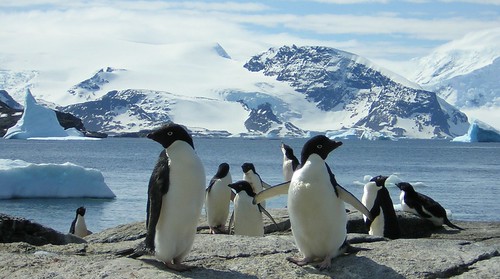
Antarctic: Signy Island - Adelie penguins
Adelie Penguins (image by jWOUW! from Flickr under Creative Commons license)
Within this framework the narrative is simple enough.  We begin with Noah's arrival at McMurdo Station and preparations for his time at a research post with two companions.  He attends survival school, builds a "snow coffin", and meets some of the colourful characters who inhabit the frozen continent.  He then heads out to a tiny hut at windswept Cape Crozier where they begin their three month sojourn studying the colony of 130,000 breeding pairs of Adélie penguins.  The remainder of the book is set at the research post but the story is interspersed with diversions both literal - counting marine mammals from a hilltop observation post and visiting a small colony of Emperor Penguins - and literary - reminiscences about Noah's experiences as a birder. 


When the book is focused on the Antarctic environment it paints a vivid picture of the life of a wildlife biologist in an extreme environment.   Some detail is provided about the purpose, methods, and results of the research being conducted and, while the scientist in me craved a little more detail, the depth of this material is probably appropriate for the scope of the book.  Noah's obvious passion for his subject shines through the text and I was quickly drawn into the experience of Antarctic life.  More disappointing were the sections on Noah's personal history.  There is no doubting his passion or aptitude (he was the ABA Young Birder of the Year in 2004) but some of his comments about the merits of his peripatetic lifestyle rubbed me the wrong way.  It's not that I don't respect his choice - and a part of me is more than a little jealous - but in my opinion his message would be clearer if presented with a little more humility and maturity. 


Overall I enjoyed reading about Noah's adventures and give this book a qualified recommendation: it is an essential read for anyone with an interest in Antarctic travel and wildlife and may be of interest to those readers looking to immerse themselves in an enthusiastic young birder's adventures in field research. 


“Among Penguins: A Bird Man in Antarctica” by Noah Strycker was published by Oregon State University Press in April 2011 as a 224 page paperback.  It is available from Amazon or Chapters for about $16.

Tuesday, 21 February 2012

Rosy Finches - Third Time's the Charm

One of my target birds for 2012 was the Gray-crowned Rosy Finch.  These little songbirds spend the summer nesting in cliffs or rock piles in high alpine or arctic tundra, such as at Sunshine Meadows near Banff.  However, rather than spending July hunting out nesting pairs while dangling from cliffs and dodging grizzly bears, a simpler option is to look for them in the winter when large flocks descend to valley floors to feed and to spend the cold season in more sheltered conditions.  Having struck out twice in recent months I was not holding my breath as my daughter and I drove over to Exshaw early on Sunday morning to check the feeders along Barrier Mountain Drive.  However, this time the supposed "sure thing" did materialize and, as you can see from these photographs, we had great views of a large flock along with a few dozen Pine Siskins and a couple of Mountain Chickadees.
I really needed my wider angle lens - less than a fifth of one flock of Gray-crowned Rosy Finches, Leucosticte tephrocotis
The particularly neat thing about this sighting is that the flock contained both of the two main subspecies (out of 6+) of this type of Rosy-finch.  The littoralis subspecies ("Hepburn's Rosy-Finch") and the nominate tephrocotis subspecies are both fairly migratory and since western Alberta is close to the overlap of their ranges it's not surprising to see them together.  Why are there so many subspecies?  The most likely explanation is their breeding habitat, which puts small populations in relatively isolated alpine and island locales.  This reduces gene flow between the groups, particularly the four less widespread subspecies.  Drawing meaningful taxonomic lines is challenging and some scientists consider the whole Rosy-finch complex (3 North American and 1 Asian species) to be a single species.  This conclusion is supported to some extent by the extensive hybridization observed and by DNA sequencing.  In any case it's an interesting example of the complexities of avian genetics.  Here are a few pictures from Exshaw showing the key differences (click to enlarge as usual).
Leucosticte tephrocotis tephrocotis - note the gray crown which stops at the eyeline
Leucosticte tephrocotis littoralis - aka. "Hepburn's Rosy-Finch", note the completely gray head
On reviewing my pictures later in the day, I realized that by pure luck I had both subspecies in the same frame on one shot
Hope you enjoyed these finches as much as I did!

Information for this post taken from Dunn and Alderfer's Field Guide to the Birds of North America, 6th ed. (great subspecies maps!) and Kaufman's Lives of North American Birds.

Wednesday, 15 February 2012

A New View on the Local Patch

My local patch, just a couple of blocks from my house, is Confederation Park.  This past week I picked up a new teleconverter - an attachment that goes between the camera body and lens on an SLR camera to increase the magnification of the lens.  The park can be good for songbirds, small birds of prey, and miscellaneous "inner city" waterfowl so it seemed like a good place to try out my new purchase.  This being February there wasn't a huge amount to be seen but I did find a flock of House Finches (first of the year - no, I haven't been out much!), before biking downtown via Prince's Island where there were several hundred Mallards with a few Canada Geese that seemed happy to pose.
Female House Finch, Carpodacus mexicanus
A male counterpart in the same bush
"Who's the fairest goose of all?"
Adding some more glass hasn't made this lens any less pin sharp - if you enlarge the image you can see the reflection of the city skyline in this lady Mallard's eye 
For the photogeeks, this is the teleconverter in question.

I'm using it with a 300mm f4 lens.  This type of teleconverter results in the loss of one aperture stop - in other words you get half as much light into the camera - so the effective result is a 420mm f5.6 lens that remains relatively compact.  I look forward to getting more practice in San Diego and on Vancouver Island over the next couple of months.

Wednesday, 8 February 2012

Book of the Month*: Birdwatching With Your Eyes Closed by Simon Barnes


One of my birding goals for this year is to learn better identification of birds by their vocalizations.  With this in mind, the first birding book I picked to read this year was this little paean to the joys of birding by ear.  The author, Simon Barnes, is the head sports writer for the Times newspaper in England, so one would expect this book to be well written.  He is also an enthusiastic and knowledgeable birder, so one would equally expect it to be comprehensive and accurate.  I can vouch that it is both of these and the real question that you should therefore ask is “why should a North American birder read a book about identifying British birds?”

The reason is simple –  Birdwatching With Your Eyes Closed is not primarily an identification guide to birdsong but rather (and I cannot put this more succinctly than the dust jacket does) “a way of hearing”.  The book is organized around notions of "time and place" and:

In order to recognize and begin to understand birds, you need to recognize and understand the times and the places.  And that works the other way round as well, creating a rather pleasingly virtuous circle, in which each visit to a place adds to your understanding of its bird, and each acknowledgement of a bird adds to your understanding of its place.

So birding is all about context, and birdsong provides us with clues about species, their behaviour and habitats.  It makes sense then, that the book is structured around 5 seasons of birding.  “First Spring” moves on to summer, fall, then winter, and ends with “Second Spring”, by which time Barnes is confident that you will, by immersing yourself in birds, become fluent in the language of the common species around you.  The free podcast that accompanies the book provides the soundtrack to these seasons, although I confess to not listening to it entirely – my head is struggling with Alberta species without 40 or so of Britain’s birds competing for space.

Putting aside the specifics of the songs themselves then, the North American birder will enjoy this book for three reasons.  Firstly, it reinforces the importance of birdsong and behaviour in identification.  While we will not be presented with the dilemma of willow warbler vs. chiffchaff in Calgary, the principles of using song for identification work equally well for distinguishing, say, willow and alder flycatchers.
The Chiffchaff
The Willow Warbler - good luck with that! (photos from Google Images - www.birdguides.com)
Secondly, the book is peppered with fascinating little tidbits of birding trivia.  Did you know that the British wren’s song (our Winter Wren) contains 103 notes in an 8 second song?  Or that Mozart had a pet starling that whistled his piano concertos and for whom he held a funeral when it died?  Or that birds may pick up and share song snippets from tropical species during migration?  The many connections Barnes makes to science, history, art and music make bird song more relevant for the reader.

And the final reason to bother with this geographically displaced book is that it is infused with the joy of being out among birds, and who doesn’t need a little more of that in their lives.  I would recommend this book to anyone with an interest in birdsong, the birds of Britain, or who is looking for a short simple read to fill a cold winter’s evening.


“Birdwatching With Your Eyes Closed” by Simon Barnes was published by ShortBooks in November 2011 as a 288 page hardcover.  It is available from Amazon for $21 and will be released in paperback in Canada in May.

*For anyone who is (inconceivably?) keeping track, this is the book of the month for January - it's been a busy few weeks!

Wednesday, 18 January 2012

Birding at Thirty Below

Yesterday it was -30°C (-22°F) in Calgary - all day long.  Today it had warmed up to a balmy -23°C (-10°F) by late afternoon so I headed out for a brisk walk around Inglewood Bird Sanctuary to see how the birds were making out with the weather.  I snapped a few photos (click to enlarge as usual!) along the river and enjoyed the company of friendly chickadees.
A huddle of Canada Geese settling down for the night
This Northern Flicker landed quite nearby and then hopped on to another nearby rock.  Why?....
...even in the coldest weather a bird's got to drink!
More riverside geese with Common Goldeneye in the background.
I ended up finding ten species in the forty-five minutes that I was able to handle the cold:

  1. Canada Goose
  2. Mallard
  3. Common Goldeneye
  4. Bald Eagle
  5. Northern Flicker
  6. Hairy Woodpecker
  7. Black-billed Magpie
  8. Black-capped Chickadee
  9. Bohemian Waxwing
  10. European Starling

It's remarkable how many birds seem so utterly unfazed by even the coldest weather - if you've got the clothing, go out and see what you can find!


Monday, 2 January 2012

Birding Banff in the New Year


2012 found us waking up in Canmore so there was a good chance that the all important first bird of the year would be something more interesting than last year’s House Sparrow.  Sure enough as I drove over to Banff for some morning birding a pair of Common Ravens flew over the Highway, the first of many for the day.
A rooftop Raven, Corvus corax, in Banff
Driving through Banff, which was relatively deserted except for groups of skiers waiting for shuttle buses, I picked up Black-billed Magpie on my way to Cave Avenue.  More excitingly, as soon as I stepped out of the car, there was a group of Mountain Chickadees making trips between a large pine tree and a feeder - a target bird both for the day and for the year.  I had great views, although with the sun still not up above the mountains my efforts at photography were, umm, impressionistic!
Oddly enough, given the terrible photo, this shows the critical field mark for Mountain Chickadee,  Poecile gambeli - it looked better through binoculars!
I took a walk down the Cave and Basin boardwalk where there were Red-breasted Nuthatches and a flock of White-winged Crossbills dropping cones on to the path.  The crossbills were so quiet and diligent in their feeding that I first thought I was being targeted by a squirrel with a sense of humour.  Suddenly the tree erupted with a flock of a dozen birds which settled into a tree that afforded better views.  Down at the hot springs I was hoping for dippers but found only a small group of Mallards paddling around in the steaming water. 
Click to enlarge and see how many White-winged Crossbills, Loxia leucoptera, you can spot
After this walk I headed over to Vermillion Lakes Drive, a flock of Rock Pigeons flying overhead.  Alongside the road at Vermillion Lakes there are several patches of water kept ice-free by underground springs.  In one I found a muskrat keeping company with a rather forlorn female Bufflehead.  A Townsend’s Solitaire perched overhead – the second year I've found this bird on my first day of birding.  More surprisingly was a group of Green-winged Teal at the limit of their winter range.  They were huddled together in a tiny open stretch of water and I wonder how they will make out when we finally have a real cold snap.
Green-winged Teal, Anas crecca, Alberta's smallest duck on the smallest remaining part of Vermillion Lakes 
On my way back to Canmore I stopped at Exshaw hoping for Gray-crowned Rosy-finch but found only Black-capped Chickadee and House Sparrow to add to my list.  As a footnote to this trip report, I should add that we skied in to Boom Lake today where Gray Jay’s made their usual begging appearance.  All in all a good start to the year’s birding.
A convenient perch for a hopeful Gray Jay, Perisoreus canadensis


Friday, 30 December 2011

A Nice End to the Birding Year (and Reflections for the New One!)

We took a family trip to Drumheller to visit the dinosaurs at Royal Tyrrell Museum - never a bad destination with a 4 year old boy!  As we drove, we kept our eyes out for Snowy Owls as there have been several reports immediately east of Beiseker (click above for a map).  We were not disappointed and saw 7 in total, including possible "repeats" on the way back.
Snowy Owl, Bubo scandiacus, click to enlarge
same Snowy Owl in flight, ditto
It was a nice way to end off the year's birding and quite the year it has been.  If 2010 was the year I started organized birding then 2011 is the year that I started to somewhat have a clue what I was doing.  Consistently paying attention to birds is tremendously rewarding in several ways, the least of which is numbers, but as that's the easiest to put into a blog here they are: my Alberta list had exactly doubled from 85 to 170, starting with Blue Jay on New Year's Day in Fish Creek Park and ending with Northern Goshawk and Hoary Redpoll on the Christmas Bird Count.

My life list has grown even more, thanks to trips to Ontario and Vancouver Island bringing in birds like Caspian Tern, Bewick's Wren and Red-throated Loon.  On my first West Coast trip of the year I managed arguably my greatest ornithological feat thus far: getting Grade 9 students interested in birding. Apparently all it takes is scope-filling views of Bald Eagles mating!

I'll wrap up this little bit of self-indulgence with some goals for 2012:

  1. Improve my birding by ear,
  2. 200 birds for the year (or approximately matching 2011's 202 species),
  3. Review a book a month for this blog, and,
  4. Find the following ten species in Alberta:


  • Eurasian Wigeon, Harlequin Duck, Red-breasted Merganser, and White-winged Scoter - the four more common Alberta duck species I haven't seen in the province (or anywhere in the case of the wigeon and the scoter)
  • Golden Eagle - which will mean at long last taking a trip to the Mt. Lorette count next fall
  • Peregrine Falcon - they nest ten minutes from my house every year so how hard can it be
  • Pileated Woodpecker - seen in Ontario before I was a birder, becoming something of a nemesis bird for me
  • Mountain Chickadee - given the amount of time we spend in the mountains you would think this would have made an appearance by now and it's my only remaining western chickadee
  • Canada Warbler - I just think they're pretty
  • Chestnut-collared Longspur (or any other variety of Longspur would be nice) - a classic prairie bird
Well that's it for 2011 - we'll see in 365 days how wildly optimistic that little list is!

Happy New Year!