Showing posts with label Local Patch. Show all posts

Wednesday, 15 February 2012

A New View on the Local Patch

My local patch, just a couple of blocks from my house, is Confederation Park.  This past week I picked up a new teleconverter - an attachment that goes between the camera body and lens on an SLR camera to increase the magnification of the lens.  The park can be good for songbirds, small birds of prey, and miscellaneous "inner city" waterfowl so it seemed like a good place to try out my new purchase.  This being February there wasn't a huge amount to be seen but I did find a flock of House Finches (first of the year - no, I haven't been out much!), before biking downtown via Prince's Island where there were several hundred Mallards with a few Canada Geese that seemed happy to pose.
Female House Finch, Carpodacus mexicanus
A male counterpart in the same bush
"Who's the fairest goose of all?"
Adding some more glass hasn't made this lens any less pin sharp - if you enlarge the image you can see the reflection of the city skyline in this lady Mallard's eye 
For the photogeeks, this is the teleconverter in question.

I'm using it with a 300mm f4 lens.  This type of teleconverter results in the loss of one aperture stop - in other words you get half as much light into the camera - so the effective result is a 420mm f5.6 lens that remains relatively compact.  I look forward to getting more practice in San Diego and on Vancouver Island over the next couple of months.

Sunday, 18 September 2011

Fall Migrants at Namaka Lake

"Of course as soon as the first snow hits, everything just disappears"

That's a comment overheard at the last Nature Calgary Bird Study Group meeting.  As we approach late September in Alberta there is a certain inevitability to the first snowfall and it will indeed chase away many lingering migrants.  With an uncertain and dwindling number of good migratory birding days left, I've been trying to squeeze in a few trips.

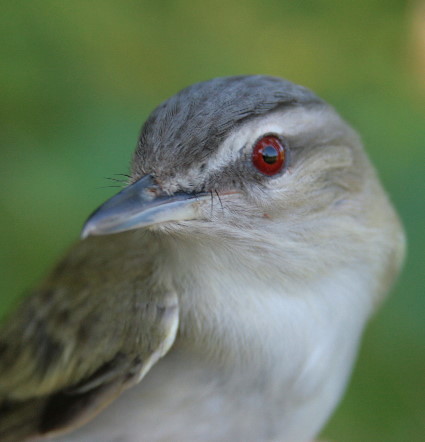
On Friday morning I managed to swing by Confederation Park on my way to school.  Large flocks of Wilson's and Yellow-rumped Warblers were a nice way to start the day.  My NMT list (explanation here) grew as well, with Orange-crowned Warbler, Ruby-crowned Kinglet, and (with the help of some experienced fellow birders) a Red-eyed Vireo.
MABO - Red-eyed Vireo - band 715
Red-eyed Vireo looks like it means business!  Image From Flickr Creative Commons taken by SeabrookeLeckie.com
Feeling suitably pumped up by that experience I dragged myself out of bed in the dark this morning and headed out to Namaka Lake, 70km SE of the city near Strathmore.  This is a designated Important Bird Area and a spot that I had been wanting to check out for some time.  Namaka certainly made a great first impression.  A fiery sunrise lit up the sky ahead of me all the way there and I arrived at the east access point five minutes before the sun broke the horizon.  As I walked towards the lake the grass was lit up golden brown.  I couldn't resist the urge to stride through stands that were five feet high, with the loaded ears bouncing off my chest sending seeds for next year flying out in all directions.  

Overblown pastoral prose aside, the lighting was pretty great for the birds too.  One of the first that I saw was a Le Conte's Sparrow.  A life bird for me and, based on my reading back at home, an amazingly cooperative example of its kind!
Le Conte's Sparrow, click to enlarge, image colour has not been manipulated - the sunrise was just this awesome! 
On the lake itself there was no shortage of bird life either.  A few late shorebirds were hanging around the shoreline: a flock of Semipalmated Sandpipers hanging out with a couple of Lesser Yellowlegs, and a few Killdeer scattered around.  The waterfowl were much more numerous with American Coot, and three Grebe species (Eared, Horned, and Western) being particularly noticeable.  The real treat on the water though was the American White Pelicans.
I know it's out of focus but this image cracks me up for some reason.  American White Pelican and a family of Ruddy Ducks
 The flocks of pelicans gorging themselves was quite a sight and I captured some digiscope video.


The video looks pretty decent in fullscreen.  Sorry about the sniffling - it was a cool but great morning of birding!

Monday, 5 September 2011

Fallout

Last week was the first week of school - 3 days of meetings and planning followed by 2 days of new kids, new classes, and new routines makes for an exciting and busy week.  That should explain the lack of posts, as well as the monumentally poor timing (from my perspective!) of 36 straight hours of rain resulting in a substantial fallout in the Calgary area.

What is a fallout?  In birding terms, fallout refers to a weather system that grounds migratory birds and/or forces seabirds to land.  A recent example is the frenetic birding on the east coast as a result of Hurricane Irene which merited its own blog.  You can also read a nice summary of the hurricane birding to be found here.  White-tailed Tropicbirds and South Polar Skuas are fantastic birds for New England (or anywhere?) but there were also some remarkable science stories that emerged from this storm.  I was particularly struck by this tale of a radio-tagged Whimbrel, which flew more or less straight through the hurricane and emerged unscathed.

While our recent wet weather was considerably less dramatic than a Category 3 hurricane, the resulting clouds of warblers and vireos delighted local birders.  A particularly nice spot to catch migrating songbirds is an area of shrubby wetland in Confederation Park (click on the link at the top of this post for a map).  One observer reported eleven species of warbler on his morning commute around this location while another added Chestnut-sided Warbler to the list on the same day.  This area has the added bonus of being my "local patch" - a short walk from work and home.

Can you find 11 species of warbler in this photo?  (Photo taken with smartphone)
Joking aside, I didn't even have time to grab my camera but just headed straight over to the park after school to see what I could find.  Fall warblers are really not an area of strength in my birding skill set but there was much to see.  The bushes were jumping with tiny birds, busily refuelling for the next leg of their migration.  I was able to positively identify Wilson's Warbler, Tennessee Warbler, American Redstart, Northern Waterthrush, Blackpoll Warbler, and Yellow-rumped Warbler, several of which are new NMT (non-motorized transport) birds for me.  Other highlights included a pair of handsomely streaked Lincoln's Sparrows and a Rose-breasted Grosbeak.  This last bird was an Alberta first for me and a special species, as it was partially responsible for getting me into birding in the first place (read under "About Me" for more details).

Not bad for a half-hour of neighbourhood birding and whenever there is poor weather bringing the potential of fallout, I will remember to get out and investigate.