Tuesday, 18 September 2012

Back to School (In More Ways Than One...)

What a fantastic summer!  There are so few opportunities for birding adventures during the school year that time spent at the computer seems like wasted time during July and August.  Now that I'm back to work and feeling somewhat organized after the first few weeks, it's time to start sharing a few of those adventures, as well as update you on what's been going on over the past few months.  I'm also helping out with the fall Friends of Fish Creek birding courses again and looking forward to getting out every Saturday with this group.

Here's a preview of what to expect on the blog over the next couple of months....

A Big(ish) Day...

...hungry migrants...
...Calgary Birders' Junior in action,...
...lifers...
...and, of course, what a great place Calgary is to live and bird.

Thursday, 5 July 2012

Purple Martins' Majesty

Another school year is finished with a mad flurry of activity but CalgaryBirder now finds himself enjoying vacation sunshine on the west side of Vancouver Island.  En route, we spent two rainy days in North Vancouver and I took the opportunity to checkout the Maplewood Flats Conservation Area.  This is considered to be a "must see" birding spot in BC's Lower Mainland and, as it's been well covered by local bloggers, I'll simply leave you with these two links and move on to the digiscoped photos:
  1. Birding in Vancouver has a site guide with recommended trails, and,
  2. BirdtrekkerBC has some photos and a species checklist
The species I particularly wanted to see were Purple Martins, which nest on the piers out on the mudflats.  So far I've missed these in Alberta - just haven't been in the right place at the right time.  There were certainly no trouble to find as they were bombing around the shoreline hunting and calling loudly.
Nestboxes out on the mudflats 
Purple Martins pausing for a rest between feedings.  The two birds with the pale faces are juveniles.
Other birds also make use of the piers (I think that's the right term?).   This is a Bald Eagle, like I needed to tell you that!

The "flats" part of Maplewood Flats looks like this.  I didn't see any shorebirds, as early July is the narrow window between northbound stragglers and southbound early-birds.  There were 6 Great Blue Herons, almost all in the arc of this photo.
Purple Martins weren't the only life bird for the morning.  Although I'm fairly certain I've seen this particular flycatcher before, I've never had the chance to confirm the ID, which is by song.  Anyway, here's the bird:
An Empidonax Flycatcher, but which one?
And here's the ID...
Handheld videoscoping doesn't give great results but it's the soundtrack that counts - "rrritz-bew" is unmistakably a Willow Flycatcher, common enough but still eluding me in Alberta.

I'm off on a sea kayaking trip tomorrow but will keep the blog updated with some more sightings, although if you want a sneak preview have a look under "Checklists".

Sunday, 17 June 2012

It's All About Birdsong

This weekend's Friends of Fish Creek Park outing headed to South Glenmore Park, where our focus was on songbirds.  We were particularly interested in locating a hybrid Rose-breasted x Black-headed Grosbeak that had been sighted in the area.  The clouds cleared by the end of our morning and we spent about three hours traipsing through the forest in the near constant company of Least Flycatchers, Yellow Warblers, and Red-eyed Vireos loudly marking out their territories.
View FFCPP Birding South Glenmore Park in a larger map
On my way to meet the group, I stopped by the sailing club on the south edge of the reservoir.  The water level is still very low as the city prepares for forecasted high river levels.  There were hundreds of gulls, predominantly Franklin's Gulls, along with Ring-billed, feeding on the mud as well as Great Blue Herons and the usual selection of waterfowl.  I snapped this terrible digiscoped image to give you a sense of what this all looked like - imagine another 3 frames of the same stitched on the left hand side of the image:
Once we started walking, a Least Flycatcher was among the first birds to give good views to all participants.  I think it was somewhat frustrating for some novice birders to locate such a drab bird in the dark understory but once we were all on the little flycatcher he put on a good show feeding and calling loudly.
Least Flycatcher, Empidonax minimus, photo from Brooks, May 2012, not on this trip
We walked on through the forest and heard Veery singing from the bushes.  A new species for me but definitely on the "BVD" (better view desired!) list.  Here's a recording of the song from xeno-canto.  Our leaders for the outing gave two descriptions of the call which seemed to me a very accurate characterization - the song sounds like the bird is "winding down" and "singing from the bottom of a rain barrel".  You can actually see the winding down part in the sonogram.
Eventually we reached an overlook with well stocked bird feeders.  These attracted Pine Siskins, White-breasted Nuthatch, American Goldfinch, Brown-headed Cowbird, Clay-coloured Sparrow, and another visitor which you will see below.  Here are a few photos taken at the feeders before we returned by the same route.
Female Brown-headed Cowbird, Molothrus ater
Enjoying some niger seed, a Pine Siskin, Spinus pinus (isn't that a fantastic latin name)
Clay-coloured Sparrow, Spizella pallida
At one point there were three of these Red Squirrels, along with a Least Chipmunk, enjoying the sunflower seeds on and under the railing.
But what about that Grosbeak?  We had seen nothing and heard little by the time we made it back to the parking lot but two of the group had taken a slight detour and found the bird singing right beside the main bike pathway.  Once I heard this I went back by myself and soon heard the bird in the spot they had described.  Rose-breasted Grosbeaks sound like "Robins in a hurry":
However, in a moment of classic birding frustration, despite the continuous singing within 30 feet of my face, I could not see the source of this distinctive song.  So, in conclusion, did we find the elusive hybrid?  Fourteen birders did not, two saw the bird as clear as day, and one (I) heard a Grosbeak right in front of me, grudgingly checked it off my list, and want to return for another look soon.

Monday, 11 June 2012

Hummingbird Hunt

The last couple of weeks have been a little hectic.  My grandfather in England passed away peacefully at the age of 91.  I went over for the funeral and that had the roll on effect of putting me behind at school, just as report cards are coming due.  Nonetheless, I'm really glad I was able to go over and, as this is a nature blog, I should mention that there was some good birding in the UK.  I will post more on Granddad and the British birds at a later date.

In the here and now, it was nice to rejoin the Friends of Fish Creek Provincial Park birding group after a two week absence.  Last weekend we looked around Bowmont Park and this week we went back to the Weaselhead Natural Area to look for Calliope and Rufous hummingbirds.  These smallest of birds once again proved to be great ambassadors for birding and the session was very well attended despite the recent heavy rains and muddy trails.  Here are a few photos from the day:

Strictly an ID photo!  This profile view shows the purple and white throat streaks characteristic of a male Calliope Hummingbird, Stellula calliope.  This is the smallest bird species in North America, north of Mexico.

A somewhat clearer image of a Rufous Hummingbird, Selasphorous rufus, showing its buffy red flanks and shimmering orange-red gorget (throat feathers).
In the same bushy riverside area where we found the Rufous Hummingbirds there were lots of very approachable Cedar Waxwings, Bombycilla cedrorum.  These ones had pulled a flower from a caragana bush and...
...were passing it back and forth between them, an activity that helps to strengthen bonds between mates and within flocks.  Both of these images also show the red waxy droplets on the wings, from which we derived their name.
The Eastern Phoebe we had seen back in April was now a pair with a nest under the bridge.  This individual waited for us to move on before delivering the package in its beak to the waiting young.
If you are interested in looking for these hummingbirds yourself, check out this excellent post over on "Birds Calgary" which has detailed directions and maps.

Sunday, 27 May 2012

Camping Among the Songbirds

I'm out of the province at the moment but wanted to leave behind something for the week.  This past holiday weekend we returned to Kinbrook Island near Brooks for a family camping trip.  Our two year old daughter had her first tent camping experience and everyone had a relaxing, if slightly sleep deprived, weekend.  As I have written previously, Kinbrook Island Provincial Park is a wonderful birding location combining prairie grassland, prairie wetland, and deciduous woodland habitats to create a real migrant trap.  For the most part, I was not actively birding - well I guess I always am, but you know what I mean - and we still saw nearly 50 species, including 11 "first of year".  Here are a few photos - as always, click any image for a slideshow:
Kinbrook Island has a healthy population of Tree Swallows, nesting in tree cavities all around the campground.  Perhaps the apparent absence of Starlings is helping them to be more successful here than some Calgary city locations.
Baltimore Orioles were present in much larger numbers than I remember from last year.  Sometimes there were four  or five birds chasing and calling to each other immediately above our tent site.
I associate Mourning Doves strongly with growing up in Ontario, where we could have half a dozen picking up seeds from under our feeders.  Their call is a nice soothing sound to wake up to.

There were probably a lot more warblers to be seen, given more time to quietly look for them.  That being said, this is the best look I've ever had at a Tennessee Warbler.

Yellow Warblers were all over the campground, seemingly calling from every other tree.
Warbling Vireos have also returned, searching for insects in the poplars
Our weekend gave me first of year sightings of both common Alberta Kingbirds - Eastern and this Western Kingbird

The Western Kingbirds were putting on a good show - drawing the attention of even the non-birders with their noisy fighting and displaying above our heads.

Sunday, 20 May 2012

The Hunt

This is the third and final part in a series of posts on my recent Gulf Islands sailing trip.  You can find Part 1 here and Part 2 here.


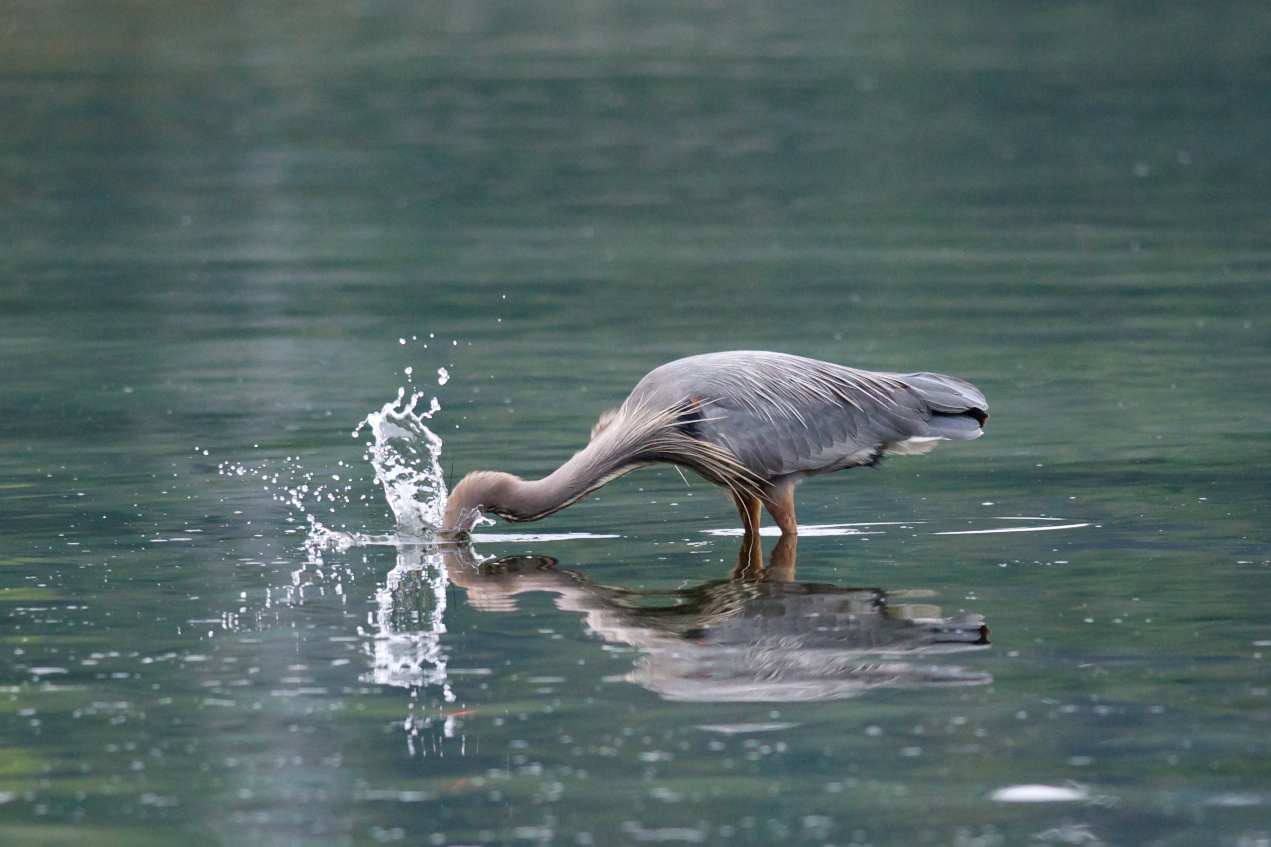
An important part of the science instruction on our Grade 9 sailing trips is intertidal explorations.  We always have fun wading around in the shallows looking at all of the squishy invertebrates and learning about their unique niches in the ecosystem.  At Montague Harbour we were not alone in our prowling through the shallows.  This Great Blue Heron, with all its breeding season plumes, was also hard at work stalking fish.  It seemed completely unfazed by our group and allowed us to watch it at distances of less than 50 metres until it was time to get back on our boat.
Patient and motionless
The strike
Success!
That's close enough folks!
Landing on the other side of the bay


Tuesday, 15 May 2012

Gulf Island Passerines

This is the second in a series of posts on my recent Gulf Islands sailing trip.  You can find Part 1 here.

The Gulf Islands are dotted with parks and protected areas, both marine and terrestrial.  The flagship park is the Gulf Islands National Park Reserve which was established in 2003 and covers 36 square kilometres of land scattered around the islands.  There are also eight provincial parks, including Montague Harbour where we spent one night on the trip.  Of course all of these protected areas, with thick forests and dense shrubbery, provide rich habitat for bird life.
Spotted Towhee, Pipilo maculatus, love tangled overgrown shrubbery so they love the Pacific Northwest.  They call "Drink TEA" and occasionally pop up to more visible perches to sing, look around, or be photographed.
Russell Island is a small island off Saltspring entirely held under the Gulf Islands National Park.  We woke up in this anchorage to hear Pacific Wrens singing across the water and found this Orange-crowned Warbler, Oreothlypis celata, during a hike around the trails.
Golden-crowned Sparrows, Zonotrichia atricapilla, are common on the coast but this was a new species for me when I spotted this one mixed in with a flock of White-crowned Sparrows.
Here's one of the aforementioned White-crowned Sparrows, Zonotrichia leucophrys, a few weeks before they show up in Calgary.
I know this is not a passerine, but I wanted to include this Rufous Hummingbird, Selasphorous rufus, as it was another bird that succeeded in drawing the interest and admiration of my crowd of non-birding teenagers.
Those are few of the smaller birds that we saw on our trip but the hummingbird was not the bird that most wowed the crowd, as we'll see next week....